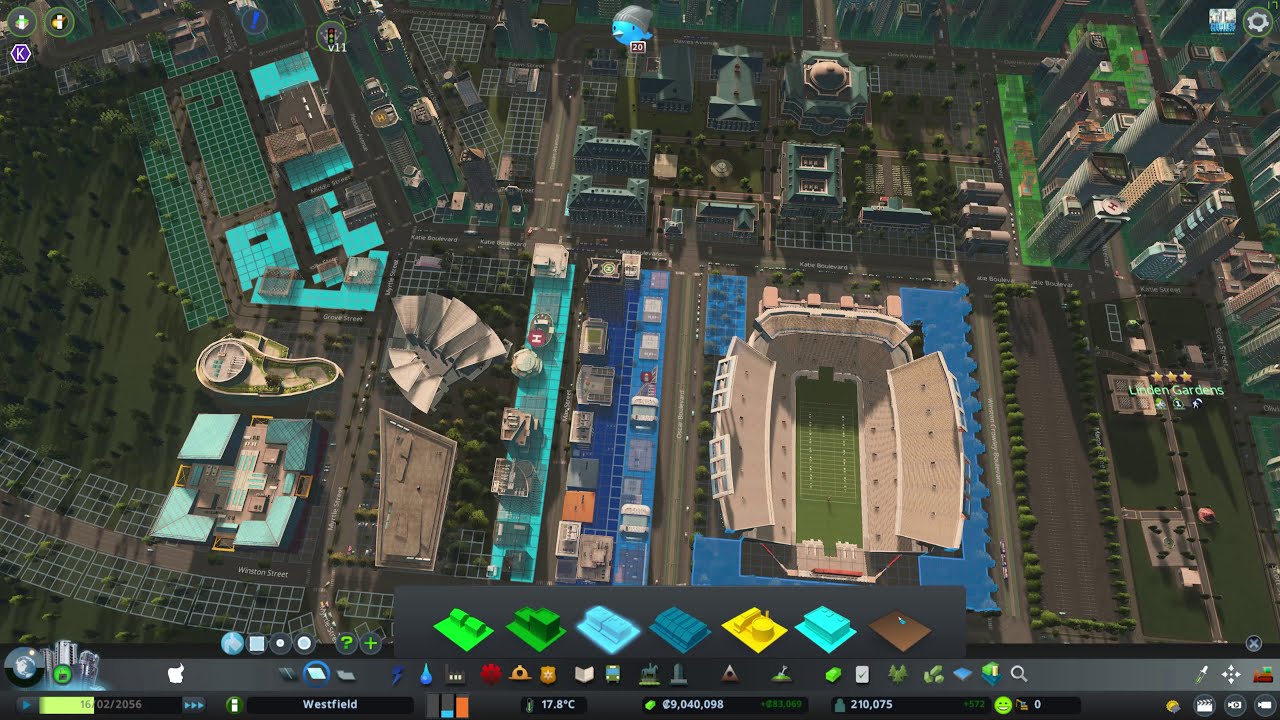
Instead of zoning over farmland and forest, Westfield buys a new map tile and builds a second district along a national road with an oval roundabout. The two water networks get connected, the farms get a flour mill, barn and greenhouse, parking is banned on main streets with TM:PE, and a new bus line links the districts.
What happens in this episode
Episode 2 left Westfield with farms, two small industrial areas and high residential demand. The obvious move would be zoning over the remaining farmland or the forest. I didn’t want to do either, so this episode buys a new map tile for a second district.
How it was built
A national road and an oval roundabout
A train line comes in nearby, which the farms will need for exports later, but residential demand came first. The new district hangs off a national road, laid out like countryside rather than a grid and smoothed into the terrain. An oval roundabout gives incoming traffic more space than a small round one without using as much land. Residential zones stay away from it because of the noise.
Zoning and the water networks
Businesses, homes, a police station, a fire station and a school went in, and people moved in faster than I expected. The new district needed sewage, but a second outlet would have wasted the old town’s water resources, so the two networks were connected along the roads, as a real city would do.
Resources and farm buildings
The resource view shows wood, ore and fertile land. Some forest squares may become a forestry strip later. For the farms, a new crop mix (wheat, cotton, oranges, a greenhouse) plus a flour mill, a small barn and a farmhouse. A warehouse in balanced mode exports flour.
Power, policies and buses
The new district ran out of power. A hydro dam out of the city limits produced only a fraction of its upkeep, so more connections fixed it. Recycling, smoke detector and water-saving policies went in. A new bus line connects the districts. With Traffic Manager, parking is banned on main streets and next to crossings, because parked cars slow traffic down significantly. New unlocks included pedestrian zones, a big hospital and a central bus station.
Recycling and wastewater
Every district should have a recycling centre, because garbage trucks take too long to cross the city. Wastewater returned, so the pipes were re-laid along the roads and the budget raised. That solved it.
Industry or forest?
Industrial demand was high again. The plan was a dedicated industrial area, but that would mean cutting down part of the forest. The fertile land got a district with no commercial specialisation for now. The forest decision waits for episode 4.
Video chapters
- 00:00Keep the farmland and the forest
- 03:08Buying a new tile
- 06:39National road and an oval roundabout
- 14:17Zoning the new district
- 17:39Connecting the wastewater networks
- 20:44Where the natural resources are
- 27:20Flour mill, barn and greenhouse
- 30:57Power again, warehouses and policies
- 37:52A bus line and no parking on main streets
- 45:04Recycling and wastewater fixes
- 48:25Industry or forest?
Clicking a chapter starts the video above at that point.
FAQ
Why ban parking on main streets in Cities: Skylines?
Parked and parking cars slow traffic down significantly. With Traffic Manager I ban parking on main streets and next to crossings as early as I can afford it.
Should each district get its own sewage outlet?
I connected the new district to the existing network instead. A second outlet would have wasted the water resources of the old town.
Why is an oval roundabout useful?
It gives incoming cars more space than a small round one without taking as much room as a large circle — handy when you don't know the traffic yet.