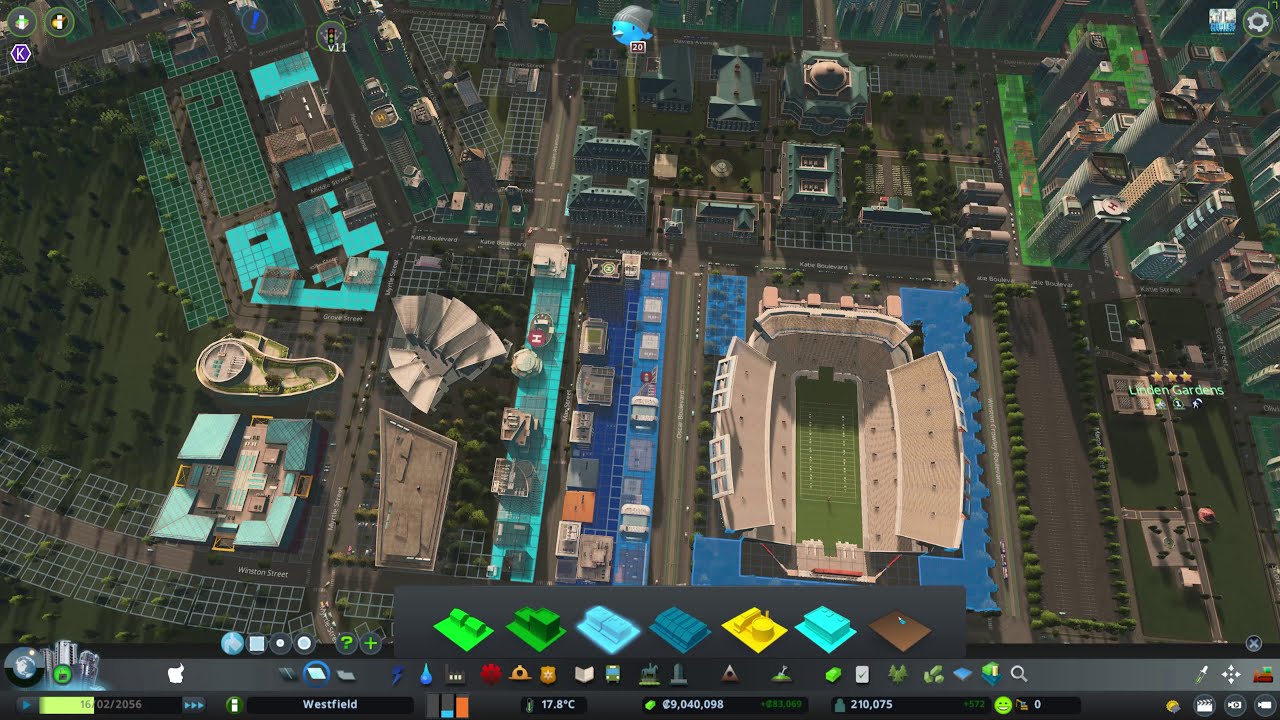
Westfield buys another tile and builds a forestry industry area in a corner of the woods, with a sawmill, plantations and a log yard. The farms reach level 3, gravel roads get upgraded, two small park areas with gates, cafés and restrooms make houses level up almost instantly, and the next city level finally unlocks the solar updraft tower to replace the coal plants.
What happens in this episode
My main focus from the start was not to destroy nature, but the old industry dumps its wastewater into the river and those outlets have to go eventually. Today’s goal: 10,000 citizens, more homes on a new tile, and a forestry industry without clearing the whole forest. It’s a long one.
How it was built
Industry along a national road
Industrial demand was very high. A small industrial zone goes in along a new national road off the main road, a very typical layout from what I’ve seen in the US. A corner of the woods becomes an industry area for forestry: a warehouse for forestry products with room for trucks to pull in, a sawmill, two small tree plantations and a log yard. The roads may need adjusting later, and the beauty work can wait. Raw materials took a while to arrive.
Power and water
A water treatment plant solved the wastewater. For power I had my eye on the solar updraft tower (240 MW), but it wasn’t unlocked yet, so another plant had to do for now.
Farms at level 3
The farming area reached level 3. I kept education at elementary schools for a while. Too much education too early leaves industries short of workers. New crops (potatoes, corn, oranges), medium fruit fields and dairy joined the flour mill and barn.
Upgrading the gravel roads
The early gravel and country roads were upgraded to regular two-lane roads, and future roads will start that way. Upgrading roads with buildings on them sometimes produced “no road access” errors, which is one downside of starting with gravel roads. A cemetery will be moved once it’s empty.
Parks that pay for themselves
Pedestrian boardwalks and park areas unlocked. The first park got paths, a main gate (which unlocks more park buildings and charges entry), cafés, restrooms, redwoods, bushes and rocks. The effect was immediate: houses around it upgraded quickly, and the population jumped from about 6,300 to almost 6,400. With visitors paying, it almost finances itself. A second, simple park, Holly Park, went in with a new residential area that uses the full width of the city limits, plus a school.
Goodbye, coal
At the next city level, the solar updraft tower finally unlocked. Some old industrial buildings (an ice-cube factory, box factories) made way for it, a second water pump went in, and the coal plants came out. 410 MW of production against about 370 MW of use. The farms also unlocked a slaughterhouse, clothing factory and large barn, and the forestry reached level 2. Episode 5 is about growing the farms and forestry further.
Video chapters
- 00:00A new tile and the 10,000-citizen goal
- 03:22A national road to the industry
- 08:16Forestry: sawmill, plantations, log yard
- 14:53Power and a water treatment plant
- 22:26Level-3 farms and why education isn't everything
- 31:57Upgrading the gravel roads
- 43:16More homes and corner shops
- 49:57Building a park area
- 1:03:49Parks make houses level up
- 1:07:06Holly Park
- 1:21:07Solar updraft tower replaces coal
Clicking a chapter starts the video above at that point.
FAQ
Why add a main gate to a park area in Cities: Skylines?
The gate unlocks further park buildings, and visitors pay entry, so even a small park can almost finance itself.
Do parks help houses level up?
Yes, very visibly. Right after the first park area opened, the houses around it upgraded within a short time and the population jumped.
Should I keep education low for industry?
Education is important, but keeping it slightly lower for a while helps industries find enough workers. I held back on more than elementary schools at this stage.