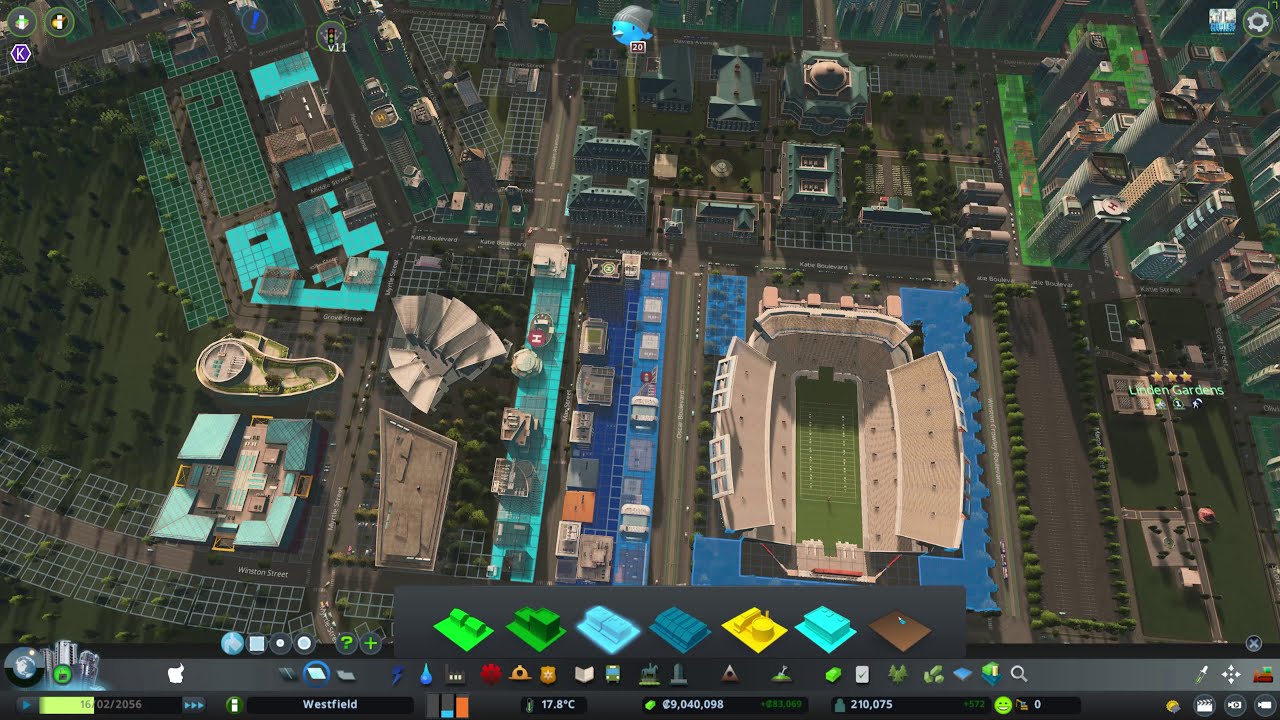
Westfield grows past 1,500 citizens: new residential streets in a less grid-like layout, upgraded two-lane roads, and the first farm built with the Industries DLC — once I worked out it needs an industry area, not a district specialisation. Power shortages force a second coal plant, and two bus lines and a cemetery round out the town at almost 3,000 citizens.
What happens in this episode
Episode 1 ended with high residential demand and farmland waiting for 1,500 citizens. I was also thinking about the bigger picture: maybe several small towns connected by highways, growing together over time, rather than one centre. For now I’m going with the landscape and keeping the beautiful redwood forests.
How it was built
A less grid-like layout
The new residential streets curve with the terrain. Modern city planning isn’t only squares: in Germany grid layouts are rare (Frankfurt’s modern centre is one exception), while in the US they’re much more common, with advantages and disadvantages. Water pipes again follow the streets, and small commercial zones give people shops within walking distance. Taxes went up to 11% for all three zones, with no loans.
Road upgrades and Tiny Town
With about 2,000 per week coming in, the main streets were upgraded to two-lane roads with trees. At 1,500 citizens (Tiny Town), parks, plazas and industry areas unlocked.
The Industries DLC lesson
The main farm building wouldn’t appear, and after two restarts I found out why. With the Industries expansion, farm buildings need an industry area, not a district with a farming specialisation. With the area painted, the main farm building unlocked, followed by a small grain silo, animal pasture, crop field and fruit field. One warehouse needed the Anarchy mod because it sat too close to the road. I placed it so it can get its own side street, because trucks can queue there later.
The fields grow pears and corn, with Highland cows on the pasture. The warehouse is set to farming products, importing and exporting everything for now. Fields have to sit on land with fertile resources. My first ones didn’t.
Power shortages and the old industry
Power ran short. A higher budget for the coal plant helped only a little, and the incinerator’s upkeep was a shock. A wind turbine helped briefly, but in the end a second coal plant was unavoidable. I removed most of the first industrial zone, which was badly polluted, in favour of one industrial strip along a road, without wasting farmland.
Schools, buses and healthcare
High schools appeared and houses kept upgrading as people got more educated. A bus depot and two bus lines went in: one circling the town and one down to the industrial area. A child health centre and a cemetery completed the services. At almost 3,000 citizens, little Westfield ends with farms, two industrial areas, mixed residential and commercial streets, and the future highway corridor still free.
Video chapters
- 00:00Small towns that may grow together
- 03:20A less grid-like residential layout
- 09:56Water, taxes and no loans
- 13:09Road upgrades and Tiny Town
- 19:42Industries DLC: industry area, not district
- 26:11Crops, cows and the warehouse
- 36:28Power shortages
- 46:14Removing the old industry
- 1:01:17Schools and a second power plant
- 1:08:16Two bus lines
- 1:15:05Healthcare and a cemetery
Clicking a chapter starts the video above at that point.
FAQ
Why can't I build farm buildings in Cities: Skylines?
With the Industries DLC, farm buildings need an industry area painted with the industry area tool, not a regular district with the farming specialisation. Once I painted an industry area, the main farm building unlocked.
Should a warehouse get its own access road?
I placed mine so it can get a separate side street later. Trucks can queue at warehouses over time, and that keeps them off the main road.
How do I fix early power shortages?
Raise the power plant budget first. When that's not enough, you need another plant — I built a second coal plant and removed a wind turbine that wasn't worth its upkeep.