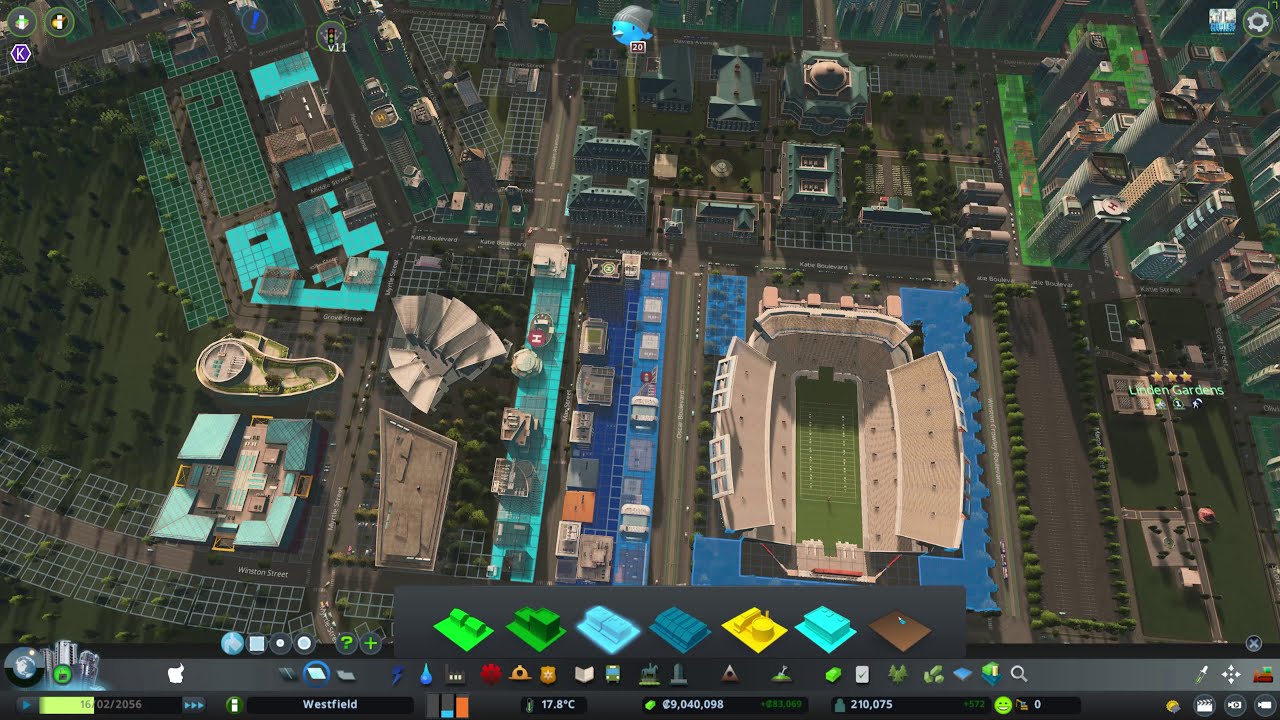
Commercial and industrial demand return, so Westfield adds an ore grinding mill, an underground mine and the long-awaited glass manufacturing plant for the lemonade factory. A new district, Mill Square, gets an IT cluster tech park with pedestrian paths, an organic and local produce commercial zone follows, a School of Education joins the campus, and a jammed junction becomes a roundabout with a four-lane one-way and lane rules.
What happens in this episode
The last episode added hotels, a new roundabout and a relocated police academy. Now commercial and industrial demand is back, so this one is about more farm fields, more ore, and Westfield’s first tech park.
How it was built
Fields and ore
Some fields were rearranged to fit a bigger one, with more potatoes and wheat. Income still swung between plus and minus, which has to change. A new tile unlocked industry workers’ barracks, a steel plant and the glass manufacturing plant I’d been waiting for. The lemonade factory couldn’t produce without glass. The ore area gets an ore grinding mill, an underground mine and ore storage on very steep ground.
Mill Square and the IT cluster
A new district called Mill Square gets the IT cluster office specialisation. A few buildings moved with Move It instead of being demolished. Pedestrian paths run between the offices, with a small plaza placed with Anarchy right in the middle. The high-tech buildings changed the view of the new downtown completely. Tech Company One and Two look the same, apart from the lighting.
Organic commercial
Next to it, an organic and local produce commercial zone, after removing some industrial zoning so they don’t interfere. Eco markets and bars made it look lively, exactly the way I wanted. High-rise or low-rise zoning didn’t seem to matter much.
Traffic and the campus
Traffic piled up at a key junction. No pedestrians and yield rules helped a little, but it’s time to think about public transport. The university wasn’t getting enough students, so a School of Education went in on an extended campus.
A new junction
The jammed junction got rebuilt: a three-lane road placed underneath, a four-lane one-way and a roundabout, followed by detailed lane rules. Traffic in the circle always goes first. Allowing a few extra lane changes isn’t usually something I recommend, but it works while traffic is light. A small roundabout went out and a two-lane highway section was upgraded for speed.
Residential demand was higher than expected, with 32,000 getting closer. Before Cities: Skylines, SimCity 4 was my favourite city builder. This game is what I always dreamed of while playing it.
Video chapters
- 00:00Hotels, a relocated academy, new demand
- 03:39Rearranging the fields
- 07:05Ore mine, steel and glass
- 11:41Mill Square and the IT cluster
- 20:32The tech park grows
- 24:30Organic and local produce
- 27:52Traffic piles up
- 31:34School of Education
- 39:30A new junction and roundabout
- 47:37Lane rules and a faster highway
Clicking a chapter starts the video above at that point.
FAQ
Why does the lemonade factory lack goods?
It needs glass. Without a glass manufacturing plant it can't produce. Mine only got going once the glass plant unlocked.
What is the IT cluster in Cities: Skylines?
An office specialisation for a district. In Westfield's Mill Square it turned plain offices into a tech park of high-tech company buildings.
Does high-rise or low-rise matter for specialised commercial?
In my organic and local produce zone it didn't seem to make much difference — both developed into the same lively mix of eco markets and bars.