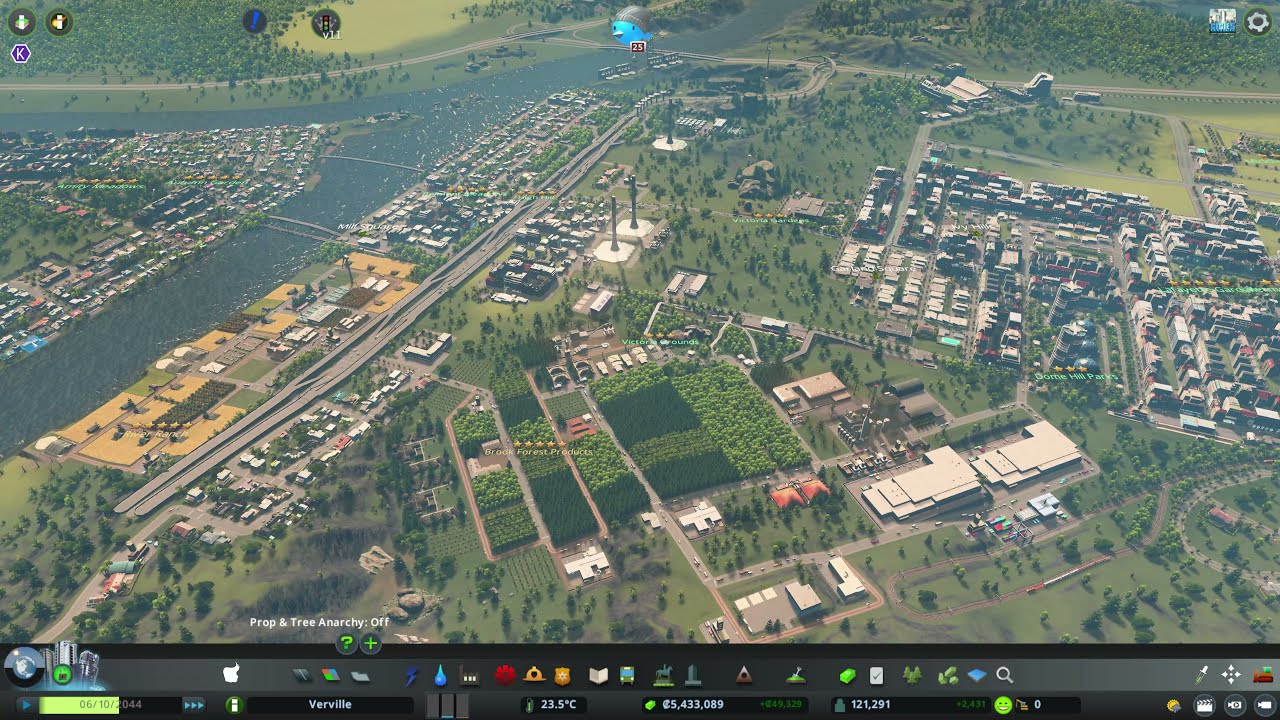
At 100,000 citizens with no residential or commercial demand, Verville lays out a more organic district behind a tree belt along the railway, then tries something I'd never done this late: a new industrial zone, Cooper Park, with the industrial-waste filter policy, its own highway connection, warehouses and a planned ore district — plus more post offices, a second sorting facility and new water towers.
What happens in this episode
Verville finally reached 100,000 citizens, which wasn’t really a goal, but I’m happy it got there. Residential demand is still low. A former industrial area down south caught my eye, and I’m planning to turn a highway into an intercity road through the mountains later.
How it was built
A more organic district
A clinic squeezed in next to the train line, and a belt of trees between the tracks and the new neighbourhood acts as a natural sound barrier. The new streets follow the landscape and leave a few free spots in the middle, so it looks less planned. A misbehaving mod kept breaking road connections, so some were reconnected by hand. Schools, a library, doctor’s offices, central shops, fire and police. Low-rise homes on the outskirts, high-rise in the middle, and water pipes following the roads as a city planner would do it.
Trying industry again
There was literally no residential or commercial demand. Offices were a bit higher. With no industry at all and lots of uneducated and unemployed people, I tried something new: a new industrial zone, Cooper Park, with the filter industrial waste policy. Buildings came in faster than I expected. Train tracks were rearranged around it, an incinerator, fire station and water pipes followed, and the zone was extended further.
A highway link
Cooper Park gets its own highway connection so trucks don’t drive through town. Traffic lights and pathways are removed so trucks can move freely. Some pollution is unavoidable, because industry is never pollution-free. It’s my first industrial zone built this late in a game, and hopefully it helps the rest of the city grow.
Ore and more
A warehouse went in, a monument is now available, and the natural resources view shows lots of ore. A new highway crossing and extension prepare a future ore district. Laying things out sooner rather than later is never bad. The polluted edges get trees. Four more post offices, a second sorting facility to spread the mail trucks, and two new “UFO” water towers.
Video chapters
- 00:00100,000 and a former industrial area
- 04:21Trees as a sound barrier for the railway
- 08:33A more organic street layout
- 13:32Schools, clinics and mixed zoning
- 18:56Trying industry again
- 23:46Filter industrial waste
- 27:54Expanding Cooper Park
- 33:16A highway link for the trucks
- 42:07Ore and a bigger highway network
- 47:50Greening the edges, more post and water
Clicking a chapter starts the video above at that point.
FAQ
Can adding industry late help a city grow?
In Verville, with lots of unemployed and uneducated citizens, a new industrial zone filled up quickly and brought in extra money. With the filter industrial waste policy, it stays cleaner.
Do trees work as a sound barrier for railways?
Yes — a belt of trees between the tracks and homes reduces the noise for the new neighbourhood.
Why lay out roads less regularly?
Following the landscape and leaving a few odd spaces makes a district look less planned and more natural.