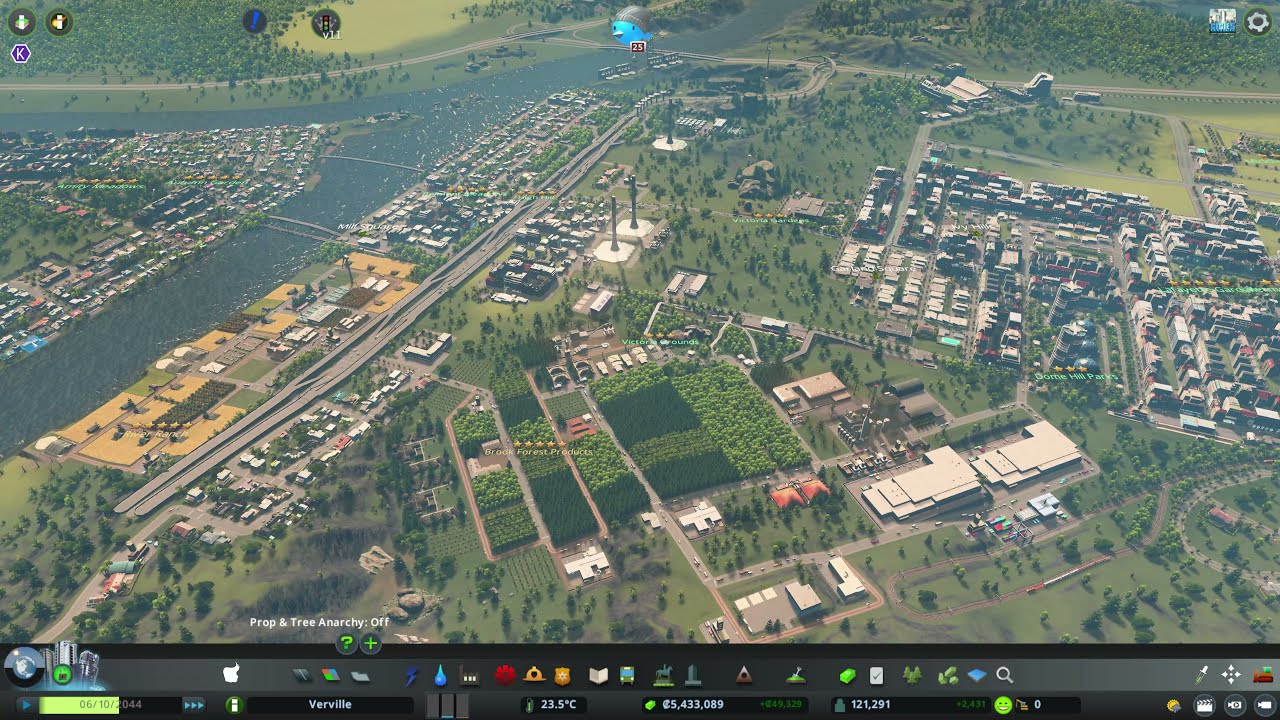
After reinstalling the game, Verville fixes some ugly bridges, extends the Cooper Park industrial zone and builds an ore industry — Magnolia Mining and Olive Ore Group — around the map's beautiful rocks. A new train stop, one-way roads for trucks, an underpass, more schools and services, eco water treatment and the removal of forgotten traffic lights help the city jump from about 100,000 to 150,000.
What happens in this episode
The game had uninstalled itself for some reason, so I reinstalled it. This episode catches up on things I’d skipped, starting with some bridges that didn’t look nice. The road to the stadium gets a proper bridge, and so do a couple of others.
How it was built
More industry
Cooper Park is extended: there’s too little industry. The resource view shows ore in Hickory Hills, but the mine wouldn’t place until the area was painted with the industry area brush, which I’d forgotten. It’s named Magnolia Mining, with a second sector, the Olive Ore Group. Sadly some beautiful landscape is lost, though the rocks stay. An ore grinding mill, sand storage and a balanced warehouse went in. The roads look blue because of the Electric Roads mod: power runs under the roads like in many cities around the world.
A new train stop
A new passenger stop needed old, broken historic tracks removed and the line adjusted with Page Up/Down. The access roads became two-lane one-ways, so trucks entering and leaving don’t block each other. Magnolia Mining reached level 2.
Lane rules and an underpass
A crossing got lane rules and no pedestrians, a busy area got more one-ways, and an underpass lets cars and trains pass without stopping. The lemonade factory finally produces, and residential demand started rising for real. Free Wi-Fi and smoke detectors stay on while money allows. More medium underground mines, a power plant and incinerators went in.
Services everywhere
Offices filled quickly. More elementary schools, high schools, libraries, fire stations (bad things can happen in industrial areas), and police. Workers’ barracks went into the mining area, and old buildings were kept because they look nice. A new mixed district of industry and shops went up.
Final fixes
A broken tram connection was fixed, two more eco water treatment plants handle sewage, and ore storage went in. A tram stop right next to a crossing turned out to be a bad idea. I also found traffic lights I thought I’d removed, and removed them properly this time. Verville went from about 100,000 to 150,000 citizens in one episode. Freight trains still get stuck, and another farm is next.
Video chapters
- 00:00Fixing bridges after a reinstall
- 05:13Industrial areas: Magnolia Mining
- 10:29Grinding mill, sand storage and power under roads
- 15:44A new train stop and old tracks removed
- 22:17One-way roads for trucks
- 28:04Lane rules and an underpass
- 39:59Residential demand returns, mines grow
- 46:13Offices, schools, fire and police
- 58:19Workers' barracks and a mixed district
- 1:03:23Tram fixes and eco water treatment
- 1:14:47Forgotten traffic lights and 150,000
Clicking a chapter starts the video above at that point.
FAQ
Why use one-way roads in an industrial area?
Trucks entering and leaving don't block each other, so traffic keeps flowing even when a building is busy.
Why are Verville's roads blue in the electricity view?
I use the Electric Roads mod, so power runs along the roads like an underground network instead of above-ground lines.
Do workers' barracks help industry?
Yes. They improve the efficiency of industry areas and, in my experience, reduce pollution a little.