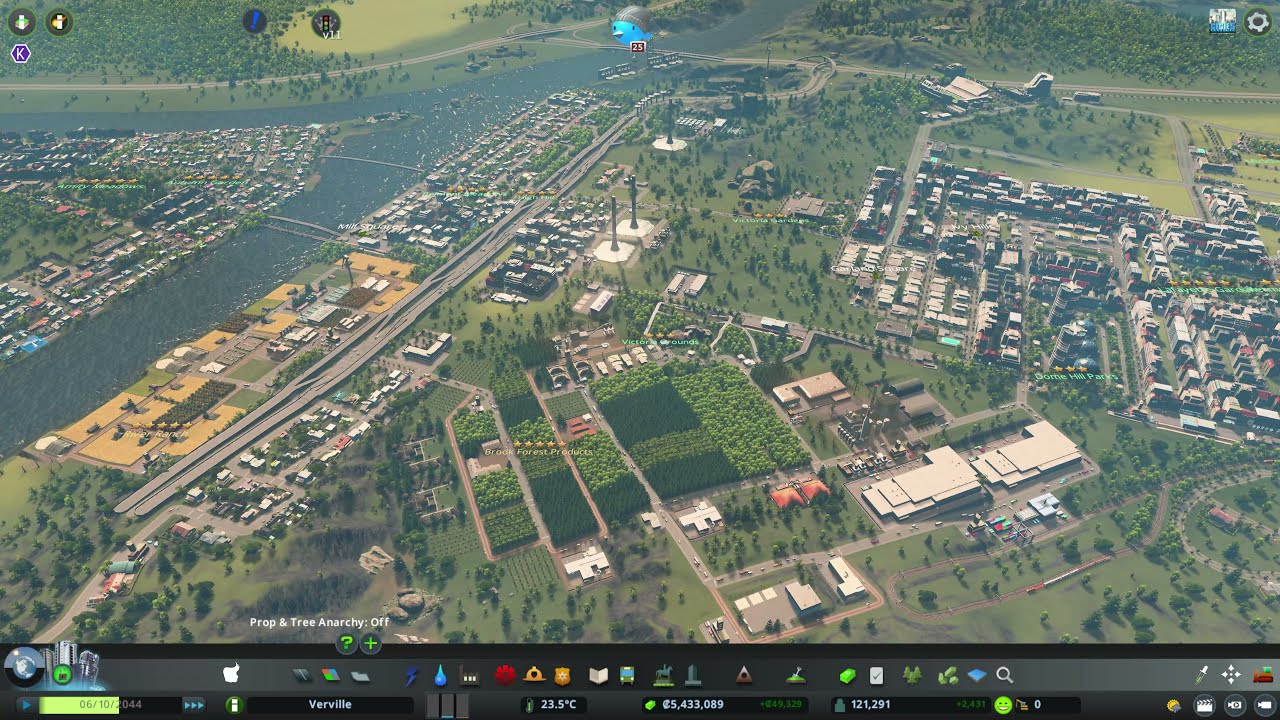
Verville's residential demand stayed low while commercial demand exploded. A new residential district gets a symmetrical city park and my first-ever zoo built around the map's rocks, which reaches level 3 with elephants and flamingos. A tourism hotel strip finally makes residential demand appear, leisure zones, a music club, parking lots, a football stadium and a biofuel intercity bus terminal follow — and the city passes 70,000.
What happens in this episode
Verville has five public train stations and a dome park next to the all-commercial district, but very few homes. A Reddit post I read explained that demand bars usually only show up when something is out of balance. My residential zones may be “fine” by the game’s logic, but I want more people, because a commercial district this size needs them.
How it was built
A new district
The 12-unit grid looks natural enough, but it feels very North American. I’m not judging, it’s just a typical layout. A new residential area starts with a central city park. I like geometric parks, but the main gate snaps left or right, so it needs Move It to be centred. Every park gets a café, because I love coffee and tasting local coffee wherever I travel. Fences line the roads and old trees fill the park. I’m not a big fan of English landscape parks. Japanese parks have a serenity that left a lasting impression on me.
My first zoo
I’ve never built a zoo before. The first area was far too small, so it was enlarged around the rocks that came with the map. It starts with moose and reindeer, a birdhouse and antelopes, plus trees and bushes. Water pipes follow the zoo paths, an exception because this is city-owned land. It reached level 2 surprisingly fast, then level 3, adding a reptile house, elephants and flamingos. The sea life enclosure was too big. Later came a monkey house and a giraffe enclosure.
Services and homes
Clinics, fire stations, police (some squeezed in with Anarchy), community schools and fire towers in the mountains. A few small low-rise homes, and more offices because there’s demand and education.
Hotels change everything
A strip zoned for the tourism specialisation filled with hotels, inns and cafés, and suddenly residential demand appeared. A leisure zone and a noisy music club followed. The college had only one star and few students. A big parking lot with tree lines serves the commercial zone.
A football stadium
Commercial demand was still rising, and freight trains got stuck. A road upgrade made room on a hill for a football stadium that everyone can see, with a levelled parking lot (I adjusted the parking marks by hand), a radio station, police, fire and a bigger clinic in case anything happens during a match. A biofuel bus depot and an intercity bus terminal bring in more tourists. Extra power went in too. Verville passed 70,000.
Video chapters
- 00:00Why is residential demand so low?
- 04:21A grid that feels too North American
- 08:24A geometric city park
- 17:09My first zoo
- 21:47Zoo animals and a new street layout
- 30:39Services, schools and fire towers
- 39:45Low-rise homes and offices
- 44:08Hotels unlock residential demand
- 48:50A parking lot and a level-3 zoo
- 57:22A football stadium
- 1:15:16A biofuel bus terminal and 70,000
Clicking a chapter starts the video above at that point.
FAQ
Why is my residential demand low in Cities: Skylines?
Demand bars often appear only when something is out of balance. In Verville, adding a tourism hotel district made residential demand rise straight away.
How do you start a zoo?
Paint a zoo area large enough for several enclosures, add the main gate, then start with the first animals (moose and reindeer, birdhouse, antelope). More animals unlock as the zoo levels up.
Can you centre a park gate?
Not exactly with vanilla tools — it snaps left or right. Move It lets you centre it for a symmetrical layout.