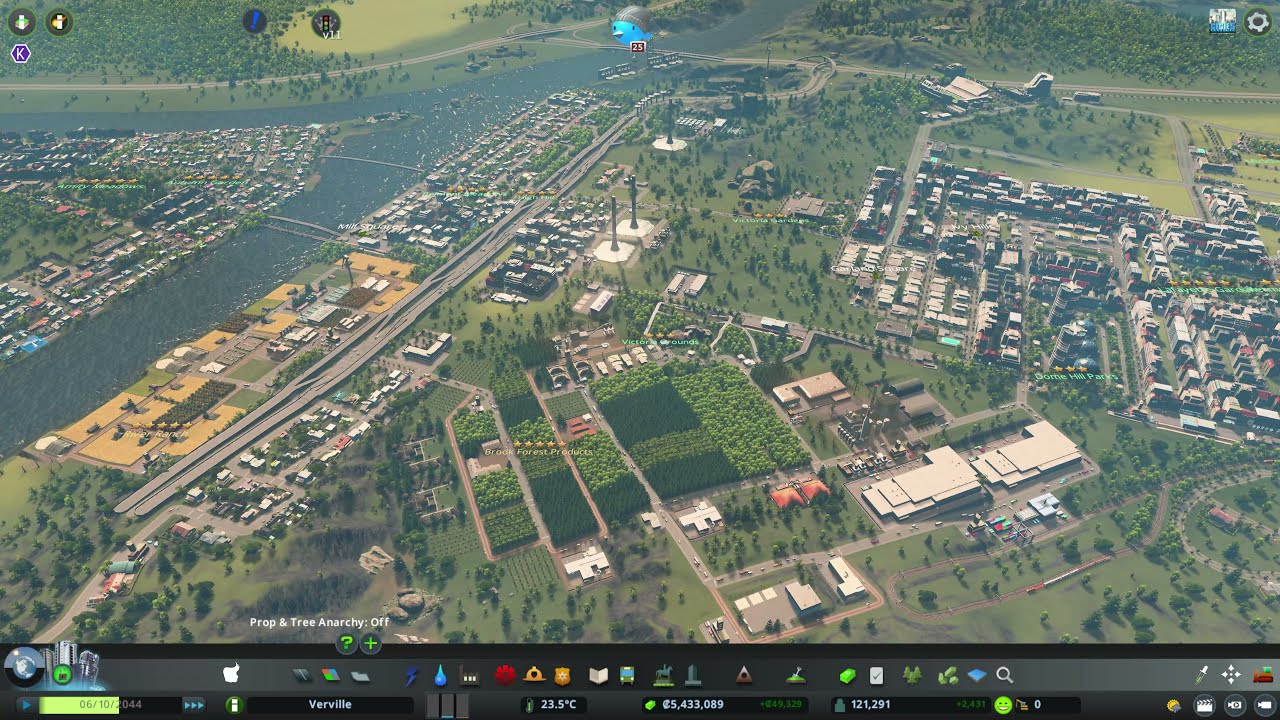
At about 60,000 citizens, Verville gets its first passenger train stations — four in the end — for residents and tourists. Six-lane city roads go back to four lanes without roadside parking, a park bridges a busy walking route, three eco water outlets turn out to pollute after all and are moved, a park maintenance building and a vertical-farm biodome park arrive, and traffic lights come out so drivers go whenever they can.
What happens in this episode
Episode 7 laid out a factory district and a new highway route into what will probably be the bigger downtown. Not all industries can be supplied yet. An airport is tempting, but probably too soon for a town of about 60,000.
How it was built
Lane switching
Drivers made unexpected lane switches and turnarounds at the new connection, despite careful lane management, so more rules went in. Commercial demand was ridiculously high, which I never planned for.
Passenger trains
The in-game passenger stations don’t really make me happy. They’re fine for the suburbs, but not exactly an attractive main station. The first one went in anyway, aligned with Move It, then more. One line stopped short until a missing track connection was fixed. In the end Verville has four passenger stations, with trains coming out of a tunnel. Drivers still crowded one lane even when all three went straight, a game mechanic I don’t understand.
Back to four lanes
Six-lane city roads came back down to four lanes. They look just as good, and versions with a planted median automatically ban roadside parking. Bus stops got checked too. Have I seen regular six-lane roads in Tokyo? Yes, but four lanes is usually enough in this game. Some Anarchy-built connections didn’t work in-game, so they were redone without it.
Harland Meadows
People walked across an open area in the middle of nowhere, so a new park, Harland Meadows, runs alongside the train station. A rock and a huge tree stayed, and a café, restrooms, an info booth and gazebos went in. Trees around the stations soften the noise.
A sewage mystery
The info panel said the eco water outlets produce zero pollution, but that simply wasn’t true. The river was dirty. A futuristic water tower and tank reservoir went in, and the three outlets were moved downstream. After that the water was clean.
Parks and traffic lights
A park maintenance building, my first here. A hill with vertical farms and a biodome becomes a farming-themed tourist park with amenities, reaching level 2. More 12-unit commercial and office blocks, still with almost no residential demand. Finally, traffic lights came out at several junctions so drivers go straight whenever they can, and traffic flowed a lot better.
Video chapters
- 00:00A factory district and an airport idea
- 04:08Strange lane switching
- 08:23The first passenger train stations
- 17:19Four stations, and why not all three lanes?
- 21:36From six lanes back to four
- 29:44Harland Meadows train station park
- 43:13Trees by the tracks and a sewage mystery
- 52:17Park maintenance and a biodome park
- 1:05:50More commercial and no traffic lights
Clicking a chapter starts the video above at that point.
FAQ
Are six-lane roads worth it in a city?
Usually not. Four-lane roads are enough in Cities: Skylines, and versions with a green median also ban roadside parking.
Why don't drivers use all lanes?
Cities: Skylines drivers pick lanes early and often crowd into one even when they all go straight. Lane connections help but don't fully fix it.
Do eco water outlets really have zero pollution?
The info panel said zero, but the river near them was clearly polluted. Moving them and adding capacity cleared it.