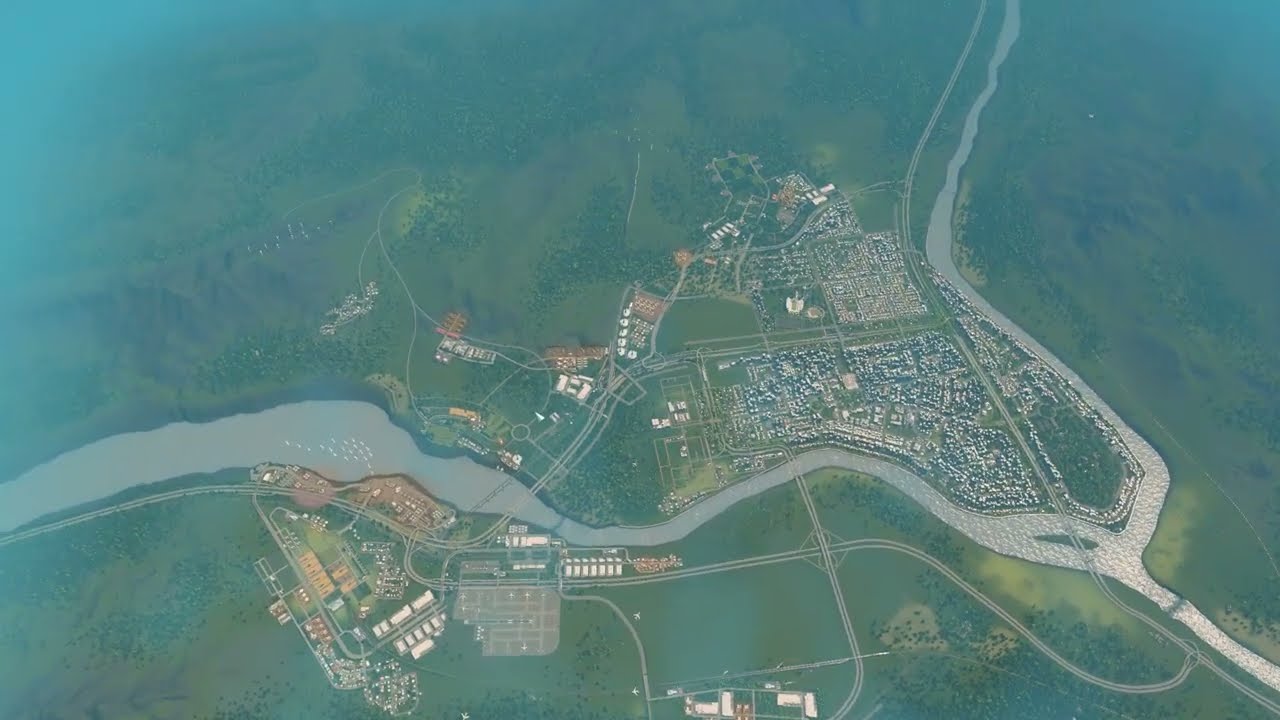
Springvalley gets a new district along the river: collector roads and a big roundabout, low-rise housing on the shoreline in front of denser blocks, the Anchor Hill nature reserve, tourism and leisure specialisations with hotels and nightclubs, policies like high-tech housing and a heavy traffic ban, and river walls. The new attractions pull in so many visitors that the only access road jams, and lane arrows, priority signs, a pedestrian bridge and a parking lot attempt only partly help at 60,000 citizens.
What happens in this episode
This is another episode I had to record twice. It’s all about a new community along the river, with a large nature reserve in the middle. First, the bus stops by the new bus lane from Episode 27 move further down, so buses don’t queue inside the junction.
How it was built
Roads first
The main collector road runs on the inner side of the shoreline, with a big roundabout to split the traffic heading south, where it will be densest. Along the shoreline I follow the pattern from across the river: low-density housing in front of denser blocks. I set aside space for Anchor Hill, the nature reserve, and for Hamilton Park.
Policies first, zoning second
The whole of Myrtle district gets its policies before any zoning:
- tax raises for high-density residential and commercial;
- high-tech housing and heavy traffic ban;
- high-rise ban, encourage biking and prefer parks.
At the tip, a tourism district and a leisure district go in, with hotels, nightclubs and restaurants. At nearly 60,000 citizens, it’s time for them. I’m really looking forward to the more precise district tool in Cities: Skylines II.
Services and zoning
Offices come first, because people need to work somewhere. The district is ringed with services: doctors, fire, police and a high school. The shoreline gets low-rise homes mixed with some high-density, offices and commercial. Thanks to the policies, the buildings look completely different from the other side of the river.
Anchor Hill
The nature reserve is built in a speed-up. Its entertainment value of 2,864 leaves room to grow. River walls match the other side of the highway for consistency.
Then the traffic came
Visitors poured in. The fixes I tried:
- lane arrows on Magnolia Bridge: reducing the lanes that can turn sometimes sorts traffic better;
- removing pedestrian crossings near the ramps, where people crossed like ants;
- priority signs instead of traffic lights, and a two-lane off-ramp;
- a pedestrian bridge, stepping down from height 12 to 6 to ground;
- a parking lot with the parking lot mod, which wasn’t doing much after the game updates.
Sometimes having no settings at all works best, and sometimes it doesn’t.
Not solved yet
It improved a little. The real problem is that this is the only entrance to the area. At 60,000 citizens I need another off-ramp somewhere, and that’s the job for the next episode.
Video chapters
- 00:00Recap and moving bus stops
- 04:01Planning around the shoreline
- 08:40Collector roads, the reserve and policies
- 13:12Tourism, leisure and services
- 19:23Building Anchor Hill
- 23:43Lane arrows on Magnolia Bridge
- 28:01Hotels, nightclubs and river walls
- 32:03Trying the parking lot mod
- 36:37Visitors jam the only entrance
- 45:26A pedestrian bridge
- 50:2160,000 and a missing off-ramp
Clicking a chapter starts the video above at that point.
FAQ
How do you build a nature reserve in Cities Skylines?
Paint a park area with the Parklife tools, set it to nature reserve, and add its main gate, paths and attractions. Its entertainment value grows as it levels up.
Why does a new park or leisure district cause traffic jams?
Attractions pull visitors from the whole city. If the area only has one access road or ramp, all those trips meet at one junction.
Does reducing turn lanes help traffic?
Sometimes. Fewer lanes allowed to turn can stop vehicles from cutting across each other and make the junction flow better.