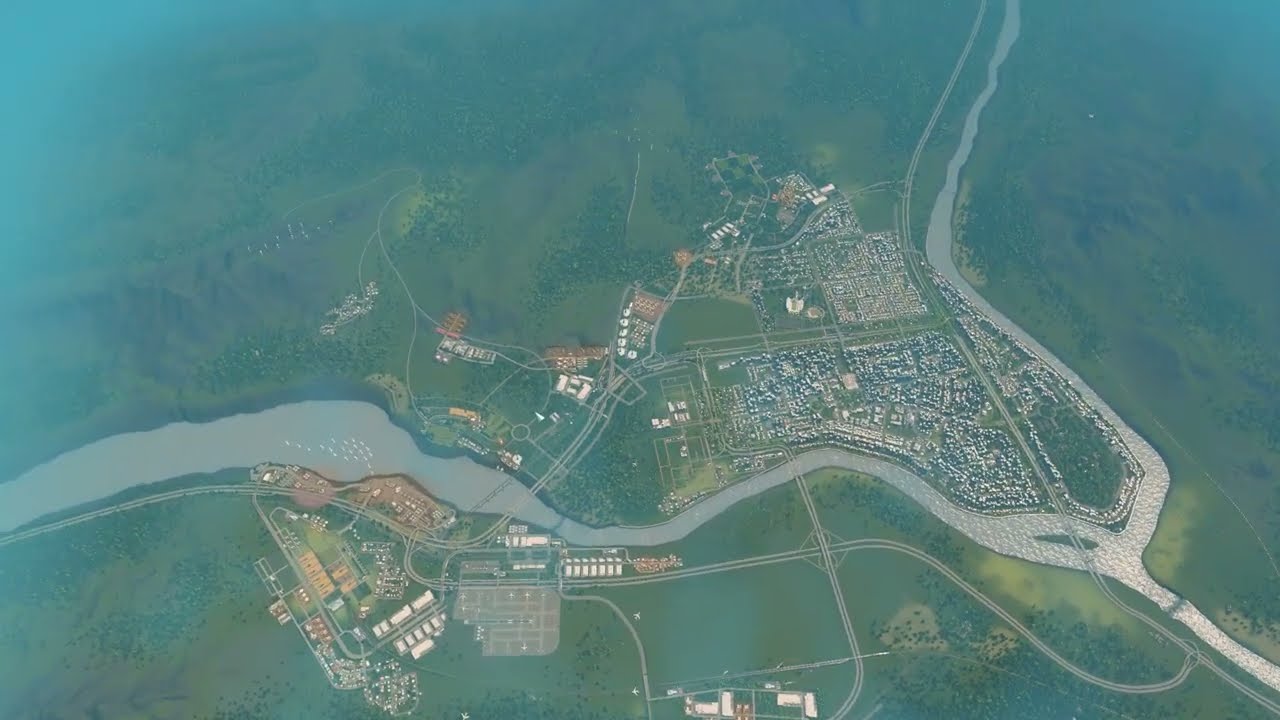
The new nature reserve, hotels and entertainment district in Springvalley pull so many visitors that cars queue along the highway. I tear down the whole connection, part of a junction and some homes, and build two parallel highway alignments: one through route and one serving the nearby exits. Extra on and off ramps, a road under the highway, careful lane counts, Node Controller for lane changes and give-way signs finally clear it. Hamilton Park gets its land back, a new power plant goes in, and my first toll booth turns out not to be worth it.
What happens in this episode
At the end of Episode 28, the new district jammed. The nature reserve, the hotel district and Summit Park pull so many people that cars line up on the highway. Rough test ramps showed that most traffic wants to go down into the district and to the park. So I tear down the whole highway connection, the junction and some housing, and build for the future.
How it was built
Two highways side by side
The new layout runs two parallel alignments:
- one through highway;
- one serving the local exits, with a new exit straight into Heather Heights and Summit Park.
I also simply wanted to build something bigger here.
Counting lanes and nodes
Where three lanes split off, the highway has to be three lanes, dropping to two after two nodes. One stretch had no node in between, so vehicles couldn’t change lanes until I added one. Nodes that were too close together caused trouble, as I expected. Traffic lights come out, pedestrians are banned on the ramps, and lane arrows go everywhere.
More ramps
Fewer people used the first exit than I’d hoped, so I add another off-ramp, and then another on and off ramp pair, so traffic splits into two directions: the longer route over the old overpass and a shorter one. Give-way signs replace stops. Pocket cars from the park areas add to the load.
Under the highway
A road under the highway, raised to 12 m in bridge mode, offers another way through. In Cities: Skylines 1, vehicles mostly stick to the shortest route they picked when they set off, so a bypass only takes some of the traffic. Cities: Skylines II should handle that very differently. Another off-ramp with a three-lane to two-lane split, plus Node Controller so drivers can actually change lanes onto it, and suddenly the traffic was almost fixed.
Tidying up
Hamilton Park loses the buildings that were placed on it. A mixed zone blends high-density residential, commercial and offices. A new power plant and more garbage capacity follow, because the city is growing fast.
A toll booth
I’d never used a toll booth. The one-way booth was huge and barely fit, it slows traffic, and the income was so small it wasn’t worth it.
I only gained about 1,500 citizens this episode, but the traffic is nearly solved. It’s a massive interchange I’m not exactly proud of, but it works.
Video chapters
- 00:00The park is jamming the highway
- 09:22Two parallel highways
- 13:45Lane counts and node spacing
- 17:51Another off-ramp
- 22:11Splitting traffic two ways
- 26:52Give-way signs and park traffic
- 31:37A road under the highway
- 35:41Node Controller for lane changes
- 40:11Hamilton Park, power and garbage
- 44:36My first toll booth
Clicking a chapter starts the video above at that point.
FAQ
Why do parks cause so much traffic in Cities Skylines?
A five-star park area attracts visitors from the whole city and from outside it. All those trips end at the same place, so its access roads and ramps need real capacity.
Do vehicles in Cities Skylines 1 avoid congested routes?
Only partly. Vehicles pick a route when they set off and mostly stick with the shortest one, so a new bypass may only take some of the traffic.
Are toll booths worth it?
In this case, no. The one-way toll booth slowed traffic and only added a little income, and the large building barely fit.