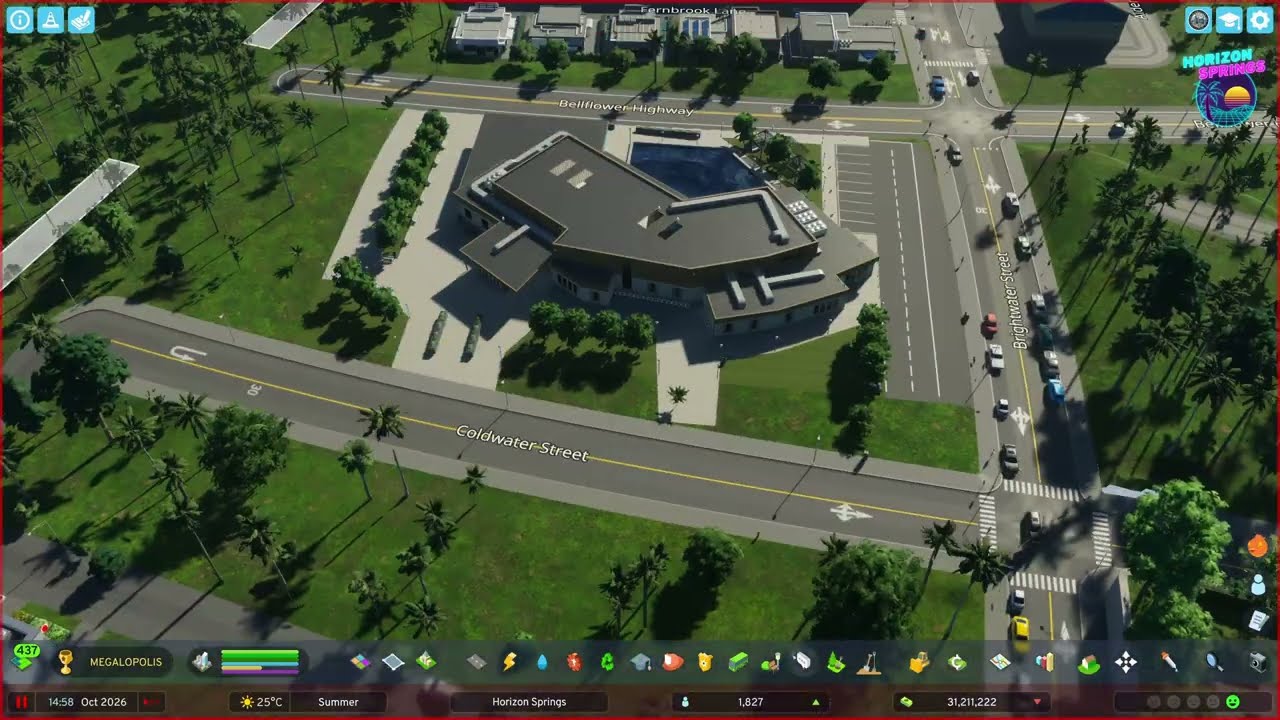
The first real downtown in Horizon Springs: an eight-lane arterial that dives under the rural highway like Yonge Street in Toronto, high-rises with varied heights, roadside greenery to stop street parking, and a Japanese-style elevated highway with tight on- and off-ramps and small shops tucked underneath — the way they sit under the tracks between Tokyo and Shimbashi.
What happens in this episode
After a break of about six weeks, Horizon Springs gets its first real downtown. The tile I picked is a stretch of flat land between the river and the beach, large enough for a bigger city to grow around it. This episode is the bridge to everything the channel does now: a Japanese-style elevated highway running through a North American downtown.
How it was built
A road hierarchy borrowed from Toronto
The main arterial starts as a six-lane road and becomes eight lanes, four in each direction, because Spruce Highway will carry a lot more traffic over time. I tried an overground branch-off first and didn’t like it, so the arterial now dips into a tunnel under the rural highway where it crosses the river. It reminds me of Toronto, where Yonge Street runs underneath the big highway interchanges. The map’s own roundabout stays for now.
Downtown with varied heights
High-density residential comes first, then offices and some smaller residential blocks. The beachside gets medium-high condos for wealthier residents. It’s flat land, so not an ultra-prime location, but still expensive. A large plot next to a 3×3 villa was left open for a school or hospital. It became a hospital, and a cemetery went next to it as a quiet green space between the towers.
The most important rule for a downtown: mix building heights. If every high-rise stands right next to another one, the city looks crowded and fake, and even New York has a distinct skyline with gaps and steps. Break up the grid with low-rise homes, small offices and parking lots between the towers.
Stopping street parking with greenery
Parked cars slow downtown traffic badly, so the arterials and smaller roads get the roadside greenery option, which removes the street parking, plus trees. If you do this, add at least one large parking lot, because you’re taking away a lot of spaces. The pre-made park next to the cemetery is one of the most boring in the game, so it gets custom textures and many more trees.
A high-rise office burned down because the area had no fire coverage yet. I demolished the rubble and added another parking lot while I was at it.
The Japanese elevated highway
The centrepiece follows what I learned in Tokyo, Osaka and other Japanese cities: elevated highways connect major districts and channel traffic into the centre without cutting the streets apart. The difficult part is the ramps. Japanese on- and off-ramps are tight, and fitting them into a dense block took a lot of trial and error. The link from the rural highway onto the elevated stretch was too ambitious at first; it needed lane management and a smooth elevation step so trucks wouldn’t have to brake hard, and the ramp had to thread under existing bridges. I used a similar technique in Cities: Skylines 1, but here it looks far more convincing once it’s right. I might publish it as a Japanese on-/off-ramp asset one day.
Why the city lost money
While the downtown grew, I couldn’t work out why I was spending more than I earned. Letterboxes, internet coverage and other services helped attractiveness, but the real cause was the outside service connections. Paying the neighbouring cities to provide services I didn’t have yet was eating the budget. Once that changed, the income turned positive.
Underground parking and the rail link
The first base-game underground parking garage goes under a special square, surrounded by new buildings. A reminder to myself: always plan the railway first. I was lucky to squeeze the rail connection into the existing grid. It links to the second tile, and the county still has no rail yard. A small Chinese-themed commercial block with shops, laundries and tobacco stores serves the surrounding towers.
Across the river: ramps, a gas station and hotels
The other bank becomes a tourist area. Instead of another bridge, which would crowd the downtown, the existing highway crossing gets on- and off-ramps. A large North American gas station with parking serves people passing through, and the episode ends with a hotel area by the beach.
Shops under the highway
My favourite small detail: commercial buildings placed by hand underneath the elevated highway. In Japan, every bit of land is used. Walk from Tokyo Station along the Yamanote Line towards Shimbashi and you’ll see small shops and restaurants built right under the elevated tracks. Cities: Skylines II doesn’t support this, but with Find It to pick suitable buildings and Move It to place them, it works.
Horizon Springs paused after this episode while the channel turned to Japanese cities. The Japanese road systems guide picks up where this elevated highway left off.
Video chapters
- 00:00Picking the downtown tile
- 02:34An eight-lane arterial, Toronto-style
- 05:28High-rises, offices and beachside condos
- 12:26Cemetery, roadside greenery, parking
- 19:05The Japanese elevated highway
- 21:50Building Japanese on- and off-ramps
- 26:25Break up the skyline; why the budget was negative
- 31:45Underground parking and the rail link
- 38:42Ramps across the river, gas station, hotels
- 49:32Shops under the elevated highway
Clicking a chapter starts the video above at that point.
FAQ
How do you build a Japanese-style elevated highway in Cities: Skylines 2?
Run an elevated highway along the main arterials and keep the on- and off-ramps short and tight, branching one lane up or down with smooth elevation steps. It takes trial and error with lane management, but the result looks much closer to Tokyo or Osaka than in the first game.
Can you put shops under an elevated highway in Cities: Skylines 2?
Not with normal zoning. I place commercial buildings by hand under the deck with Move It, using Find It to search for buildings that fit — like the small shops under the elevated tracks between Tokyo Station and Shimbashi.
Why was my city losing money with a growing population?
In my case it was the outside service connections. Paying neighbouring cities for services I didn't provide myself cost far more than expected. Once I stopped relying on them, the income turned positive.