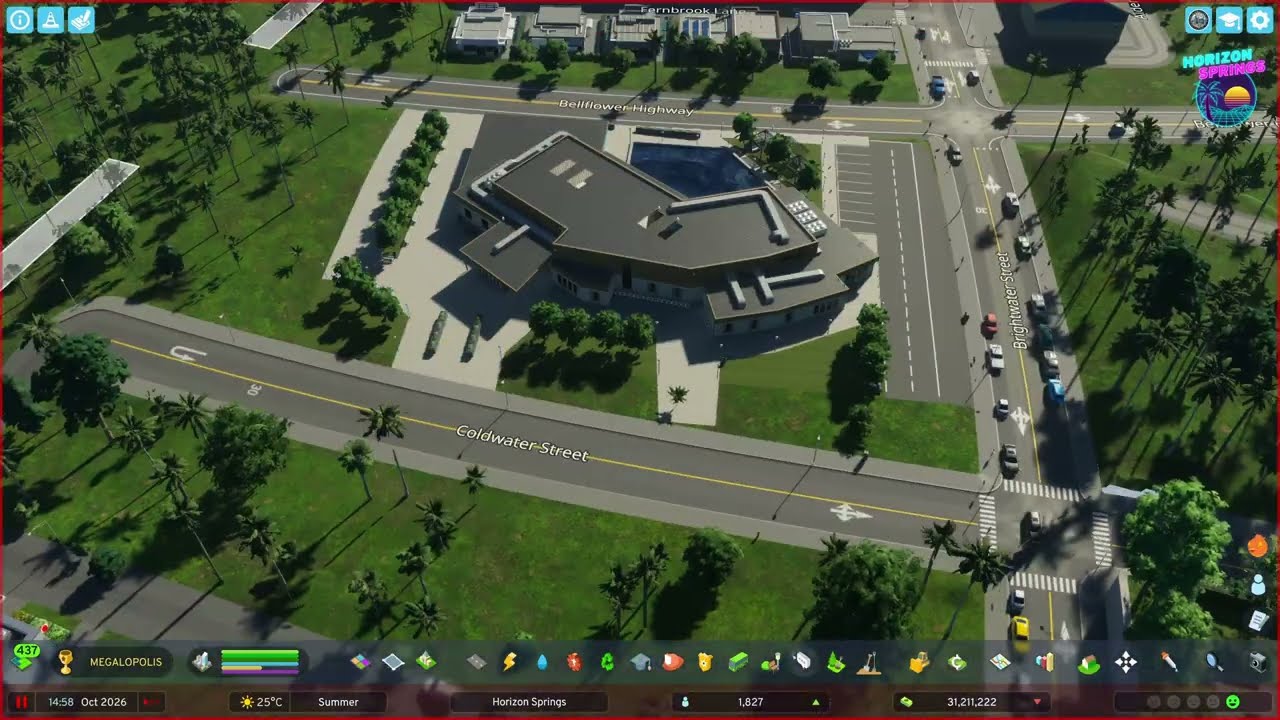
Tile 5 turns the rural town urban: passenger trains bypass the industrial rail hub through a cutting instead of a tunnel, a small station becomes the centre of a modern mid-rise district, row homes and family houses fill the space between two highways, and forest industry and farmland round off the tile.
What happens in this episode
After the coast in episode 4, tile 5 is the most urban step so far in Horizon Springs: a small passenger station so residents can reach the big city that comes later, a modern district around it, plus forest industry and more farmland. I recorded it shortly before a two-week holiday, still on the last version of the game from Colossal Order, before Iceflake Studios’ first updates.
How it was built
Routing passenger trains past the freight hub
Passenger trains shouldn’t run through the industrial train hub, so they get a bypass across the river to a station much closer to the existing town centre. My first idea was a tunnel through the hillside. It was tricky to set up, and in real life nobody would pay for a tunnel on such a short stretch. So the tunnel went, and the line now cuts straight through the hill, with the cutting landscaped afterwards. A couple of parking lots sit next to the station.
Junctions, forest industry and small wind turbines
At the highway junctions the pedestrian crossings go, and lane management adds dedicated turning lanes from the rural highway onto the two-lane roads. The coastal highway now ends properly at the regional highway. A new industrial area becomes the forest industry, with a few homes nearby, and the farms get the small wind turbines that look so much like rural North America.
A modern district around the station
The station is meant to anchor a new residential and commercial centre, so the lots around it are large enough for mid-rise and high-rise buildings. The first two commercial buildings came out far too small next to the residential towers that grew behind them, so I placed two larger, matching buildings at the station exit. The idea is to keep the modern centre clearly separate from the historic one: business, commercial and taller residential buildings here, the old Main Street from episode 1 left as it is.
People started moving in right away, which the commercial area and the industry badly needed: both were short of workers and customers.
Parking and pocket parks
Two in-game parking lots combined with a texture underneath make one larger lot. The only way to connect the parking spaces next to the big roundabout was invisible net lanes, which worked well. It’s becoming a bit of a concrete jungle, so two small parks act as buffers between the homes and the highways.
A quiet row-home district
A block of row homes, surrounded by greenery to shield it from the highway and the railway, is meant as a quieter, slightly more upscale area than the mid-rise blocks to the south. Larger single-family homes fill the rest of the space so it flows naturally, and two homes next to the forest industry let workers walk to their jobs in half a minute.
The second highway connection is kept plain on purpose. A rural interchange doesn’t need to look over-engineered, so it only gets dedicated left and right turning lanes.
No public transport — and one big mistake
The town still has no buses or rail yard for passenger transport, and I’m not sure a town this size needs them. Car traffic makes sense here, and I haven’t seen a single bike yet. The farmland that ends the episode turned out well, with small clusters of trees and bushes inside the fields. What I only realised after recording: I forgot to extend the industrial rail line down to the coast and built farms on the land it needed.
Video chapters
- 00:00Plan: urban expansion around a train station
- 04:22Tunnel or cutting? Routing the passenger line
- 07:30Turning lanes, forest industry, small wind turbines
- 10:40Station square and mid-rise blocks
- 15:52Parking with invisible net lanes, pocket parks
- 18:51A quiet row-home district
- 23:43Family homes, no public transport yet
- 26:18Farmland — and one big thing forgotten
Clicking a chapter starts the video above at that point.
FAQ
Should I use a tunnel or a cutting for a short rail line?
For a short stretch through a small hill, a cutting is more realistic — a real railway wouldn't pay for a tunnel there. I tried the tunnel first, then cut straight through the hill and landscaped the sides.
Does a small town in Cities: Skylines 2 need buses?
Not necessarily. Horizon Springs has no bus network at this point. Car traffic suits a small rural town, and the new train station handles trips to the future big city.
How do you separate a historic centre from a modern one?
Put the modern buildings somewhere else. Here the mid-rise and commercial blocks cluster around the new station across the river, so the historic Main Street from episode 1 keeps its low-rise character.