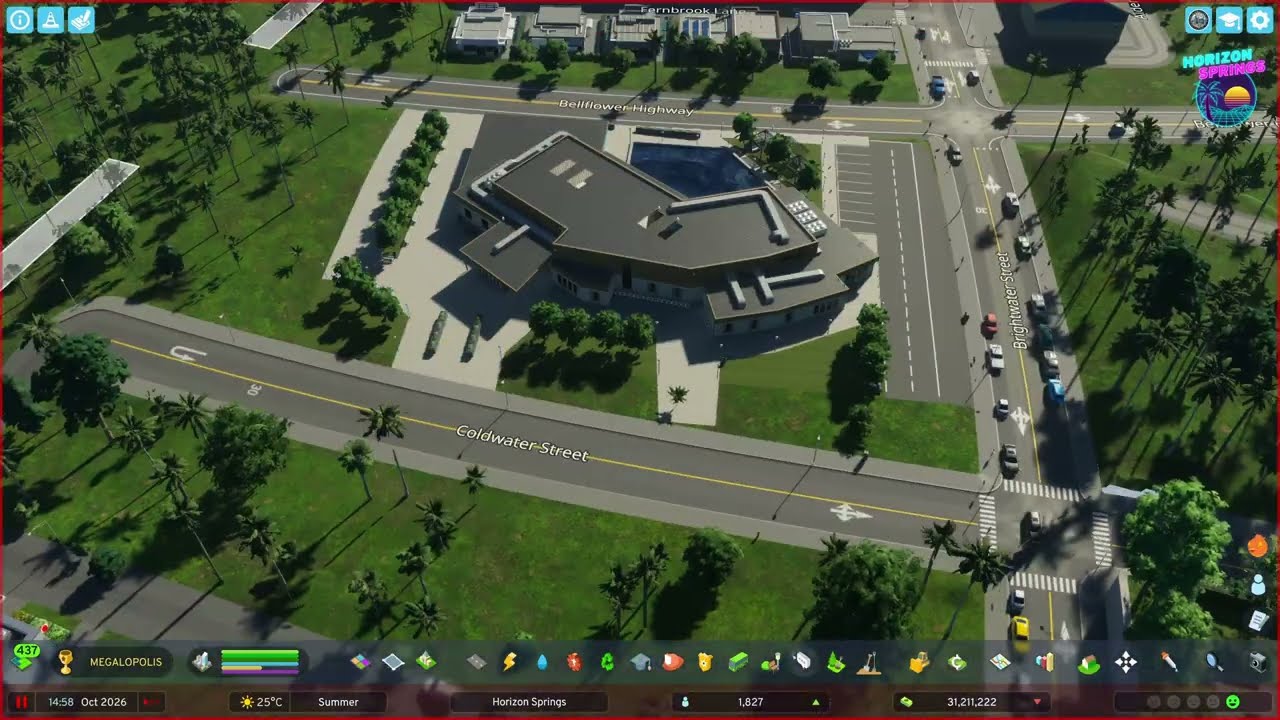
Tile 3 becomes a farming valley without square grids: gravel roads that follow the terrain, farms only where the land allows, irrigation ponds with natural edges, trees and tracks inside the fields, a small hillside neighbourhood with hand-made gardens and a recreational lake with two islands.
What happens in this episode
Tile 3 of Horizon Springs is the farming district in the west of the map. My first idea was a vineyard, but the mountain valley doesn’t suit one, so I looked at North American farm regions on Google Earth and built something closer to those: farms that follow the land instead of a chessboard of square fields. The episode title says it — no more grids.
How it was built
Getting the highway in first
The rural highway crosses a valley at an angle I chose by eye rather than by the grid, so the junction took some work: flattened landing areas, lane management, and ramps on both sides that merge cleanly. I went for two-lane on- and off-ramps in case the farming district ever brings heavy traffic. Over the small valley an arched bridge turned out better than I’d imagined, and I extended the river a little further into the mountains so it runs visibly under the highway bridge. Pedestrian crossings are removed at the busy junctions, and the access ramp stays at about one to two degrees of slope.
Gravel roads and fewer alleys
Farm traffic gets gravel roads laid on gently flattened strips along the river. Alleys are only used for the few residential streets and one main connection. The key idea is to flatten only where a farm really needs it and leave the rest of the terrain alone, including some empty lots. In a mountain valley, not every patch of land would be a field.
Farm size: production versus jobs
One mechanic worth knowing: in my testing it makes no difference to production whether you build one farm with a huge field or several small farms with small fields. The difference is in jobs, because the number of workers seems to depend more on the farm buildings than on the field size. If you want more people employed in farming, build more small farms.
With the lane connector I remove the U-turns and unsafe turns that cars like to make, and an underpass lets farm vehicles cross under the highway instead of using it.
Turning a street for the view
The first residential street faced the wrong way, so I deleted Hawthorne Lane and rebuilt it so every small family home looks out over the valley. The game crashed once or twice during the rearranging, probably because of Move It. Noise stays a problem: trees no longer dampen highway noise for nearby homes, and I don’t want sound barriers in a rural area.
Irrigation ponds that look natural
Each farming area gets its own wind turbine and an irrigation pond. A water source mod fills the ponds. The base game’s sandy texture would make them look like beaches, so I covered the edges with custom riverbed textures and layered lighter textures on top. Bushes separate the road from the water, and boulders and small stones keep cars out. A wider footpath along the pond can double as an access track for farm machinery. When Move It made trees pop up in the wrong places, they had to be removed by hand.
Details inside the fields
Google Earth shows that real farms often have trees inside the fields, for shade and wildlife. So there are trees, a few greenhouses, props, and gravel paths cut through the fields where machinery would leave tracks. It looks custom-built without taking hours.
A hillside neighbourhood with real gardens
West of the highway, gravel roads, a new junction and an alley merging back into the rural highway open up space for another farm and more homes. I used standard 2×2 houses at levels 5, 3 and 1 instead of row houses, set further back from the road, closed off with small roundabouts, and added a third row so the layout reads as a loose community rather than a copy-paste street. Every house gets its own lawn, fences and garden trees. The fence tool doesn’t snap to edges, but it’s doable. Two small commercial zones give the area its first shops.
Mid-detailing, a house caught fire and the flames spread into the trees. Luckily a fire station was close enough and the fire crew stopped it.
The recreational lake
My favourite part: a lowered basin filled with the water tool, dark riverbed textures at the bottom and lighter layers towards the grass, an irregular shape instead of an oval, and two rocky, bushy islands in the middle. It turned out to sit almost directly where the river ends below the highway bridge, which makes it look like it has always been there. A hiking parking lot, footpaths, log piles, letterboxes and an internet antenna finish the area, and the first family was using the paths right away.
Video chapters
- 00:00Planning farmland with Google Earth
- 04:38Two-lane ramps and an arched bridge
- 07:22Gravel roads that follow the valley
- 10:28Farm size: what actually matters
- 16:00Re-orienting homes for the view
- 18:30Wind power and irrigation ponds
- 27:17West side: more farms and homes
- 33:23A recreational lake with islands
- 39:19A house fire, lawns and fences
Clicking a chapter starts the video above at that point.
FAQ
Do bigger fields produce more in Cities: Skylines 2?
In my testing the output is the same whether you build one farm with a huge field or several small farms with small fields. What changes is employment: the number of workers depends more on the farm buildings than on the field size, so several smaller farms create more jobs.
How do you make farmland look less like a grid?
Follow the terrain. Use gravel roads that curve with the valley, flatten only where a farm really needs it, leave some lots empty, and add trees, greenhouses, props and machinery tracks inside the fields.
Do trees still reduce highway noise?
Not any more. Trees used to dampen highway noise for nearby homes, but in the current version they don't, so the noise level stays high. Sound barriers would fix it, but I don't want them in a rural area.