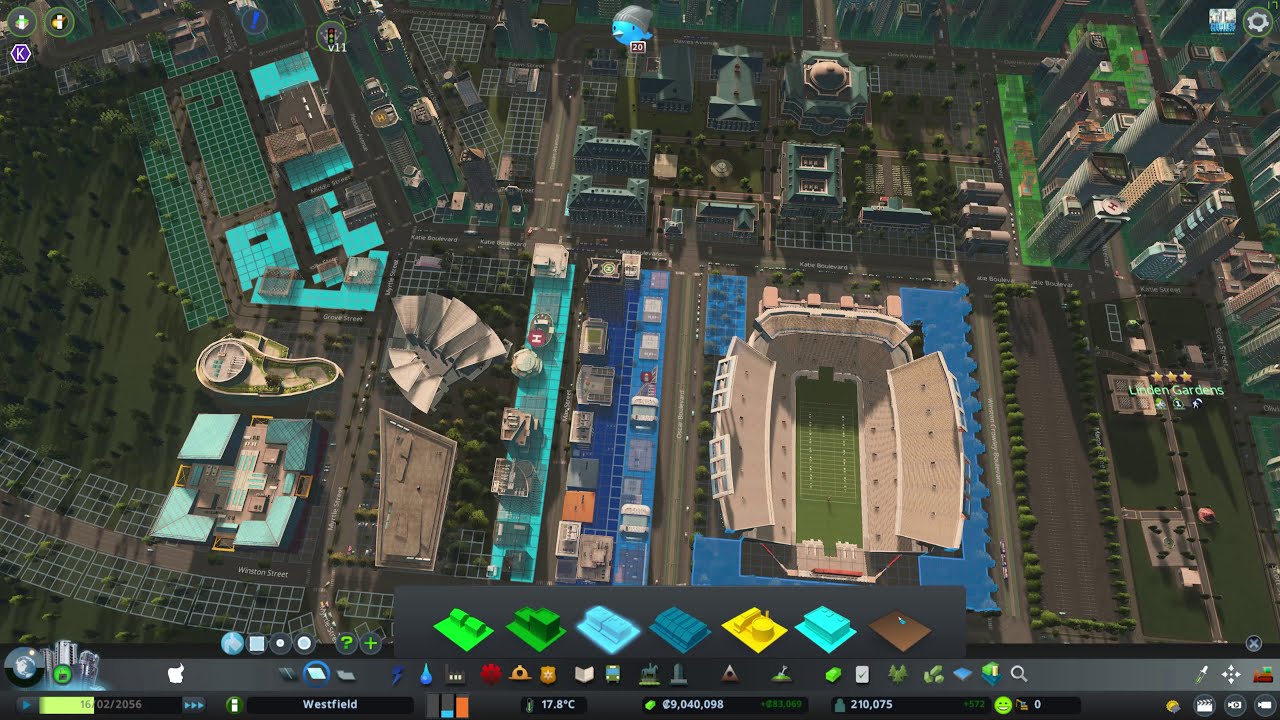
Across the river, Westfield builds a district with no road connection at all: people arrive by ferry, tram, bus and metro. It gets its own services, Hawthorne Hill and Island Hill parks, an incinerator and taxis, then the High Interest Tower, a courthouse and a central medical center. Ending free public transport turns out to be a big income boost.
What happens in this episode
Happy New Year 2021, and thanks to everyone who followed and subscribed in a weird year. Since the last episode, Westfield has no general industry left, only the farms and ore. Residential demand is high, so a new ferry line serves Oriental Street on the far side of the river.
How it was built
A new district across the river
Roads follow the river as naturally as possible. The main street becomes a separated tram line, and a depot needs a road upgrade. Short connecting streets let people cross the blocks. Someone asked why I lay hot-water pipes in a map without winter. I set them up long ago to keep things realistic. I wish Cities: Skylines had seasons, with snow, heat and cold making things more challenging. The game is from 2015, and I’d love to see a new one, because nothing else in the genre matches it yet.
Services and zones
A tram circle line covers the district, with police headquarters, a hospital, a fire station, schools and a library. Homes line the river, with shops along the roads and offices. Offices don’t mind commercial noise, while homes are better with a park in between.
Car-free
There’s no road connection, so the district is reached by tram, ferry, bus and a new metro link. Only a police car got in at first. Should it stay traffic-free? I asked viewers what they thought. Hawthorne Hill park got a side gate, natural paths, an info booth and trees. An incinerator, taxi depot and stands, a crematorium, eldercare and child health followed.
Landmarks
The massive High Interest Tower overlooks the whole town, joined by a courthouse and Island Hill park with a café and restrooms. In Japan, you always find clean, free public restrooms, even in every park. I wish that were common everywhere. A bus line had to be redrawn after the road changes, which happens.
The medical center finally appeared, but it costs 15k a week and doesn’t cover the whole city, so the clinics stay. Taxes went up a little, and ending free public transport brought in much more money. With residential demand high again, new homes and offices filled the rest. For now, the car-free district stays.
Video chapters
- 00:00No industry left, a new ferry line
- 04:26Tram tracks for the new district
- 08:31Why heating pipes — and seasons I'd love
- 13:03A tram circle line
- 17:35Services and zones by the river
- 22:12Car-free: buses and a metro link
- 26:21Hawthorne Hill park
- 34:38Incinerator, taxis and transit hubs
- 39:18The High Interest Tower and a courthouse
- 43:58Island Hill and free restrooms
- 52:52A medical center
- 1:00:54Paid transit and more homes
Clicking a chapter starts the video above at that point.
FAQ
Can a district work without a road connection in Cities: Skylines?
Yes. Westfield's district across the river is served only by ferry, trams, buses and a metro line — people moved in and services reached it.
Does the medical center replace all clinics?
No. It's expensive and didn't cover the whole city. You still need the smaller clinics and health centres.
Should public transport be free?
Ending free public transport gave Westfield much more income. A few citizens left at first, but the city stayed attractive.