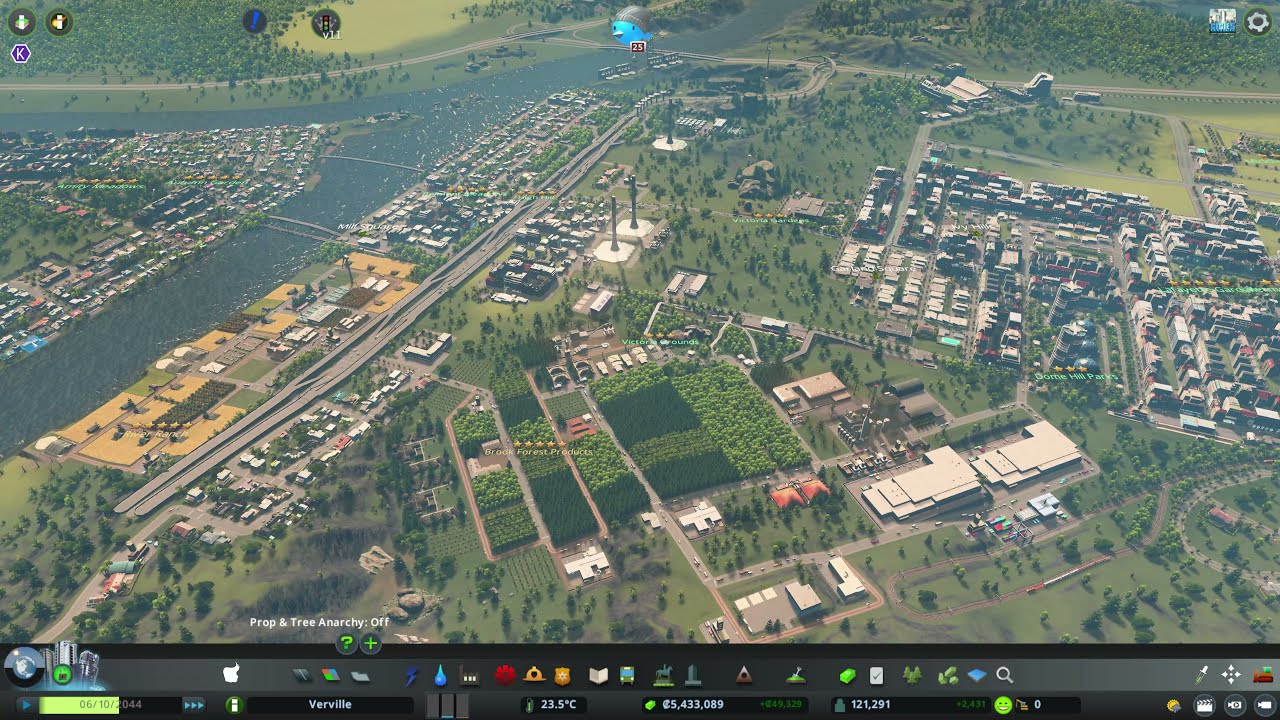
With no general industry left and about 33,000 citizens, Verville fights traffic with a new roundabout, removed traffic lights and lane rules, builds High Hill Park on an overpass so pedestrians stop crossing the highway (and pushes it to five stars), adds college amenities, fills a surprisingly huge commercial demand, and opens a cargo train terminal on one-way roads with a new local produce district.
What happens in this episode
The highway rebuilt in episode 5 still had packed roads leading to it. Verville has no general industry left: one level-5 ranch and a five-star forestry area are enough for a town of about 33,000.
How it was built
A roundabout and lane rules
A new roundabout, built with helper roads as usual. Traffic lights came out so people go whenever there’s room. Lane rules stop unnecessary lane switching. Intersection Marking Tool or Node Controller can add a node where drivers can switch lanes. Sometimes too many lanes cause more mess than they solve. One road became a four-lane one-way with Anarchy. One piece of road kept causing a jam until lane changes were blocked there.
High Hill Park
Lots of people walked across the highway, so High Hill Park goes on a 6 m overpass, with side gates on both sides, gazebos, restrooms and a trampoline park. Network Extensions issues came back briefly, but the developers do this for free, so no complaints. I swapped most of the bamboo for local trees, because bamboo looks unnatural in this climate. People used the park immediately, and it climbed to five stars.
College amenities
The college got student healthcare, a gym and a cafeteria. Never underestimate a cafeteria. More elementary schools went in.
A commercial puzzle
I don’t love the European-style buildings on this map, but I don’t want to change the theme. Commercial demand was the highest I’ve ever had, so more commercial zones went in, plus plazas, Japanese gardens, child and elder care, and a sauna. Do bus lines need two directions? I build for coverage, with nearby stops on different lines for easy transfers.
Cargo trains
New tiles bring a rail connection. A cargo train terminal goes on one-way roads, which makes traffic management much easier later, with warehouses for forestry. The first train brought more trucks, but not as bad as expected. A new local produce district, Garland Square, followed, and its crossing needed lane rules straight away.
Video chapters
- 00:00No industry, lots of traffic
- 04:14A new roundabout and lane rules
- 12:59Four-lane one-ways and a stubborn jam
- 22:34High Hill Park over the highway
- 31:00Local trees instead of bamboo
- 35:33College amenities and a five-star park
- 47:52Europe-style buildings and huge commercial demand
- 56:11One or two bus directions?
- 1:00:26A cargo train terminal
- 1:05:12Garland Square
Clicking a chapter starts the video above at that point.
FAQ
Should cargo train stations use one-way roads?
Yes. Placing cargo stations on one-way roads makes traffic management much easier in the long run.
Do bus lines need to run in both directions?
I build mine for coverage and haven't found it necessary. Make sure lines share a few stops close together so people can transfer.
Can a park bridge a highway?
Yes. High Hill Park sits on an overpass with side gates on both sides, so pedestrians cross through the park instead of walking across the highway.