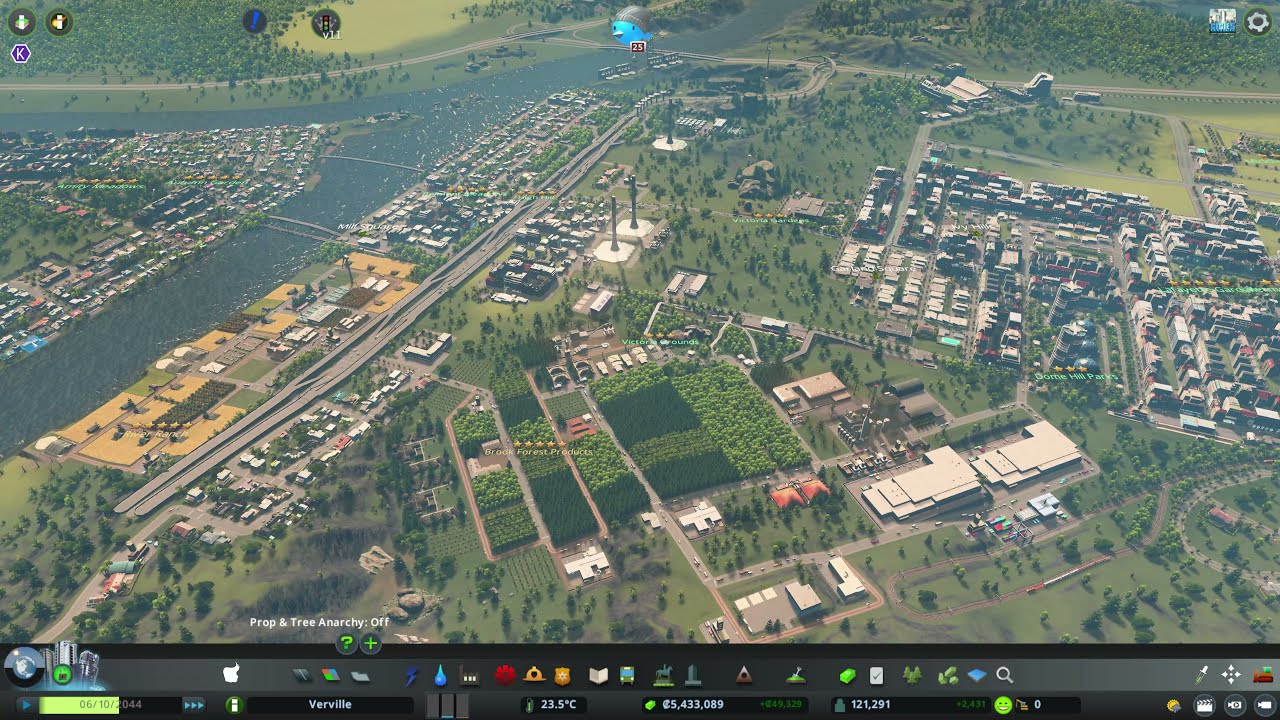
Verville grows from its starting roundabout: more homes on 12-unit blocks, a first forestry area with a main building and new tree types, milking parlors, warehouse yards and a bakery for River Ranch, parking bans, and a rebuild of the main road into a sound-barrier highway inspired by Tokyo and Osaka — while the game refused to place roads properly, probably because of a mod.
What happens in this episode
Episode 1 explained why I came back from Twitch: stream quality. Verville starts with my usual roundabout off the highway, which makes it easy to organise districts around it. The first industrial block was already being removed.
How it was built
Industry vs. offices
In the beginning you can’t do without industry, because you have lots of uneducated workers. Once citizens get educated, office zones appear, and from about 7,000 citizens the “industrial” demand is really office demand. The game puts both in one bar, which is misleading when you’re new. My plan: farms and wood industry, then offices instead of general industry.
12-unit blocks
New residential streets follow the 12-unit rule wherever the landscape allows, with one curve I don’t like much. Schools, a doctor’s office and a fire station come first. Crossings too close together are something I usually avoid, because they limit traffic management later.
Brook Industries
A forestry industry area, Brook Industries, gets its main building, and three tree types are planted with Move It: beech, alder and conifer. Forestry needs much more space than a farm. River Ranch gets two milking parlors, a cattle shed, warehouse yards for flour and animal products, and a bakery. River Ranch reached level 4. A few buildings had ended up in the corridor I reserve for the highway, and those had to move.
A highway rebuild
Too many people crossed one bridge and the main road jammed. Parking bans went in, then a rebuild. I sometimes sketch highways with regular roads first because they behave differently. Stacked highway junctions remind me of Tokyo and Osaka, which have amazing highway networks (I never drove there, because a foreign licence makes that hard). I recently designed a big Osaka-style interchange. All highways get sound barriers, because citizens like them more.
The game misbehaves
Roads refused to connect or placed strangely, no matter which type, probably a mod not working properly. A new bridge took some load off. To finish, the forestry area got sawmills, a pallet plant, a log yard and sawdust storage. Then I restarted the game, something I hadn’t needed to do in a long time.
Video chapters
- 00:00The roundabout start
- 03:33Industrial vs. office demand
- 06:5312-unit blocks and essential services
- 10:32Brook Industries: forestry
- 18:08Milking parlors, warehouses, a bakery
- 25:29Parking bans and a main road rebuild
- 30:23Highways like Tokyo and Osaka
- 38:15Sound barriers and ramps
- 45:39The game misbehaves
- 53:25Sawmill, pallet plant and a restart
Clicking a chapter starts the video above at that point.
FAQ
Why is industrial demand high late in Cities: Skylines?
The demand bar combines industry and offices. Once citizens become educated (around 7,000 citizens), much of that demand is for offices, so you can replace industrial zones with office zones.
Why avoid crossings close together?
Junctions too close to each other limit what you can do with traffic management later and create bottlenecks.
Why lay out highways with regular roads first?
Regular roads sometimes behave more predictably when sketching a layout. You can swap them for highway pieces once the shape is right.