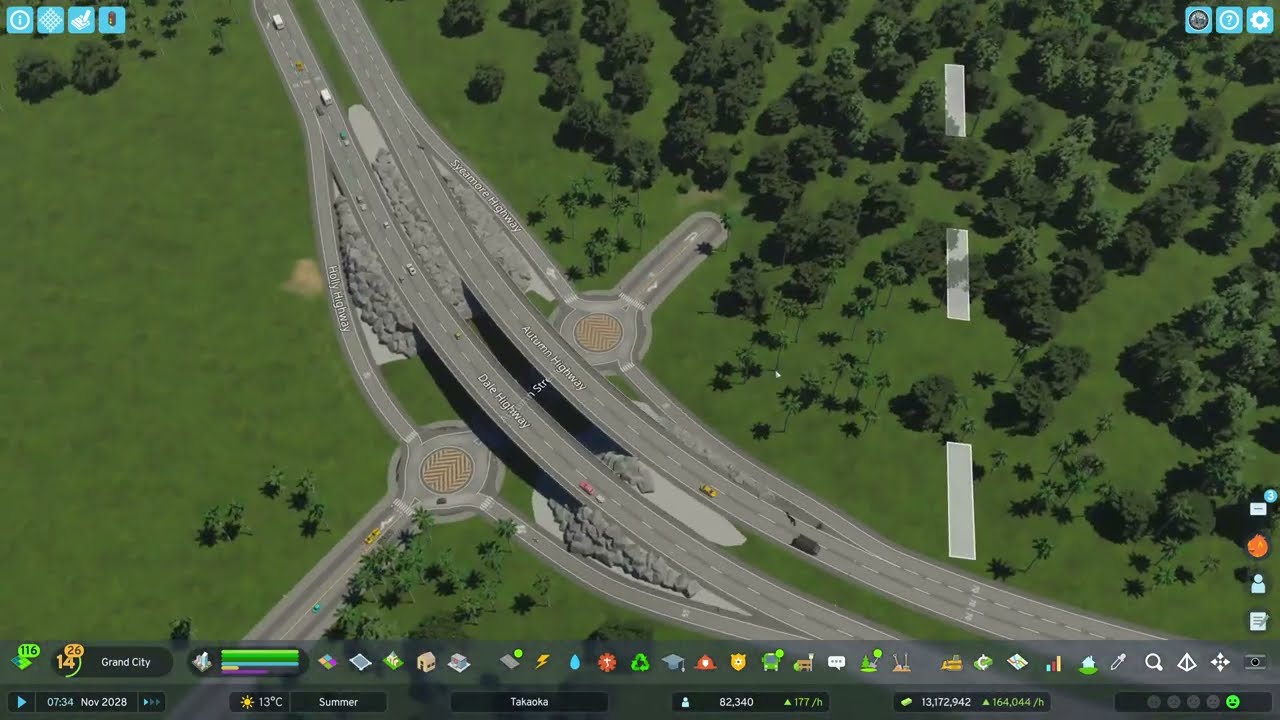
The finale of Takaoka: the land freed by moving the industry gets a new arterial connection via a large roundabout, low-density shops, northeastern row homes with roadside beach parking, a riverside grill, North American offices, a bigger Japanese police headquarters for a crime hotspot near the station — and the last forgotten factories removed.
What happens in this episode
The last episode of Takaoka fills the land freed by relocating the industry. The new eastern industrial area is running. Now the old zone near the beach becomes a place where people want to live.
How it was built
A new arterial link
An arterial road extends into the former industrial area, connected with a very large roundabout. Washington Street might go eventually to avoid a detour. Roadside greenery makes the arterial a no-parking road, and the change is made with the game paused so traffic doesn’t break. It was a quick fix: nothing had to be torn down, and it saved a lot of money.
Shops, row homes and beach parking
Low-density commercial zones and hand-picked shops close the gaps, so the area feels cohesive. The terrain is more rugged here, so northeastern row homes fit well. The “city council” decided the beach needed parking, so roadside parking is added along an existing road, with a new sidewalk on the other side. A strange artifact in the road took a while to understand. Proper quay walls on only one side kept the beach edge looking natural.
Trees, a busy junction and a riverside grill
Trees and bushes replace the standard grass. One junction is overloaded by all the people moving in and will need a rebuild. A riverside grill from the new pack goes in as a leisure spot, and Linden Lane is left open for future development.
Offices, schools and crime
Larger North American offices give people jobs close to home. School coverage is fine, but the crime view showed a hotspot near the train station: high crime probability and the jail almost full. A bigger Japanese police headquarters and a small Chinese local police station near the station bring it down as the patrols start. I’d also overlooked a few remaining industrial buildings in the area, which were removed. Sorry, industries. The track field for a merged school was too big, so the schools stay as they are.
The end of Takaoka
This is where Takaoka ends: an island that went from an empty start in episode 1 to more than 90,000 residents, with the industrial zone moved downwind and its old land given back to homes, shops and the beach. After this, the channel turned towards Japanese, transit-first cities. Episode 1 is still the most-watched video on the channel.
Video chapters
- 00:00What to do with the old industrial land
- 04:02A big roundabout and a no-parking arterial
- 10:10Low-density shops filling the gaps
- 14:45Row homes and beach parking
- 24:10Trees and a busy junction
- 28:45A riverside grill
- 36:44Offices, schools and a crime hotspot
- 46:51Police headquarters and goodbye
Clicking a chapter starts the video above at that point.
FAQ
What should you build on old industrial land?
Mix it: a few shops and offices so people can work nearby, row homes for density, parking for the beach, and leisure such as restaurants or a park. Check pollution first — once the industry has gone, it clears over time.
How do you deal with a crime hotspot in Cities: Skylines 2?
Check the police and crime info view, then add coverage where crime probability is high — here a bigger Japanese police headquarters plus a small local police station near the train station.
How did Takaoka end?
With the industry relocated east and its old land turned into homes, shops and recreation. The series ended after this episode, as the channel moved towards Japanese, transit-first cities.