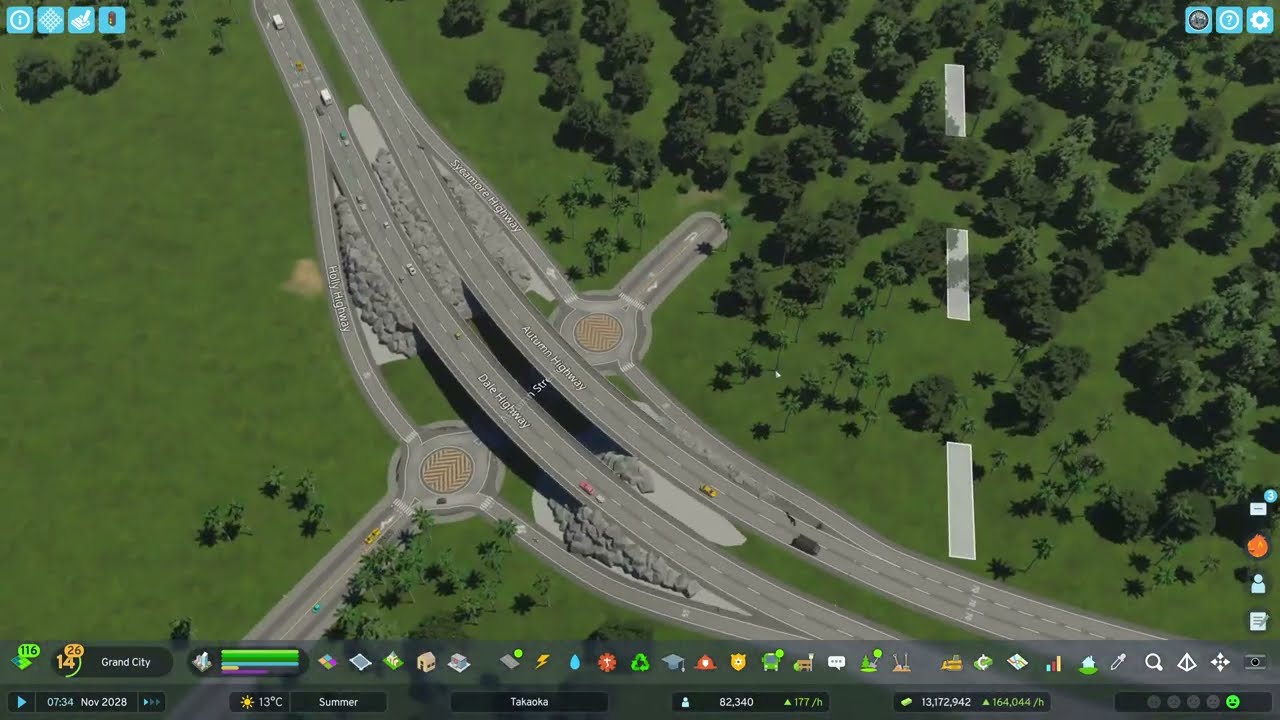
After a game update that shifted demographics, Takaoka gives industry more room: factories placed by hand under bridges and rail lines, a geothermal power plant by the highway that makes the wind turbines redundant, a landscaped hillside for the industrial harbour, a water pollution scare, a rebuilt tunnel, and district policies that keep heavy trucks out of town.
What happens in this episode
A game update had just landed. Other creators had warned it could shift demographics and population, and some services, schools among them, got more expensive. Before the main project, Takaoka needed more jobs, so industry gets room to expand.
How it was built
Industry under the bridges
With Find It, industrial and manufacturing buildings are placed by hand in the spaces under bridges and railway lines, to fill every gap. More offices follow downtown. The happy little medium-density houses will have to make way eventually, because low-rise offices don’t belong in a downtown. Not everything gets concrete: a few trees break it up, and most of the buildings with smoking chimneys are deleted, keeping only one or two.
Geothermal power
The wind turbines were reaching their limit. The resource view shows large groundwater deposits; the best spot, good for about 150 MW, is near the highway. After landscaping, the geothermal power plant goes in, and the wind turbines on the hillside, which did a great job, are retired. The city now produces more than it needs and could even sell power through an outside connection. A wave of hearses followed the population shift from the update, something the simulation should settle over time.
A hillside for the harbour
Removing the wind farm frees space for an industrial harbour. A train line can branch off to it, and the radio mast is moved. A huge harbour on a hill isn’t realistic, so it needs serious landscaping first.
Water pollution and a broken tunnel
While reworking things, I discovered serious water pollution again. Fixing it meant redoing the tunnel I had worked so hard on. Without Anarchy the tunnel broke and cut the city off, so it was rebuilt with bridges in places. It looks different, but it works. Pedestrian crossings and traffic lights go on the industrial roads.
Harbour traffic
All harbour trucks used the only road into the industrial area. Changing the traffic direction helped, as did one-way sections and turning rules. This is where left-hand traffic really confused me, as someone who grew up driving on the right. Setting up the ship route increased cargo ship traffic straight away.
Districts against through traffic
Following a truck’s route showed it running along the coast and straight through town. The fix: districts with a heavy-traffic ban, such as Stirling Beach. After that, far fewer trucks cut through, although some remained. Delivery vans still come into town, as they should. The power is now split between both parts of the city, future-proof for now. The harbour itself is finished in part 2.
Video chapters
- 00:01After the update: more industry
- 04:41Fewer chimneys, more trees
- 09:16Geothermal power replaces the wind farm
- 14:37Water pollution and a rebuilt tunnel
- 19:42Harbour traffic and left-hand driving
- 24:01Decorating the geothermal plant
- 29:01Districts to keep trucks out of town
Clicking a chapter starts the video above at that point.
FAQ
Where should a geothermal power plant go in Cities: Skylines 2?
On a groundwater resource — check the resource view first. In Takaoka the best spot was near the highway, good for about 150 MW, enough to retire all the wind turbines.
How do you stop trucks driving through town?
Create districts for the residential areas and enable the heavy-traffic ban. Trucks then route around them to reach the industry and the harbour.
How do you make industrial areas look less ugly?
Don't cover everything in concrete — add trees in places — and delete some of the buildings with smoking chimneys so only one or two remain.