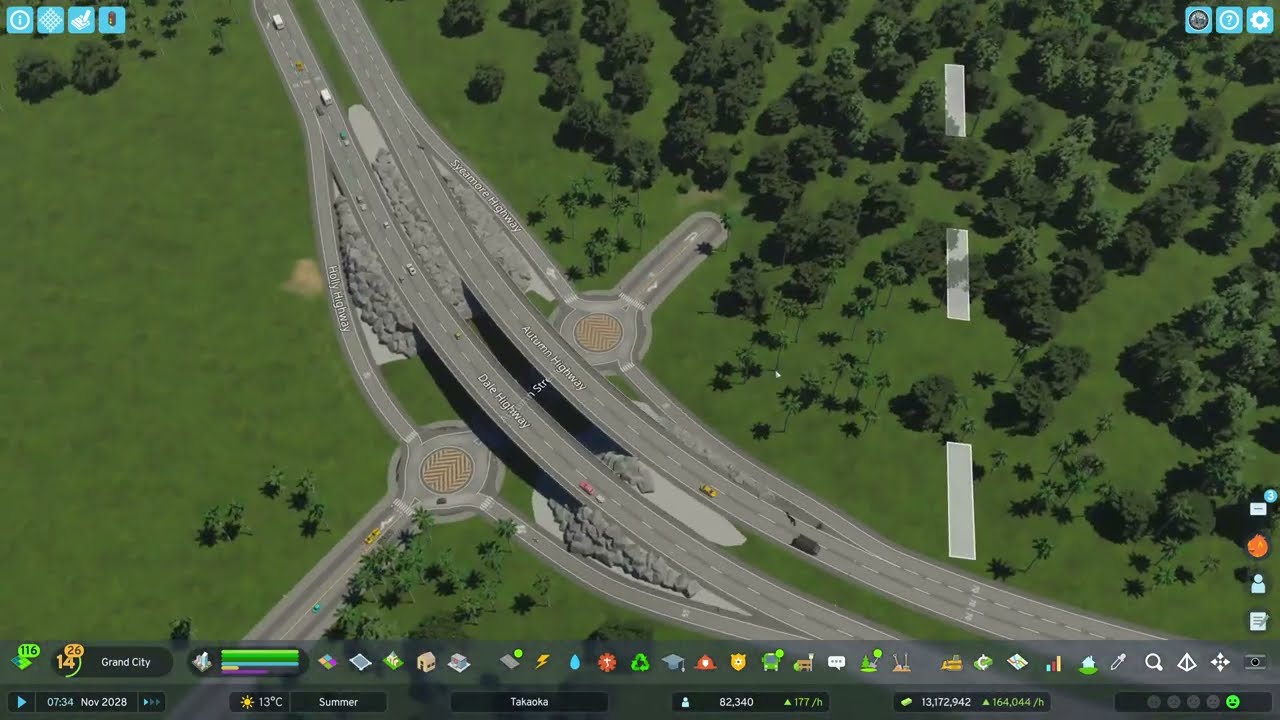
With 27,000 residents and schools far behind demand, Takaoka gets an education overhaul: urban and community elementary schools squeezed into blocks with Move It, the small high school replaced by a modern one with 1,600 seats, a college, a modern university on a hill with its own parking and bus stop, a Japanese welfare office — and the realisation that money has stopped being the challenge.
What happens in this episode
After episode 5, Takaoka has its beach, a decorated rail yard and the first trains to the central station, and 27,000 residents. The budget looks fine. Education doesn’t: elementary schools are far behind demand, and without fixing that now, the city would end up with an education problem that takes years to undo.
How it was built
Elementary schools that fit
The community elementary school is small. The urban one is bigger and goes into a block that held only a few houses and a park, moved closer to the road with Move It, given the urban playground and extended with an extension wing. It also adds a nice spot of colour to the city. That still only covered 1,700 students, so another one went in. One school was a tile too large, so the nodes of Heather Lane were moved slightly and the school was placed with Anarchy.
Replacing the high school
The small high school I picked earlier was a bad choice: about 500 students, plus only 100 per extension wing. The modern high school, fully extended, holds 1,600, which is far more sensible for this city. The old one goes, and the buildings around it are rearranged. After a crash I redid this part: the urban high school and another urban elementary school go in, and Madison Street is replaced by a two-lane road to give the school more space and room for a park.
A community elementary school replaces more houses, and Japanese medium-density buildings fill the rest. When an alley wouldn’t connect, a path fixed it.
A university on the hill
I love the hill above the city, and it’s the perfect spot for a larger university campus. The connection is a weak point, since students have to climb, so a one-way road leads up and an angled parking area at the bottom serves the college. The modern university sits slightly off the grid so more academic buildings can follow, with a university library and extension wings. A technical university, a medical university and large sports parks were unlocked too, and a new bus stop serves the school district.
Welfare office and big service buildings
The Japanese welfare office fits with 50 employees and a through alley. Many service buildings in Cities: Skylines II are so big they actually hurt the city, and moving things around is part of the game. A business had to move to give the citizen service centre access.
When money stops being the challenge
I built a lot of schools, and income still went up. The university costs about 152k a month, yet income jumped again. Financially, the challenge is gone at this stage. It becomes a different game: city planning, meeting demand, decoration. There’s still a lot of fun in that. Old low buildings are demolished for high-density towers and offices. People don’t like it at first, then they appreciate it. I’d love North American mixed-use towers where you can shop and live in one building.
Left-hand traffic still caught me out at times, and the traffic flow made more sense once I adjusted for it. The big mystery at the end: every parking lot is full to the brim, even in the outskirts. That, and districts for local policies, was next on the list.
Video chapters
- 00:0027,000 people and too few schools
- 04:41Why the small high school was a mistake
- 09:09Urban elementary school and a road rework
- 13:38Community elementary and Japanese mid-rises
- 18:16A university on the hill, angled parking
- 23:11Welfare office and service buildings
- 27:13When money stops being the challenge
- 35:51Technical university and a school bus stop
- 52:58Why are all the parking lots full?
Clicking a chapter starts the video above at that point.
FAQ
Which high school has the most capacity in Cities: Skylines 2?
In my build the small high school only took about 500 students (each wing adds 100). The modern high school, fully extended, holds 1,600 — far better for a growing city, so I replaced the small one.
Why are my elementary schools always full?
Because a city needs far more elementary places than you'd expect. Compact urban and community elementary schools, extended to the max, can be squeezed into existing blocks with Move It.
Where should a university go?
Somewhere with room to grow and good access. I put a modern university on a hill slightly off the grid so more academic buildings can follow, with an angled parking area below and a new bus stop.