The rail yard access from episode 4 is rebuilt without its tunnel-like bridges, a second highway connection finally takes traffic off the only entrance, junctions lose their traffic lights, the first residential high-rises appear, the wind turbines run out — and the first passenger train stops at the new central station.
What happens in this episode
Episode 5 of Takaoka starts with a view of the new central station: reserved, but no trains yet. The rail yard from episode 4 is connected to the only highway entrance in an almost bad way. The slope is too steep, and cars pass under several bridges in a row, which feels like a tunnel. The elevated commuter station has to stay, because it will be the key stop for people working in the industrial area.
How it was built
A straight road instead of a tunnel
A speed build reworks the area around the rail yard. A true tunnel didn’t work even with the extended road tools, and in the end it didn’t need to be a bridge or a tunnel at all: a straight road at ground level looks far better. Stones, textures and trees are cleared and redone in the decoration pass at the end.
A second highway connection
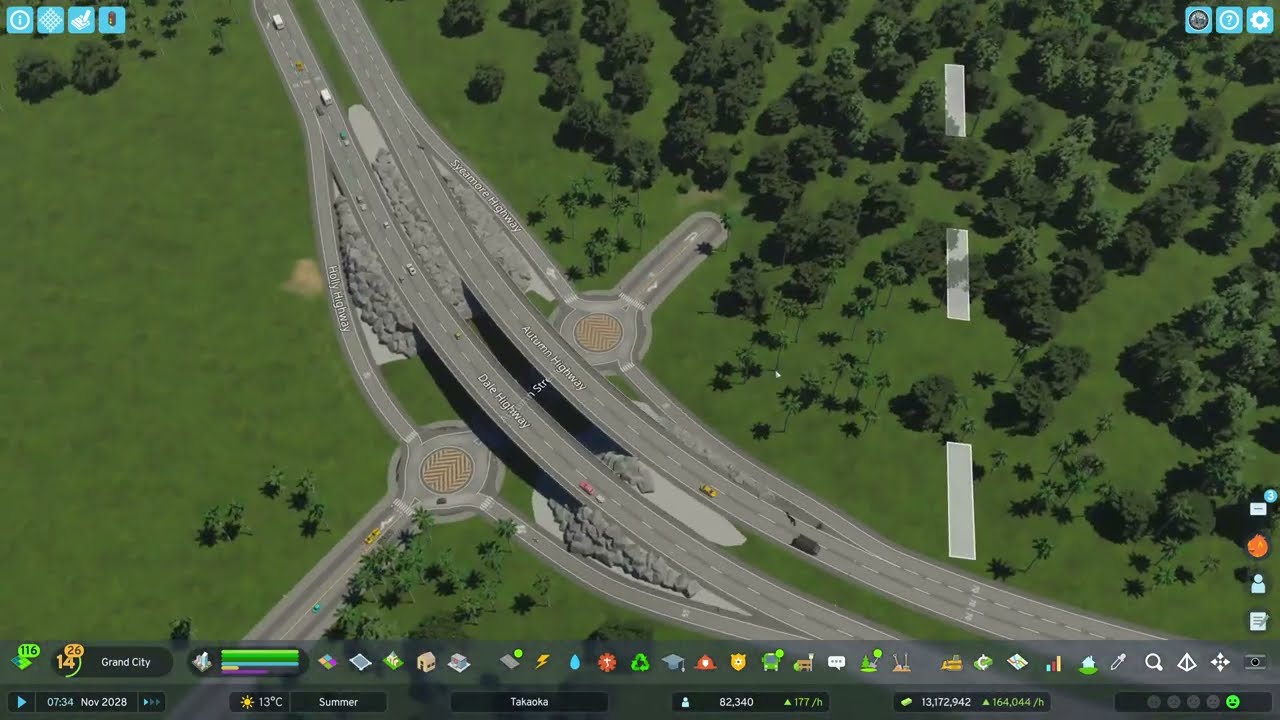
The real fix for traffic is a second highway connection into downtown. There were already merge lanes at a good spot, so the future main arterial comes above ground with a slightly steeper slope and the new link runs underneath it. That alone took a good chunk of traffic off the old entrance. The highway crossing loses its stop signs, traffic lights and pedestrian crossings. Some pedestrians still walked along the highway, probably a glitch or the wrong road type. A two-lane road merges in, dedicated lanes follow, and a bigger roundabout plus removing more traffic lights fixes a new jam.
The first high-rises
The first really tall residential towers appear. It’s becoming a skyline. The foundation for the historic central station, which reminds me a little of Tokyo Station, is linked to the network, and then comes a long decoration pass.
Out of power
Right at the end, the city runs out of electricity. Four wind turbines cost about 7,500–12,000 each per month, around 50,000 in total. A geothermal plant is the obvious next step and could even export energy later. Mailboxes and a radio mast fill coverage gaps. The city stats show too few parks, 30% unemployment, small homes, unreliable internet and polluted water. The pollution would become the big story of the next episodes.
The first train
The stations come back into service and the first passenger line opens. Watching the first train roll into the central station is always a joy: it makes the city feel alive. Few people use it yet, but that will grow with downtown and the industrial area, because people can now commute without a car. A morning bottleneck on a road too small for its traffic gets a quick fix with a second gravel road.
Video chapters
- 00:00What's wrong with the rail yard access
- 12:35A straight road instead of a tunnel
- 16:40A second highway connection
- 21:17Roundabouts and the first high-rises
- 26:07Central station link, decoration speed build
- 63:53Running out of power
- 68:53City stats and the first train
- 73:58A morning bottleneck, a quick fix
Clicking a chapter starts the video above at that point.
FAQ
How do you add a second highway connection in Cities: Skylines 2?
Find a spot where merge lanes already exist, bring the arterial above ground with a slightly steeper slope so the new link can pass underneath, then remove traffic lights and pedestrian crossings at the ramps and add dedicated lanes.
Are wind turbines expensive in Cities: Skylines 2?
They add up. In Takaoka four turbines cost around 40,000–50,000 a month in upkeep. A geothermal plant costs more to build but becomes the better long-term option for a growing city.
Why does a new train line have few passengers at first?
People take time to change habits. Ridership grows as the districts around the stations — here downtown and the industrial area — grow.