Takaoka's second episode keeps the island profitable while the basics go in: wind turbines upgraded with batteries plus solar panels, a Japanese water purification plant on a quay, chicken and crop farms in the hills, police, clinics and a recycling centre, two roundabouts that clear a jammed junction, custom industrial parking and evenly built row houses using 'zebra' zoning.
What happens in this episode
After the first episode, Takaoka has a road layout, some houses and industry, and it’s already profitable. Episode 2 takes care of the basics before anything bigger. The railway was the plan, but the episode got pulled into other things, so it arrives in episode 4.
How it was built
More power from packed wind turbines
Electricity was on the brink. The turbines stand so close together that the game won’t let you upgrade them, so Anarchy places the battery extension anyway. Each one added about 4 MW. Solar panels add a little more, staying with renewables.
Farms in the hills
The natural resources view, switched to land fertility only, shows good farmland up in the hills. Chicken farms don’t need fertile land, so they go on the poorer soil. A small road with a bridge off a 90-degree junction connects the farms to water and power.
A Japanese water purification plant
For clean water I compared the Japanese and North American purification plants. Same price, but the Japanese one looked better. The land is flattened, a quay wall is built on the water side, and the sea level is pulled back up to it with the landscaping tool and softened so it looks natural. Industry next to the water always looks good to me, and palm trees don’t belong in an industrial area.
Filling demand
The statistics show many uneducated residents and no offices yet, so some office lots go in. A mix of medium density, low-rent housing and low-density homes eases the high-density demand. A few small industries and low-rent homes for farm workers go on levelled ground near the farms. Industry on slopes rarely works well. The wind blows the bad air away from them.
The first development point goes to trains, for later. Then police: a small Japanese police station. Garbage was piling up, a fire broke out, and a second clinic in another part of town spread the medical coverage.
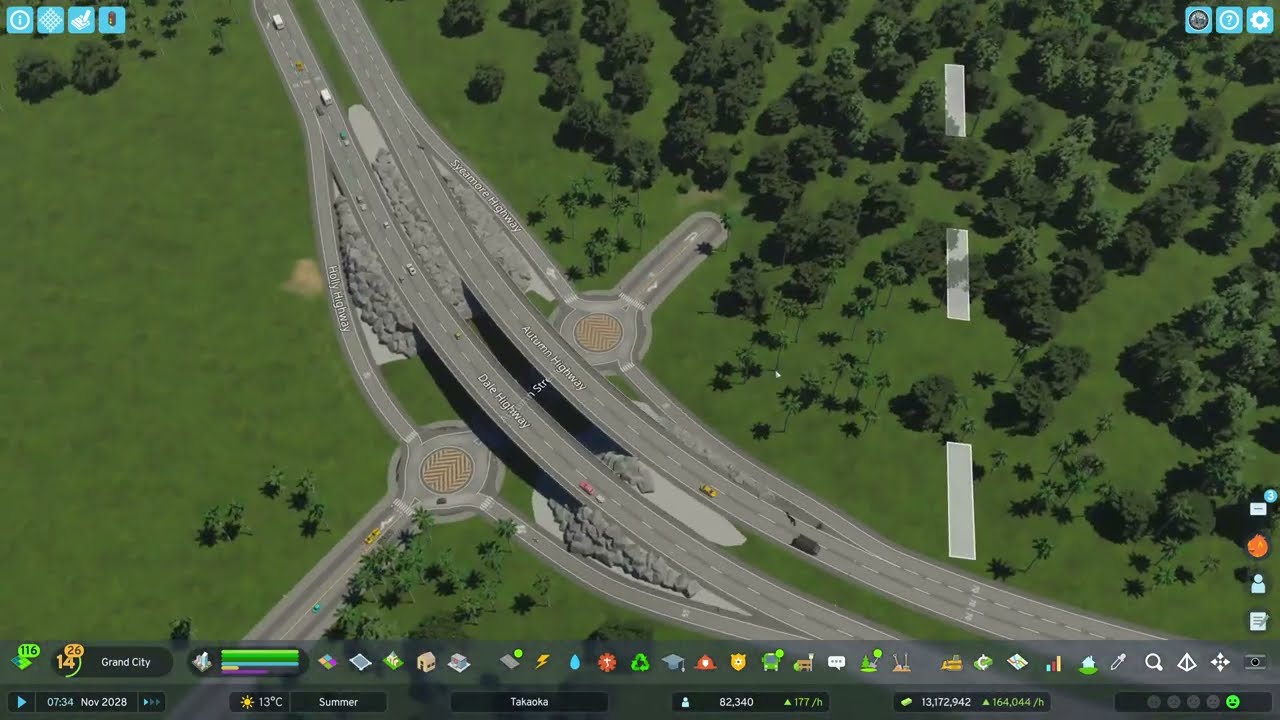
Two roundabouts
One crossing was jammed by everyone driving in and out of town. Unlocking roundabouts and replacing the junction with two of them cleared it almost instantly. Sometimes two roundabouts are the answer to heavy traffic.
Custom parking in the industrial area
The industrial district needed parking. A small lot fits after moving a road node with Move It, and Find It turns up concrete surfaces (“surface 2”) for the ground underneath. Fences and boxes that ran through the lot go, a few dump sites are added, and street parking eased straight away.
Cul-de-sacs and zebra zoning
Light landscaping makes room for some side roads, as a developer would grade the land. The cul-de-sacs, now officially in the game, make a nice difference in these areas. For row houses I use what I call zebra zoning: decide the final row length, then zone thin stripes with gaps in between, so the houses build evenly instead of in random lengths.
Boomtown arrives, and the recycling centre (the Japanese one is the smaller) goes in. I wasn’t sure it would solve the garbage problem. School and service buildings still take a lot of space, the only real challenge here. Residential growth was slow, probably because the city needed more jobs.
Video chapters
- 00:00Upgrading tightly packed wind turbines
- 04:43Farms and a Japanese purification plant
- 09:14Quays, curves and education stats
- 13:28Density mix, offices and small industries
- 17:55Police, garbage and Level 5
- 22:03Two roundabouts fix the traffic
- 27:07Custom industrial parking with surfaces
- 36:08Cul-de-sacs and 'zebra' row-house zoning
- 40:50Boomtown and the recycling centre
Clicking a chapter starts the video above at that point.
FAQ
Why can't I upgrade my wind turbines in Cities: Skylines 2?
If you place them very close together, the upgrade (the battery extension) has no room. Anarchy lets you add it anyway — each upgrade added about 4 MW here.
Do chicken farms need fertile land?
No. Chicken farms (and stone quarries) work without fertile land, so put them on the poor soil and keep the fertile land for crops.
How do you get row houses to build evenly?
Use 'zebra' zoning: decide the final row length, then zone thin stripes with small gaps between them. The row houses fill each stripe evenly instead of spawning in odd lengths.