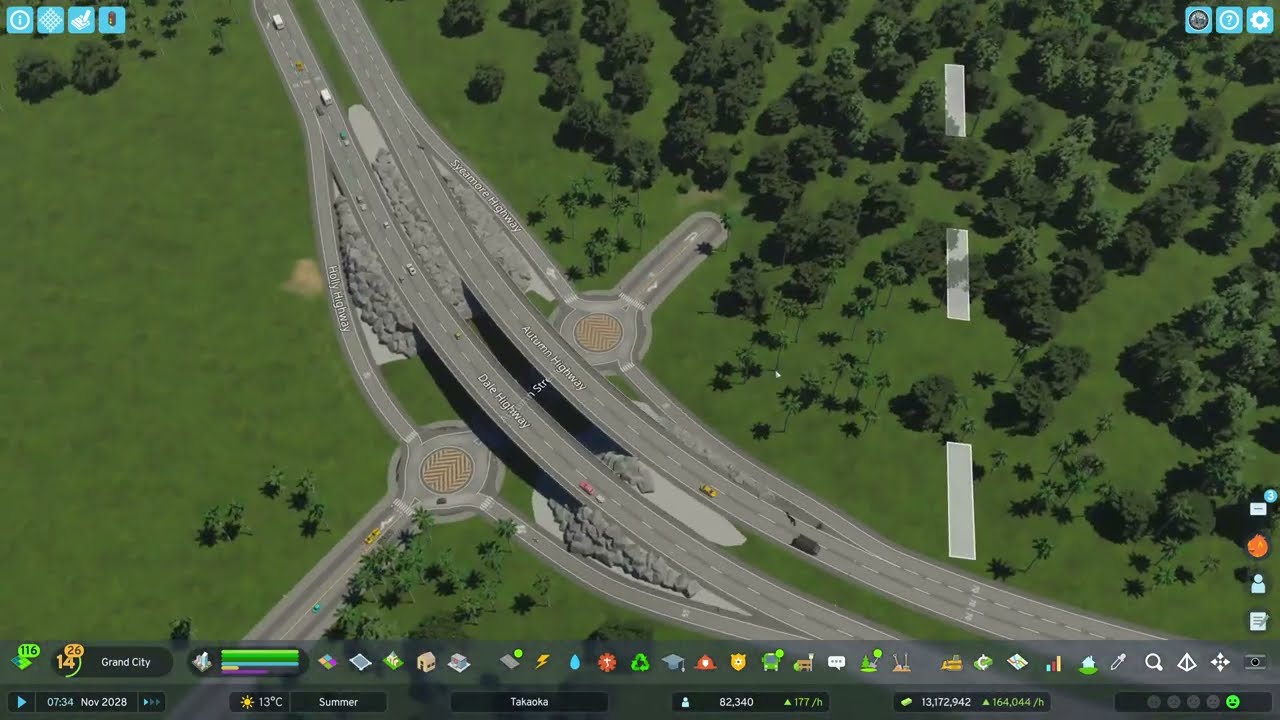
With funds running low, Takaoka grows carefully: the first Japanese houses and shops placed with Find It, a bus depot and three bus lines kept off the big roads, tree-lined arterials without street parking, lower residential taxes, a post office with mailboxes, a high school and a second elementary school — towards 10,000 residents and Busy Town.
What happens in this episode
Takaoka is growing, with bigger houses, an industrial area next to the wind turbines and two connections from the highway, but money is tight. I wanted to start public transport, and there was barely enough to do it. Level 6 had just unlocked trains, but the budget came first.
How it was built
The first Japanese buildings
Farm workers need homes close to their jobs, so the farming area gets a few more houses, including the first Japanese ones, filtered in Find It (3×2 and similar). I love the Japan region pack, though I’d hoped for more high-rises in it. Commercial demand was high, so a row of Japanese shops goes in with the marquee tool. What matters is the depth of the lot rather than the width, and Move It keeps them connected to the road. Pedestrian paths help realign building sites for a few low-density offices.
Can we afford buses?
A bus depot costs 150k plus 31k upkeep per month. Raising taxes on commercial, industry and offices (not on residents) brings in about 10k more per month, enough to afford it. The depot goes on the far side of the river near the future rail yard, at the end of a cul-de-sac, placed with Anarchy, and a taxi depot follows. A small grid of 80 × 200 m blocks keeps part of the area strictly residential, and another roundabout fixes a junction too close to a bridge. Slopes close to junctions can wreck traffic.
Tree-lined arterials without parking
Highland Street and the arterials get trees on both sides with the road services tool, and parking is disallowed. People should use the parking lots.
Three bus lines
In Japan you wouldn’t put bus stops right on the big roads, so they sit on side streets with good access to the arterials. People will walk a bit. I’m always tempted to build many bus lines, but it’s better not to overdo it. Three lines, including one collector, are enough to start.
Taxes, parks and demand
Industry wasn’t filling despite available jobs, because taxes were too high. Residential tax comes down too: residents couldn’t afford 11% yet. Mini parks give people recreation. Low-rent housing and UK high-density buildings take some demand, and the wind turbines and water supply get their last upgrades before new sources are needed.
Busy Town: post and schools
Milestone 7 brings 15 development points: highways and large roads, college, the post sorting route. A small post office, squeezed in with Move It, plus mailboxes spread across town, including the industrial and farming areas, keeps everyone connected. The small modern high school goes in with its upgrade straight away. A stone quarry fills an empty industrial plot, which makes industry more interesting to look at, and concrete covers the grass between industrial buildings.
The most important lesson: build elementary schools early. Education is slow, and if children don’t get in early, you end up with too many uneducated adults, and offices can’t find staff for a long time. A second elementary school goes in.
A downtown corner and vending machines
Low-rent towers replace some small homes, because people don’t earn enough yet, and some buildings are placed by hand along the street fronts. One nice touch: vending machines, which in Japan are everywhere, in every small alley, and cost hardly more than in a shop. A building with a lovely overhang turned out to be a non-functional plopable, so it went again. Demand came back, and the railway was next on the list for episode 4.
Video chapters
- 00:00Low funds, two ways forward
- 04:32Japanese homes and shops with Find It
- 08:53Can we afford a bus depot?
- 13:17No street parking, a taxi depot
- 17:48Three bus lines, stops off the main roads
- 26:31Taxes, parks and demand
- 35:35Busy Town and the post office
- 40:16High school, stone mining as filler
- 54:26Why elementary schools come early
- 63:25Vending machines and a downtown corner
Clicking a chapter starts the video above at that point.
FAQ
How many bus lines should you start with in Cities: Skylines 2?
Fewer than you think. It's tempting to build lots of lines, but a few well-placed ones — here three, including one collector line — work better. Keep bus stops off the big arterials; people will walk a little.
Why build elementary schools early?
Education is slow. If children don't get into elementary school early, you end up with too many uneducated adults, and offices and high-skill industry can't find workers for a long time.
How do you stop street parking along an arterial?
Use the road services to disallow parking, and plant trees along both sides with the road tree tool. Drivers move to parking lots and traffic flows better.