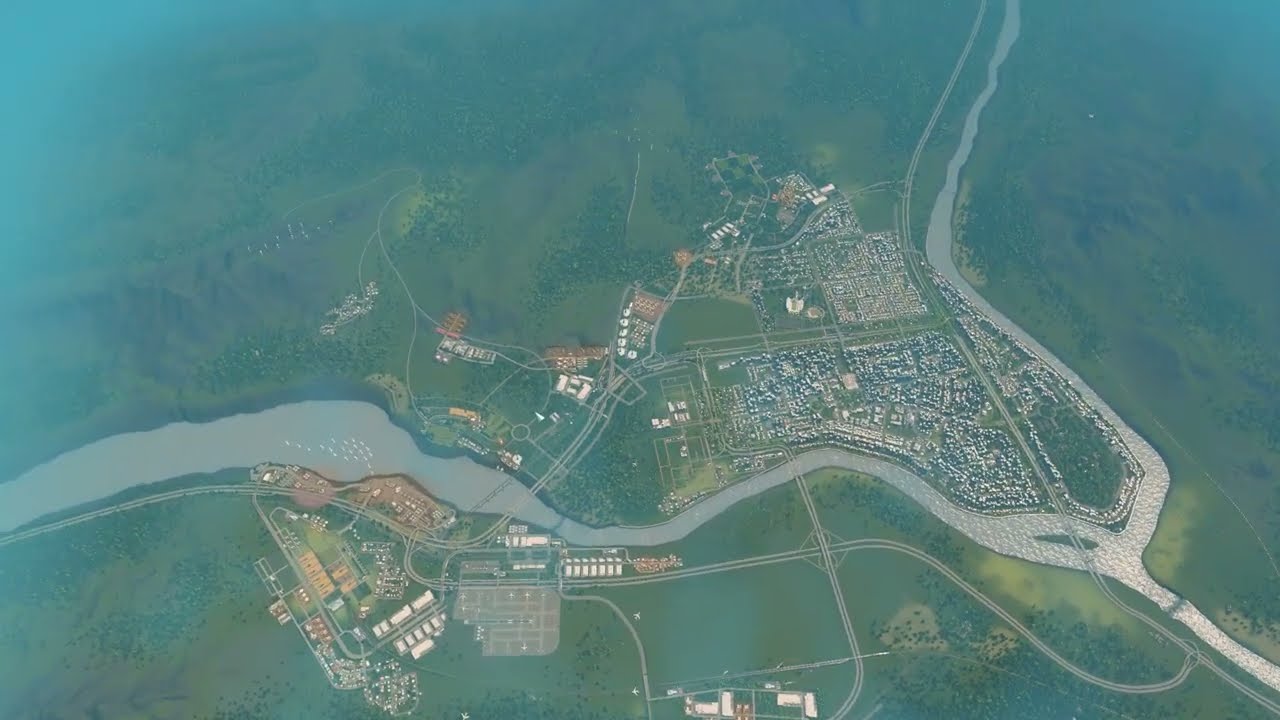
Springvalley's farm still jams, so I start over. First I add the 25 Tiles mod and buy every tile, because 81 tiles goes too far against the original game for me. Then the farm district is replanned around one idea: raw material production in one area, storage in another, processing in a third, plus transport. Storage gets its own highway ramp, a big ring road ties it together, dirt roads split the fields, processing gets its own district and the water network is rebuilt. The district is twice the size, and traffic is far better.
What happens in this episode
After Episode 21 the farm district still had a lot of traffic, and the test roundabout looked wrong for a farming area. So I replan most of it. This is an episode with speed-ups in the middle and commentary in between.
How it was built
25 tiles
The unmodded game stops at nine tiles. The 81 Tiles mod goes so far against what Cities: Skylines was meant to be that I chose the 25 Tiles mod as a middle ground. With 4.8 million in the bank I bought every tile at once. (In Westfield I went all the way to 81.) Cities: Skylines II has achievements for 50 and 150 tiles, which is massive. My big dream is to rebuild part of Tokyo one day, though even Osaka or Kyoto might not fit.
One function per area
The new concept:
- raw materials production (fields, pastures) in one area;
- storage (silos, warehouses) in another;
- processing (mills, dairy, slaughterhouse, bakery) in a third;
- transport: highway ramps and cargo rail on two sides.
Storage moves completely and gets its own on and off ramp. A much bigger roundabout and a four-lane industrial ring road connect everything.
Fields and dirt roads
Fields are realigned along single dirt roads, with two separate production areas and room to grow on purpose. The farm main building and maintenance building move. Trees and bushes are deleted for now. A second train station connects to the existing network, and the area gets a fire station.
Processing gets its own district
Mills, dairy and the rest move into a new processing district, separated by another dirt road and spaced out because I couldn’t remember where flour mills have their entrances. I deleted a lot of generic industrial buildings, which hurts income because they earn far more than the farm. I kept three grain silos so farmers don’t drive too far.
Rebuilding the networks
I rebuild power and the water network from the pumps to fit the new layout. It’s expensive, but there’s enough money. Then comes lane management: no traffic lights in an industrial district, plus the highway lanes for the three new ramps. Two nodes that were far too close together caused a glitch. A police station covers the countryside.
The result
Separating traffic really helps: trucks enter and leave the area on their own routes. The district is almost twice the size, but traffic is far better than before. If something in your city needs rebuilding, go for it. It’s worth it.
Video chapters
- 00:00Still jammed, and the 25 Tiles mod
- 04:04Tile counts and dreaming of Tokyo
- 13:12Storage moved, a ring road built
- 17:16Production, storage, processing
- 22:00A second train station
- 27:44Processing in its own district
- 32:40Rebuilding power and water
- 37:59Lane management on three new ramps
- 42:22A police station for the countryside
- 47:11Separating traffic flows
- 52:38Twice the size, far better traffic
Clicking a chapter starts the video above at that point.
FAQ
How should you lay out a farming industry in Cities Skylines?
Split it by function: raw material production (fields and pastures) in one area, storage (silos and warehouses) in another, processing (mills, dairy, bakery) in a third, with direct links to the highway and cargo rail.
25 Tiles or 81 Tiles mod?
The base game allows 9 tiles. I chose 25 Tiles as a middle ground, because 81 tiles felt too far from what the game was designed for. In Westfield I did use 81 tiles.
Does deleting generic industry hurt income?
It can. Generic industrial buildings earn a lot compared with a farm alone, so watch the budget and reinvest when you replace them.