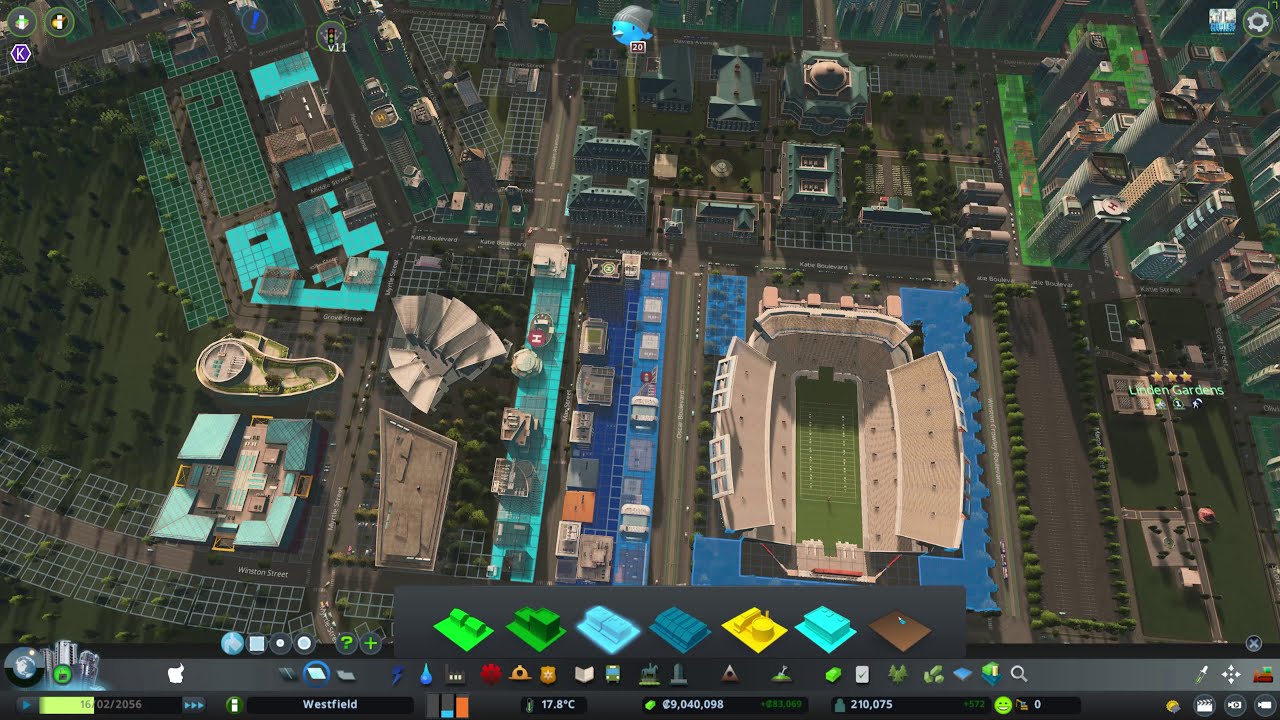
With Realistic Population Revisited and Lifecycle Rebalance Revisited set up (households per building counted from floors and balconies), Westfield jumps from 58,000 to 80,000 and reaches Megalopolis. Understaffed shops sort themselves out, a whole block of new tiles is bought, and the flood of incoming traffic forces a rebuild of the old national-road junction into a highway interchange.
What happens in this episode
Last time I installed Realistic Population Revisited together with Lifecycle Rebalance Revisited. You don’t need the second mod if you start a city with Realistic Population, but when you add it to an existing city it’s highly recommended. The mod changes how many households a residential building holds and how many jobs a commercial building offers. A building that showed one household before can now show 76.
How it was built
Realistic households
I went through every residential building in the game and set the number of homes based on floors and balconies, as realistically as I could. Shops, offices and industry stay on defaults for now, and eco low-rise buildings still need checking. The tutorial shows what I changed. The whole area showed about 58,000 citizens, far too few for this many high-rises.
80,000 and Megalopolis
After a few minutes Westfield jumped from 58,000 to 80,000 and reached Megalopolis, the highest level as far as I know. The understaffed shops sorted themselves out as more people moved in, so no businesses were abandoned. With plenty of money, a whole block of tiles was bought for the coming episodes. I use the 81 Tiles mod, but I still buy the tiles instead of just unlocking them. One new tile came with a maze and a ruined theatre.
A traffic flood
All the new residents meant a flood of incoming traffic: the highway and roundabout were packed. Some zones get de-zoned, a park moves, the roundabout is removed, and the old national-road junction is rebuilt as a proper highway interchange serving both parts of the city. Trees planted in the middle of the road came out, and slopes were adjusted. Noise matters too: where I live, a natural sound barrier along a highway makes a real difference.
Still packed
The interchange isn’t perfect yet. The ramps were used less than I’d hoped, U-turns were banned, and some lanes were cut to one. The real missing piece is public transport. I wanted to start it this episode, but it’ll have to wait for the next one.
Video chapters
- 00:00Households per building, made realistic
- 03:0958,000 felt too few
- 06:1780,000 and Megalopolis
- 10:25New tiles — and a traffic flood
- 13:59De-zoning for a new junction
- 20:42Ramps, slopes and trees in the way
- 24:35The new highway interchange
- 29:37Still packed: public transport next
Clicking a chapter starts the video above at that point.
FAQ
Do I need Lifecycle Rebalance with Realistic Population?
If you add Realistic Population Revisited to an existing city, using Lifecycle Rebalance Revisited alongside it is highly recommended. Starting a new city with it, you don't need to.
How did you set realistic household numbers?
I went through the game's residential buildings and set the number of homes from their floors and balconies. Shops, offices and industry stayed on their defaults for now.
What happens to traffic when population jumps?
It floods in. Westfield went from 58,000 to 80,000 and the incoming highway and roundabout jammed, so the main junction had to be rebuilt as a highway interchange.