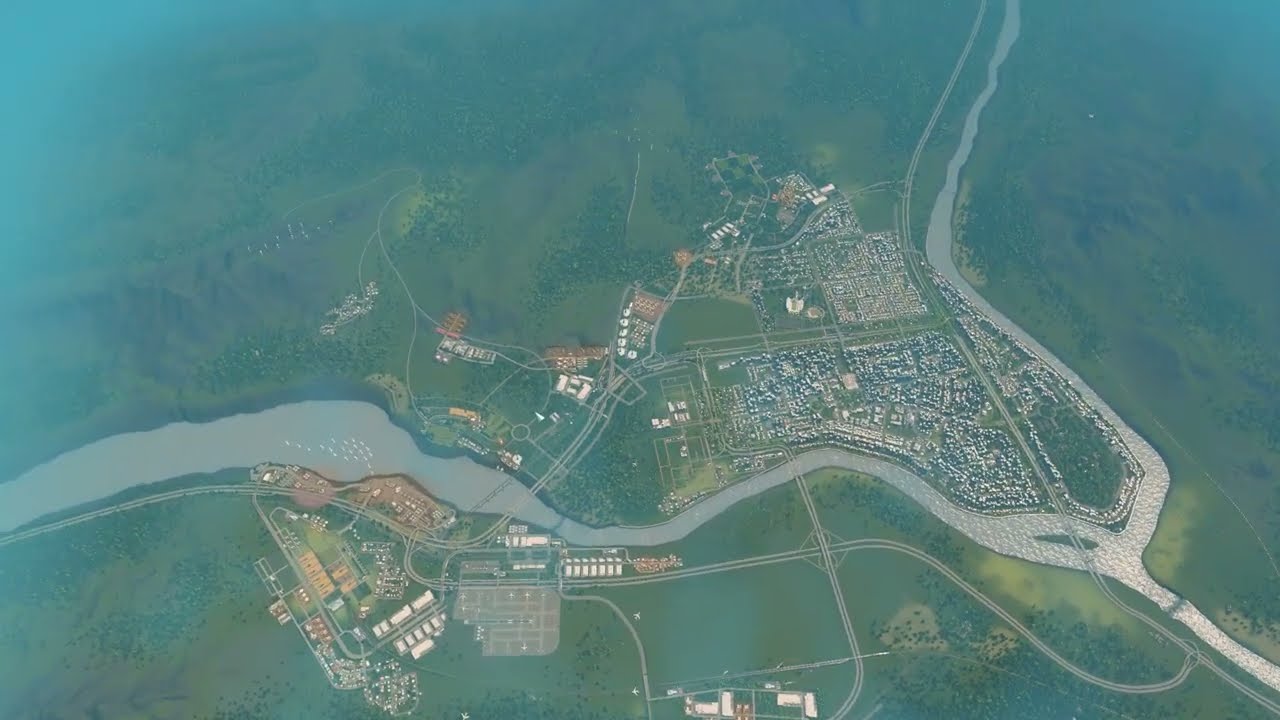
Springvalley upgrades its highway to sound-barrier versions, removes pointless traffic signs on the highway, and replaces the space-hungry standard interchange with a compact self-built one that uses an underpass and longer slopes. Heather Gardens is extended with my usual park pattern, a new neighbourhood tries a non-grid layout with only three entrances, and an office park with IT cluster and financial specialisations fills the last square.
What happens in this episode
Episode 14 added banks, which boosted commerce, and a slowly growing new district. Now I want to rebuild the main interchange and add greenery so people aren’t bothered by the noise.
How it was built
Sound barriers
The three-lane highway is upgraded to the version with sound barriers, another way to block traffic noise from homes. Lane management had to be redone with a two-lane section. I also found traffic signs on the highway, which makes no sense, so they came out.
A compact interchange
I don’t like how the game’s standard interchange looks or works, so it’s demolished. I sketch with regular roads, then upgrade them to sound-barrier ramps. The result is more compact, using an underpass that you don’t see often but saves space. Slopes are made longer so traffic doesn’t slow down too much, and the nodes are levelled smoothly. Lane counts go one into two into three.
Heather Gardens
The park borders are laid out with a line tool, and Heather Gardens grows as big as possible for the homes around it. This time the two parks are connected so people can walk from one to the next. The amenities may look random, but they follow a pattern I’ve learned to grow parks to two, three or four stars: cafés, restrooms, an info booth next to the gate, a small baseball field and sparse trees.
A different neighbourhood
There may be too many buses now, but Springvalley passed 30,000 last episode. A new neighbourhood breaks my usual pattern with only three entrances. That might cause trouble if it gets busy, but I’m not afraid of re-planning. Same in real life.
An office park
The last empty square becomes an office park, with an IT cluster and a financial district (Rose Heights). The IT towers are huge, and the financial offices are smaller. Residential demand dropped, so more child and elder care went in, plus trees, a helicopter depot, police headquarters and fire towers. A prison isn’t needed yet. This is mostly vanilla Cities: Skylines with a few DLCs, and it keeps me going. Give it time and it never ends.
Video chapters
- 00:00Sound barriers on the highway
- 03:41Demolishing the standard interchange
- 08:39Upgrading roads, longer slopes, an underpass
- 12:22Heather Gardens
- 15:42My park pattern for star levels
- 19:44A neighbourhood with three entrances
- 23:24IT cluster and financial offices
- 27:08Services and wrap-up
Clicking a chapter starts the video above at that point.
FAQ
Why not use the standard interchanges in Cities: Skylines?
They take a lot of space and look the same everywhere. A self-built one can be more compact — mine uses an underpass — and lets you control lanes.
Why make highway slopes longer?
Longer slopes stop traffic slowing down too much on ramps.
Are financial office districts different from IT clusters?
Yes — IT cluster buildings are high-tech towers, while financial offices are smaller. Both are office specialisations for a district.