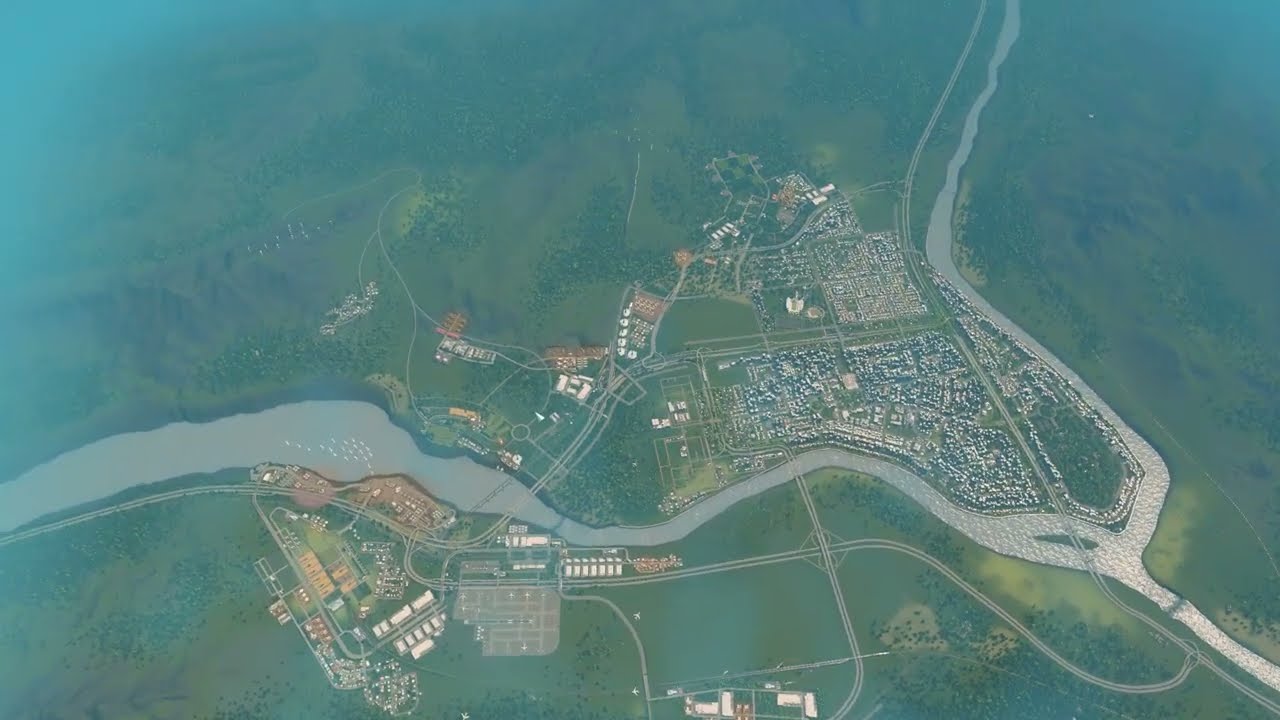
A glitchy pedestrian construction is swapped for a simple underpass. The college grows with the School of Engineering, a med lab and more, banks arrive as a new city service, disaster response, radio masts, earthquake sensors and shelters are added, an intercity bus terminal follows a viewer's tip, and a deliberately less grid-like district, Manor Hills, mixes homes, shops and offices — while an accidental city-wide policy costs money.
What happens in this episode
The pedestrian construction from episode 13 looked nice but caused a visual glitch, with stray tiles left behind. Don’t build something like that. A simple underpass under the ramps does the job much better for pedestrians and cyclists.
How it was built
A bigger college
The college gets most of its remaining buildings: the School of Engineering, the biggest, a trade school med lab and more, with paths rearranged and buildings moved with Move It. Some bigger buildings simply didn’t fit. A dead-end road removes another crossing from the north-south arterial while still letting pedestrians through.
Schools and banks
A big fire station, schools along the dead-end road, a library and a high school. Banks are a new city service. Small banks have a limited reach, so larger ones were placed along the commercial zones, near the IT area.
Disaster readiness
A disaster response unit, tall radio masts to warn people, earthquake sensors hidden between highways, a weather radar and large emergency shelters. Disasters are off, but it makes the city more realistic. A viewer suggested an intercity bus terminal, so one went in near the highway, which also gives the nearby bus station a reason to exist.
Manor Hills
The interchange is smoothed with Move It, and a new district deliberately breaks up the grid a little, with few crossings on the arterials and an empty square for a future park. The more the city grows, the harder it is to fix traffic, so I’m being patient. Manor Hills gets recreational use and water policies. Is a long commercial strip along an arterial helpful? I’m not sure, so it’s mostly residential for now. Changing things later is part of learning.
An expensive mistake
I was suddenly losing 13,000 a week. I had applied policies (heavy traffic ban, encouraged biking) to the whole city instead of the district. Once fixed, a mix of offices, shops and homes and fewer traffic lights kept people coming. The college got grants, crematoriums were added, and the city nears 30,000. One day the industry will move to the outskirts and this will be the core of a metropolis.
Video chapters
- 00:00A glitchy walkway becomes an underpass
- 04:24School of Engineering and a med lab
- 08:55Schools, libraries and banks
- 12:59Disaster readiness and an intercity bus terminal
- 17:31Smoothing the interchange
- 21:44Breaking up the grid: Manor Hills
- 26:37An expensive policy mistake
- 30:40Mixed zoning and fewer traffic lights
- 34:50College funding and crematoriums
Clicking a chapter starts the video above at that point.
FAQ
What do banks do in Cities: Skylines?
Banks are a city service for commercial areas, collecting cash via transport vans. Larger bank types cover more businesses.
Why add disaster buildings without disasters on?
Radio masts, earthquake sensors and shelters make citizens feel safer and the city more realistic, even if disasters are off.
Why break up a grid?
A slightly irregular layout with fewer crossings on the arterials keeps traffic manageable as the city grows and looks less planned.