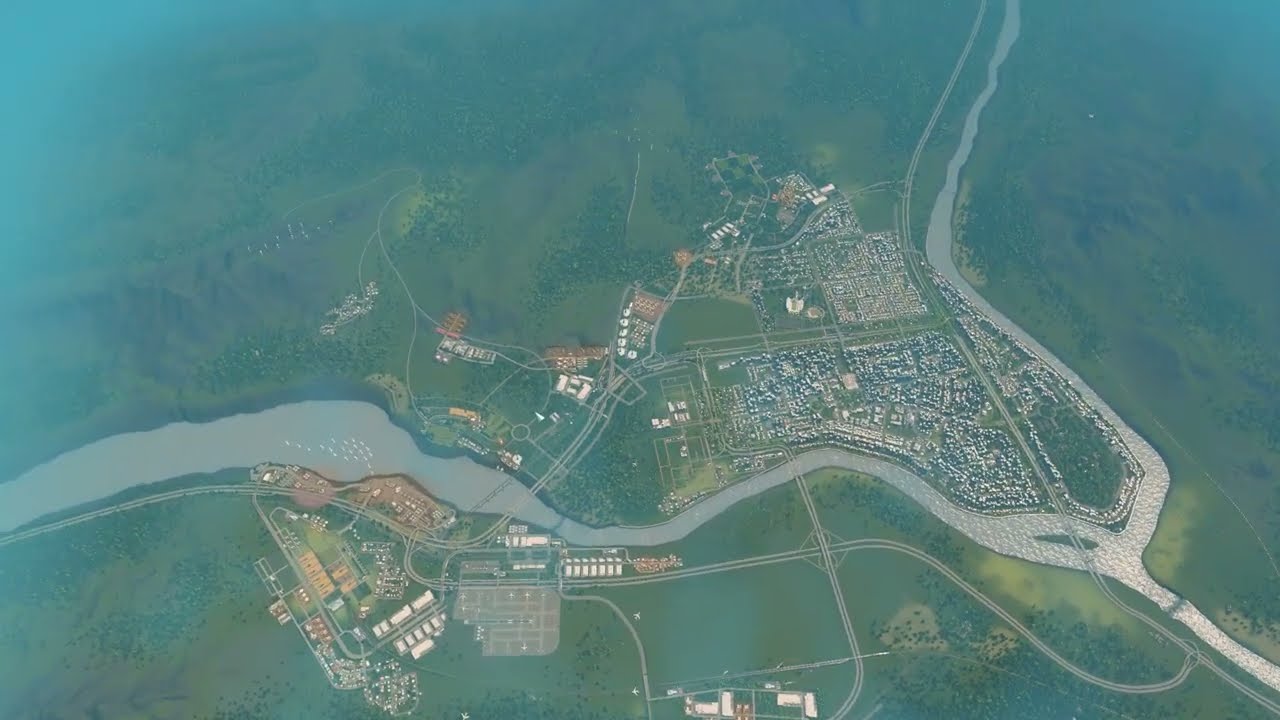
With crematoriums running, Springvalley removes its graveyards, turns side streets into dead ends to spare the arterials, plans an IT cluster and a bigger college, replaces all oil power plants with three solar updraft towers, swaps small water towers for five big ones, and builds Victoria Park and Elm Park along the highway as a tree-lined noise barrier with a pedestrian overpass. Traffic sits at 79%.
What happens in this episode
The library bus line from episode 12 worked: before, crowds walked out of the library and pulled out their “pocket cars”, jamming the roads. The new roundabout has pedestrian overpasses, there’s a new highway connection in the north, and the crematoriums are running, so the empty graveyards can finally go.
How it was built
More room, fewer crossings
With the graveyards removed, commercial strips get more room. A new road heads north without ramps, ready for future districts, smoothed with Node Controller. Some roads were downgraded again, and side streets became dead ends. Crossings put stress on arterial roads, so I’ll avoid them as long as I can.
Offices and the college
Using a surface painting mod, pavement goes where it looks better. New office zones, an IT cluster, homes, one empty square saved for future services, and the second part of the college area pre-planned with an overpass path. This college will be massive one day.
Solar power and big water towers
Solar updraft towers unlocked. They’re expensive, but produce a lot with zero pollution. Three replace all the oil power plants. They’ll have to move out of the centre one day. Eight small water towers went, replaced by five big ones (160,000 m³ each; I needed three, and I want headroom). More recycling centres cover the waste, and the college gets IT and engineering research funding.
Parks against highway noise
Noise from the intersection was high. Two parks, Victoria Park and Elm Park, go along the highway with a line of big trees placed with a line tool, with spacing, size and rotation varied, as a natural noise barrier. Paths use S-curves to feel natural, and a pedestrian overpass links them so people from the future district across the highway can come over. People used it quickly. Each park gets two cafés, restrooms, four gazebos and a climbing frame. Traffic is at about 79%.
A bamboo business plaza
A square in the business area is painted with concrete tiles and planted with single bamboos, so it looks like a planned business park.
Video chapters
- 00:00Recap: the library bus lines worked
- 04:27Graveyards out, commercial strips in
- 08:52A link north without ramps
- 13:25Dead-end streets to spare the arterials
- 17:53Painting surfaces, offices and an IT cluster
- 22:37Solar updraft towers replace oil
- 26:41Bigger water towers and recycling
- 31:07Parks as a highway noise barrier
- 35:09A pedestrian overpass between the parks
- 43:53A bamboo business plaza
Clicking a chapter starts the video above at that point.
FAQ
Are solar updraft towers worth it in Cities: Skylines?
They're expensive but produce lots of power with zero pollution — three of them replaced all of Springvalley's oil plants.
Why turn side streets into dead ends?
Every crossing on an arterial road adds stress. Dead-end side streets keep access to homes and shops while removing intersections from the main roads.
Can parks work as a noise barrier?
Yes. A park strip with a dense line of tall trees between a highway and homes keeps the noise away and gives residents easy access to green space.