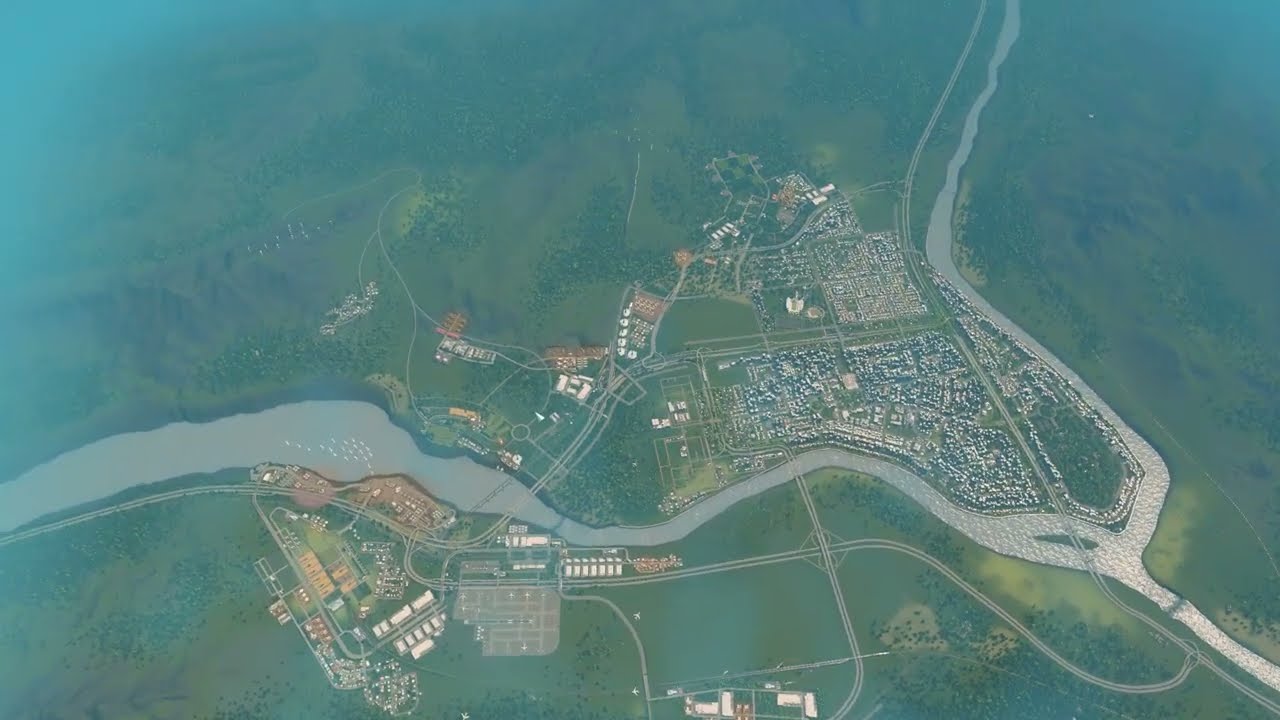
More than a year and a half after my last Let's Play, and with Cities: Skylines II announced, I start one last Cities: Skylines 1 city: Springvalley on the Riverrun map, which has two incoming highways. Gravel roads on a 240 m grid, overpasses raised four steps, water pipes under the streets, a coal plant out of the way, the first citizen's home made historic, and the first park.
What happens in this episode
It’s been more than a year and a half since my last Let’s Play series. Cities: Skylines II was announced a few weeks ago, and I’m very excited about it. Before it comes out, I wanted one last city in Cities: Skylines 1 to get back into the game. I picked up the DLCs I was missing at a discount, and I’m using the Load Order Tool, which I learned about from Biffa, plus recording mods and the standard gameplay mods I’d recommend to everyone.
How it was built
Riverrun and a new setup
Of the built-in maps, I chose Riverrun and called the city Springvalley. The map is interesting because it has two incoming highways. I’ve also changed my setup: new recording software (Bandicam), a new microphone and some hardware upgrades. Let me know if it sounds better.
Overpasses and the grid
The diamond interchanges that come with the game aren’t great for traffic, so the plan is a highway-style artery into town. I start with gravel roads. Overpasses go up four steps, not three, so the bridge clears the lamp posts below, and the slope runs out as far as possible (usually 12 steps). The grid is laid out in 240 m units, which makes construction costs easy to estimate. Service roads give room for things like waste management away from homes.
Water, power and the first citizen
The coal plant goes at the farthest possible spot, plus an inland water treatment plant and a water tower. Water pipes follow the roads: if pipes ran under houses, the council would have to tear homes down for every repair. The first car to arrive belonged to Taylor Peters, so his house became a historic building, and the main road is now Taylor Peters Highway, with priority.
Services
At 900 citizens, a medical clinic came first, then fire stations (one for the industrial zone too) and police once the money allowed. Power ran short, so budgets went to 100%, and later a second plant. The water near the outlet was polluted, which should improve over time.
Evergreen Grounds
The first park, Evergreen Grounds, is the start of what I hope will become a very green city. Education was next on the list. Some favourite shops (a bookstore, a gas station) were made historic so they keep their look. People walk to work and to the shops.
Video chapters
- 00:00Why one more CS1 city
- 04:09Riverrun and a new recording setup
- 08:51Overpasses four steps high
- 13:08The basic grid and service roads
- 17:23Water under the streets and first zones
- 22:00The first citizen and power
- 26:31Clinic, fire and police
- 35:56Water quality and Evergreen Grounds
- 40:50Historic shops and wrap-up
Clicking a chapter starts the video above at that point.
FAQ
Why raise overpasses four steps instead of three?
With four steps the bridge clears the lamp posts on the road below, which looks more realistic, and I run the slope out as far as possible — usually 12 steps.
Why lay water pipes under the streets?
Real cities put water mains under roads they can maintain easily. Laying them under houses would mean tearing down homes for every repair.
Can you protect a building's look in Cities: Skylines?
Mark it as a historical building. It then won't level up and change its appearance.