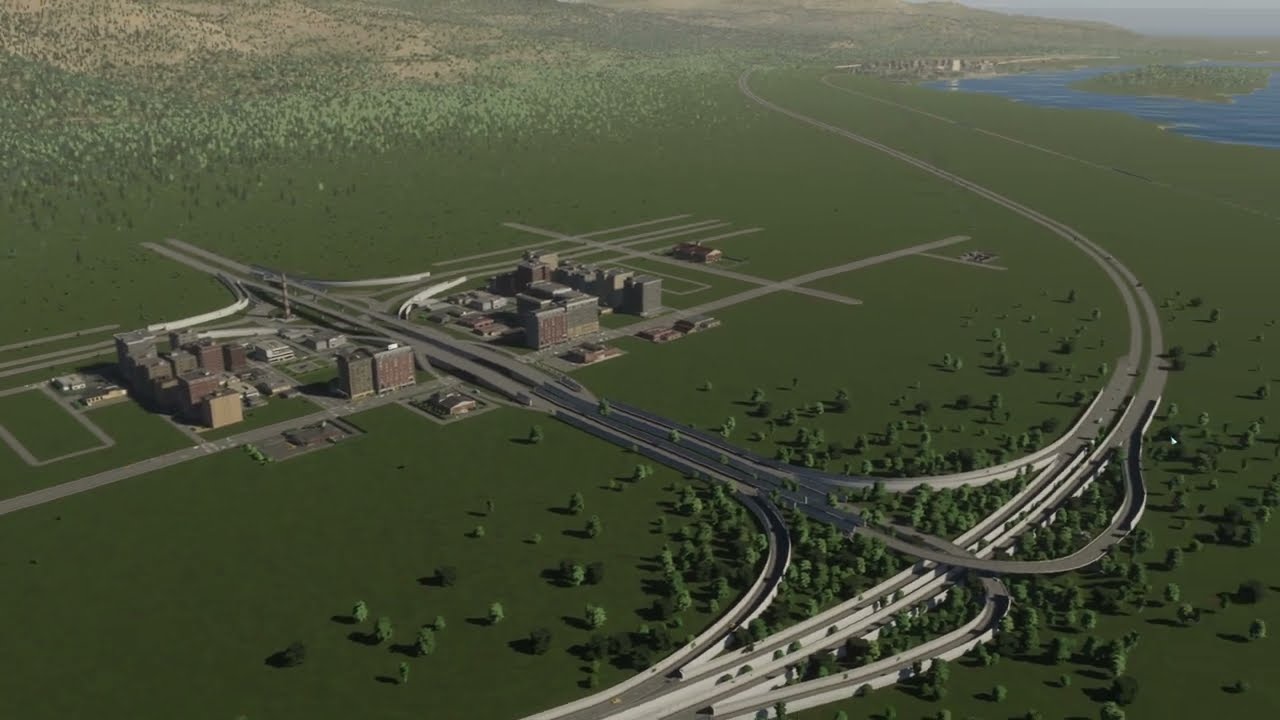
The new city grows around its rebuilt inner-city interchange: medium-density housing because low-density isn't planned yet, a first sports field, a commercial signature building, waterfront houses for variety, Milestone 8 with high-density housing — and a busy city entrance fixed by turning it into a two-lane road without crossings.
What happens in this episode
Between episodes, the inner-city interchange where the four main roads of the new city meet was rebuilt in a quick-build video (episode 7, which has no voice-over). Now every driver can travel in every direction. It takes up a lot of space, but there’s plenty of room for growth here, and it’s far more future-proof. Episode 8 of Shiroku grows the downtown around it. Money was no longer a problem.
How it was built
Medium density first
Most of the sound barriers went: they’re very tall and look strange. There’s high demand for low-density homes, but this part of the city isn’t planned for them, so medium-density housing and some commercial along the highway come first. When a lot wouldn’t snap, adding a footpath did the trick again. Two schools are in, and a high school is on the wish list. The road layout gets an upgrade and the city its first sports field with extra parking.
A signature building and pedestrian paths
The commercial zones performed well enough to unlock a signature commercial building: +1 commercial attractiveness and +4 wellbeing within 750 m. A park is too big for the plot, so a pedestrian path takes its place, because the plan is to keep car traffic in this area low. Business lots stay small to avoid the high-rent problem Cities: Skylines II still had.
Milestone 8
Milestone 8 brings more tiles and North American high-density housing, which the city needed. Eight development points (ten in total) go to underground parking, the hospital, college, a bigger fire station, police headquarters and large parks. Low-density waterfront houses mix in for variety, so not every house looks the same, and leftover small gaps become parks. That’s the easiest way to keep lots even.
A crash cost the latest row of houses, and an Anarchy-placed building got stuck and couldn’t be moved: a reminder that Anarchy can break things.
A jammed city entrance
An accident at the first entrance into the city showed the problem: the road was too narrow for the traffic coming in. Rebuilding the first stretch as a two-lane road and removing pedestrian crossings and traffic lights where they made no sense cleared the queue almost immediately. The next step is a train station for the new city, in episode 9.
Video chapters
- 00:00The rebuilt inner-city interchange
- 04:22Medium density, schools and a sports field
- 11:10A signature building and pedestrian paths
- 15:37Milestone 8 and low-density variety
- 19:59A crash and a rebuilt row
- 24:09Offices, commercial and a jammed entrance
- 28:34Two lanes, no crossings: fixed
- 32:46Next: a station for the city
Clicking a chapter starts the video above at that point.
FAQ
Why rebuild the inner-city interchange?
The old one didn't let every driver travel in every direction. The new layout from the quick-build episode takes more space but lets traffic go left, right, up and down, which is far more future-proof for a growing downtown.
Are Cities: Skylines 2 sound barriers worth it?
Use them sparingly. They're very tall and look odd, so I removed most of them and only kept a few where residents complained about noise.
How did you fix the traffic jam at the city entrance?
By turning the first stretch into a two-lane road and removing pedestrian crossings and traffic lights where they didn't make sense. The queue cleared almost immediately.