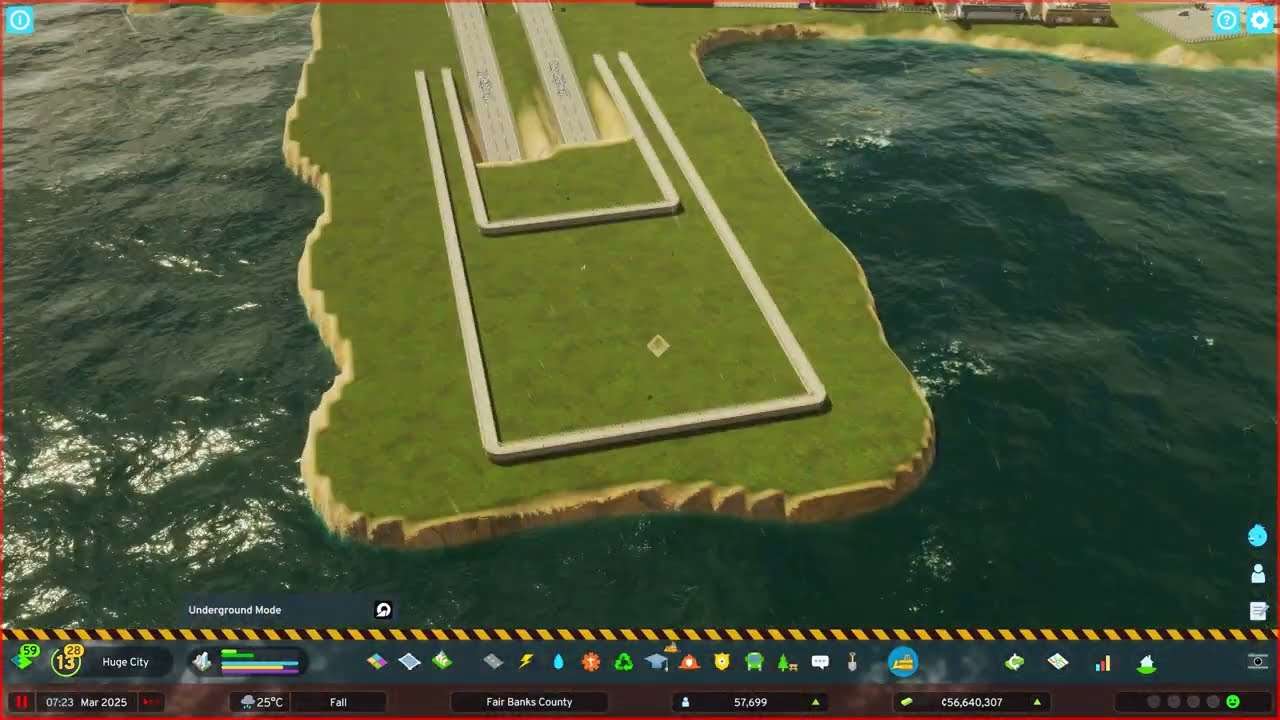
Sound walls can't be placed on bridges in Cities: Skylines II, so Fair Banks County sinks its elevated highway and rail line into a trench about 8 m deep. Before that, the farmland is reorganised into straighter North American plots with hickories and birches between fields. Avenues cross over the trench, ramps are rebuilt, traffic lights go — and a police car stops on the highway for an accident below while charging stations catch fire.
What happens in this episode
The central bank from episode 19 sits at the edge of the nature reserve. It really belongs in the middle of downtown and will move later. Episode 20 of Fair Banks County has two projects: decorating the farmland, following a viewer’s tip to make it more North American, and bringing a highway section down so sound walls can be used. In Cities: Skylines II you can’t add sound walls to bridges, unlike in the first game, and residents keep complaining about noise.
How it was built
Straighter farm plots
The farmland is reorganised into straighter plots at 90° and 180°. It’s surprisingly hard in this game to separate farmland cleanly from industrial areas. Then trees and bushes go between the fields: birches, and oaks where they fit, but mostly hickories, because the gaps were too narrow for oaks. It looks random now, but once everything grows it will be densely green.
An 8 m trench
The elevated highway section and its parking lots are demolished. People won’t love it. The landscaping tool digs a trench of about 8 m, and the highway sits in it with a retaining wall built piece by piece. A sunken highway makes it easy to let roads cross over. Getting the highway to run straight took several attempts, since the problem was the highway rather than the railway. The double tracks follow, rising back to ground level at one end. I couldn’t find a better solution there.
Ramps from the trench
The avenues are reconnected over the trench, then come the on- and off-ramps. The highway stays four lanes so the game recognises the slip roads, with a ten-metre rise on each side, which is quite steep. Terraforming the slope first would have been better than letting the slip road do the work. A small park and part of Lafayette Lane had to go. A mysterious dead end turned out to be something buried underneath.
Traffic lights out, crazy accidents
Traffic lights and crosswalks come out at the new junctions, the big roads become priority roads, and the lane maths get cleaned up. A police car stopped right on the highway to attend an accident on the road below, and an electric vehicle charging station caught fire. The helicopter arrived immediately.
Still to fix
The one-way road to the cargo station from the last episode is used, though not yet for deliveries, and its direction may need changing. Through traffic now detours through the Evergreen Meadows residential area, which isn’t so evergreen anymore. The industrial connection is one of the weaker things I built in this series and needs a redo.
Video chapters
- 00:00Plan: farms first, then the highway
- 04:40Straightening the farm plots
- 08:43Digging an 8 m trench
- 14:26Sinking the double tracks
- 18:49Ramps from the trench
- 25:24Traffic lights out, priority roads
- 30:21A one-way puzzle and burning chargers
Clicking a chapter starts the video above at that point.
FAQ
Why can't I place sound walls on my highway in Cities: Skylines 2?
Sound barriers can't be added to bridge sections. If your highway is elevated, bring it down to ground level or sink it into a trench — then the sound walls become available.
How deep should a sunken highway be?
Deep enough for roads to cross over it. I dug the trench about 8 m deep and set the ramps at a gentle slope; terraforming the slopes first works better than letting the slip roads do all the sloping.
How do you make farmland look North American?
Straighten the field plots at 90/180 degrees, then plant tree and bush strips between fields — birches, oaks or hickories where oaks don't fit.