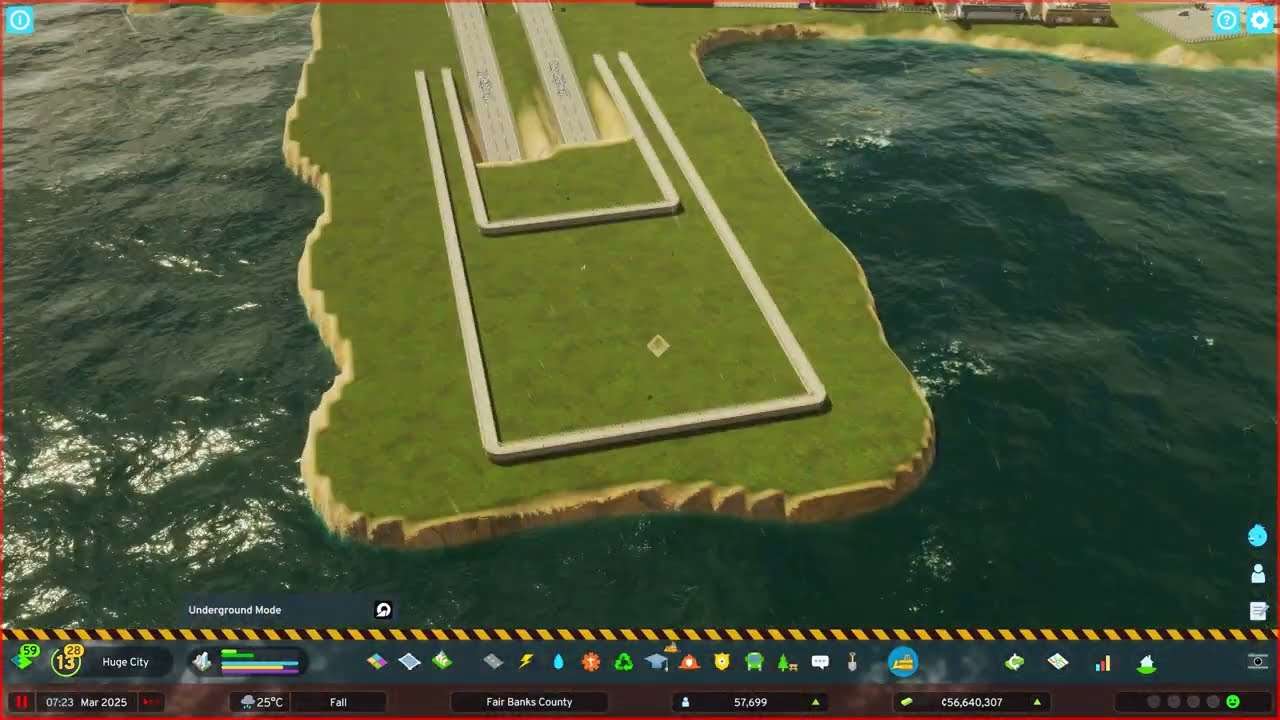
After the tunnel, Fair Banks County focuses on beautifying instead of sprawling. The rail line is shortened, one-way roads and a second road access untangle the cargo train station, traffic lights and crosswalks go, Grand City brings 14 development points, and the central bank (−5% import costs) and an industrial waste processing site join a city earning absurd amounts.
What happens in this episode
The underwater tunnel from episode 18 looks so much better than the bridge. From here, Fair Banks County focuses on beautification rather than covering the island in concrete. There’s still a lot of room, and a new industrial district will need a home eventually. The main highway arterial into the city still feels too massive, and the rail crossing next to it is wonky.
How it was built
Is traffic too easy?
A thought I shared here: either I’m doing something right, or Cities: Skylines II is simply more forgiving about traffic than the first game. There’s hardly any congestion, except around the industry. The job stats show plenty of work for uneducated and poorly educated people, but a big shortage of positions for the well educated and highly educated, which probably means more industrial and office jobs are needed.
A shorter rail line
The rail line is shortened using the existing elevation, saving a detour and freeing land for a residential addition. The tracks still looked like a mess, so a one-way road along them smooths the transition, and a fire station moves.
A second access to the cargo station
Pedestrians kept crossing where there’s no room and no crosswalk. Industrial zones, and above all cargo train stations, are where Cities: Skylines II traffic gets difficult, just as in the first game. One connection to the cargo train station wasn’t used at all. With a three-lane road, realigned tracks and a second access, plus traffic lights and crosswalks removed, the trucks sorted themselves out and the jam almost disappeared. The highways will need a full redo someday because of all the lane switching.
Grand City
Grand City, milestone 14, brings 14 development points and 28 expansion permits, 42 points in total. They go into health research, the industrial waste processing plant and the incinerator plant (unlocked but not built). An industrial waste processing site goes in off the second roundabout. Water and power still have room.
The central bank
The central bank (−5% import costs, better export profits) sits next to the downtown area. Not that money mattered: the city was making absurd amounts each month. The secondary downtown grows slowly. High-density residential demand is still low, so offices or high-density commercial might suit it better. I still owed viewers a district based on where I come from.
Video chapters
- 00:00Beautify, don't sprawl
- 04:03Missing jobs for the well educated
- 08:16A shorter, tidier rail line
- 12:34A second access for the cargo station
- 16:35Traffic clears, Grand City
- 20:45Development points, waste processing
- 24:45The central bank and the secondary downtown
Clicking a chapter starts the video above at that point.
FAQ
How do you fix traffic at a cargo train station?
Give it more than one road access and make the approach logical — one-way roads, fewer traffic lights and no pedestrian crossings where nobody should walk. In Fair Banks a second connection to the cargo station cleared the trucks almost immediately.
Is traffic easier in Cities: Skylines 2 than in the first game?
In my experience it's more forgiving overall. The exceptions are industrial zones and especially cargo train stations, which were also the hardest spots in the first game.
What does the central bank do?
It lowers loan interest, reduces the price of imported resources by about 5% and increases export profits.