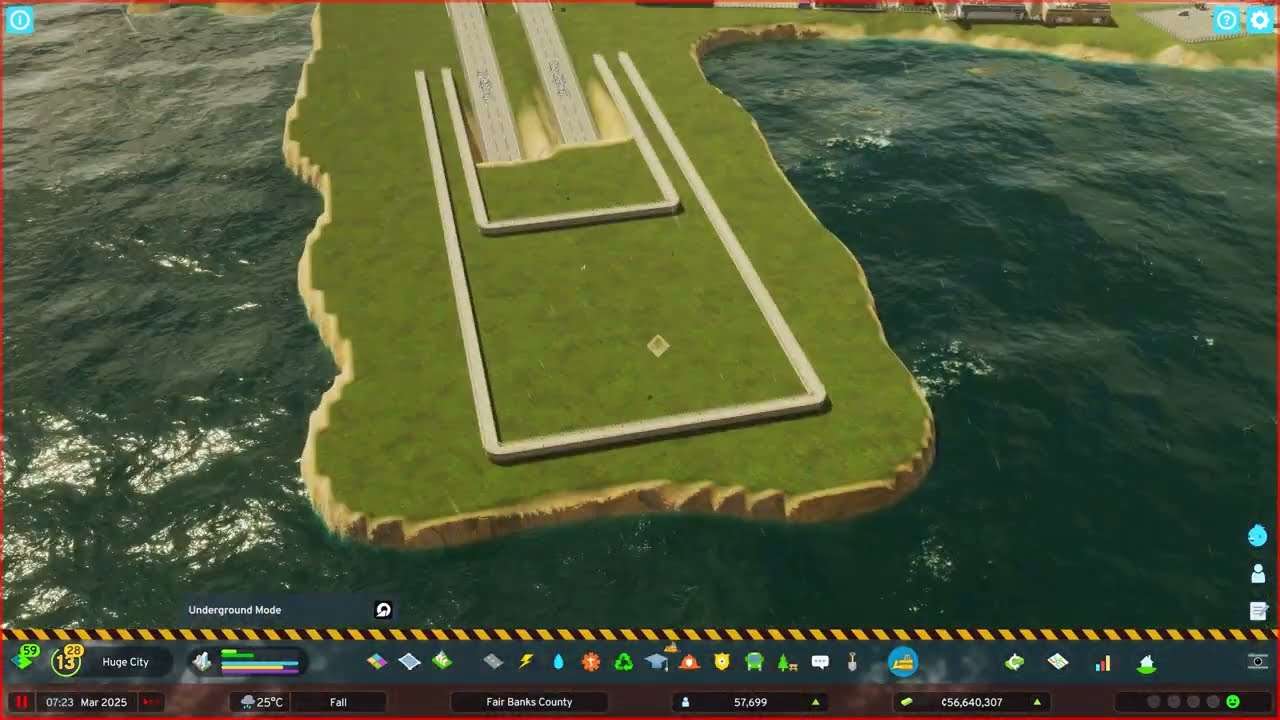
Fair Banks County crosses the coast and edges into profit: pre-planned roads, lots of low-density housing, a gentle hill with hickories and oaks to break up the flat map, speed bumps and roadside trees (which also remove street parking) against noise, the first parking area, advanced pollution management for industry and Milestone 6, Boomtown.
What happens in this episode
The basic grid and the historic island from episode 1 are in place. Episode 2 of Fair Banks County pre-plans the road layout across the coast and, more importantly, gets the city profitable. A small irritation: the district tool seems to have a limited pool of names, and I ended up with “Empire Glade” twice, something I never saw in thousands of hours of the first game.
How it was built
Low density pays
After the road layout, the city stops losing money and starts making a little. More low-density residential zones fill instantly. Downtown is becoming large, which makes good spots for low-density homes harder to find. Residents don’t want to live next to roundabouts, and Cities: Skylines II seems stricter about where people accept housing than the first game was.
A hill on a flat map
The map is almost completely flat, which I don’t like. With a low brush and gentle softening, a small hill gives the area some character, without making it rocky, so it reads as different from the islands. Hickories and a few oaks go on top, with space to grow. The industry’s efficiency is good, but its resource may run out, which could force a move later.
Speed bumps, trees and parking
Noise pollution was high near the roundabouts and schools. Speed bumps slow drivers down in Applegate Downs and the other districts. With a development point in advanced road services, roads can get roadside trees, which also disallow parking. I’d heard in a developer preview that trees help with noise and wanted to test it. If street parking goes, people need somewhere else to park, so the first parking area is unlocked and placed.
Boomtown
Milestone 6 brings textile fibre farming, the heavy-traffic ban (useless while the highway is the only way in and out) and advanced pollution management, applied to the industrial zone straight away. Industrial demand is maxed out, the landfill still has room, and it turns out a 4×4 lot can grow into industry as well. Schools and another service building go in, because an investment in education is an investment in the city’s kids, and a university will follow eventually. A corridor is kept free for a future train line.
Walkways and saved space
Paths between houses keep the residential areas walkable. Some land near the highway stays empty on purpose, for the highway development to come. A large area across the water might become a natural reserve with small settlements later.
Video chapters
- 00:00Duplicate district names and the plan
- 07:37Small profits from low-density homes
- 11:53A hill, trees and noise problems
- 16:22Parking areas and Boomtown
- 21:30Schools, services and a train corridor
- 26:38Walkways between houses
- 30:45Saving space for the highway
Clicking a chapter starts the video above at that point.
FAQ
Do roadside trees reduce noise in Cities: Skylines 2?
At the time I tested it because the developers had mentioned it in a preview. Adding trees via road services definitely removes street parking; whether it lowers noise is less clear — later in the channel's history it didn't seem to work.
Where should low-density housing go?
Away from roundabouts and big roads if possible — residents don't like living next to them, which makes low-density housing hard to place near a growing downtown.
What does Boomtown (milestone 6) unlock?
A higher loan limit, textile fibre farming, the heavy-traffic ban policy and advanced pollution management, which I applied to the industrial zone straight away.