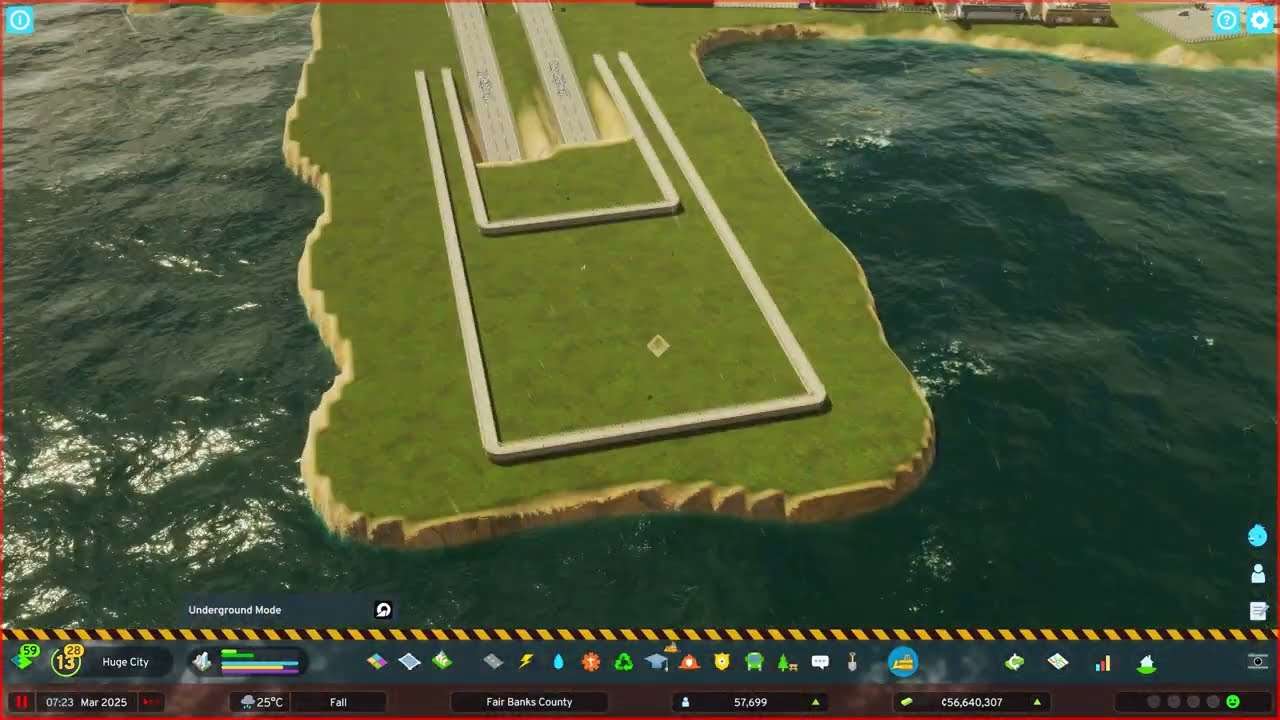
Fair Banks County starts on the vanilla Barrier Island map after a water bug flooded my previous city: a small 6×6 grid that keeps lots small against high rent, imported power at first, a crematorium as the first development point, milestones up to Tiny Town, a historic island for the first settlers, first bus lines and district policies — and a failed wind turbine in low wind.
What happens in this episode
Fair Banks County began because my previous city had to be abandoned. Water started appearing on cliffs and highways, flooding a cargo station and industrial roads. Raising the terrain, building a barrier around it, even running three water pumps at full power didn’t help. It seemed to be a bug in the game’s water simulation at the time, and I decided not to play that map again until it was fixed.
So: a new start. I didn’t want rivers this time. I chose the Barrier Island map, even though I don’t love the huge bridge between the mainland and the island. The settings: North American theme, right-hand traffic, no disasters, no unlocked tiles and no unlimited money. The whole season is vanilla, with no mods.
How it was built
A small grid first
The map is nearly flat, so terraforming is light: rough changes with a large brush plus a few natural slopes. Downtown will run along the coast. I don’t like grid cities much, but a small grid (6×6, later 7×7) is a practical start. Electricity is imported through a transformer station at first. The sewage outlet goes where the water flows away from the coast for now, knowing that sewage pollution takes a very long time to clear.
Small lots against high rent
This trick carries over from my Oakside County episodes: zone a small grid, wait for the first construction sites, then fill in the gaps. That way only small building lots exist, which helps avoid high-rent problems later. Tiny Village came quickly and unlocked EU and North American row housing, which I wanted for an old neighbourhood near the main road.
Commercial first, then services
Commercial demand was high, and people won’t move in without shops, so small businesses go at the town entrance: a gas station and a few shops. I kept them small so they wouldn’t struggle for customers. A medical clinic answers the first complaints. The game picks which side a building’s entrance faces, which is mildly annoying.
The crematorium first
My recommendation for the first development point: the crematorium. People will complain about hearses very quickly, and a crematorium near the town centre solves it. Garbage trucks come from outside connections at first, so no landfill yet. Small Village unlocks taxation (I set 13%), medium density and education. Elementary schools look absurdly big next to the small houses; everything seems scaled up compared with the first game.
Space for a future highway
The incoming highway can’t be modified until highways are unlocked, so I left plenty of space between it and the town, and placed roundabouts early so they don’t cost buildings later. Block sizes increase gradually towards a future business centre. Large Village brings service budgets, police, fire, stone mining and livestock. The healthcare coverage warning was really about staff: it needs well-educated employees, which takes time to graduate.
A wind turbine in the wrong place
To stop paying 14k a month for imported electricity, I built a wind turbine. It ran at 25% efficiency because the wind speed there was too low, so I bulldozed it. A bad move. Imports again for now.
Grand Village, a name and the historic island
Grand Village unlocks districts, the production panel, buses, taxis and parks. The small playground is my favourite park, because a 2×2 fits almost anywhere. The save finally got a name: Fair Banks County. A college follows, and then the old bridge going nowhere gives me an idea: the island becomes the historic island of the first settlers, with small farms, a gentle hill and scattered houses.
Industry against poverty, buses and policies
Poverty became a problem because there were no industrial jobs. The wind blows the wrong way for industry, but a small industrial area cured the poverty warning immediately. The first bus depot and lines followed (I’m still bad at bus lines), along with a small landfill, and Tiny Town unlocked district policies: energy consumption awareness, roadside parking fees, recycling and speed bumps. Two radio masts improve internet coverage, and the first signature building is beautifully detailed, although its grass doesn’t match the rest. The city wasn’t profitable yet at the end of the episode.
Video chapters
- 00:00The water bug that ended my last city
- 12:56Choosing Barrier Island
- 17:20Terraforming and a small grid
- 22:36Small lots against high rent
- 27:03Commercial demand and a clinic
- 31:56Crematorium first, taxes to 13%
- 46:42Space for the highway, roundabouts in advance
- 55:18A wind turbine that didn't work
- 63:25Grand Village and naming the county
- 71:43The historic island
- 81:14Industry against poverty, districts, buses
Clicking a chapter starts the video above at that point.
FAQ
How do you avoid high rent in Cities: Skylines 2?
Keep building lots small at the start. Zone a small grid, let the first construction sites appear, then fill the gaps — that way only small lots exist, which helps avoid high-rent problems early on.
What should you spend the first development point on?
I go for the crematorium. Hearses become a complaint very quickly, and a crematorium near the town centre solves death care early.
Is Fair Banks County played with mods?
No. The whole season is vanilla Cities: Skylines II — no mods, normal money, no unlocked tiles.