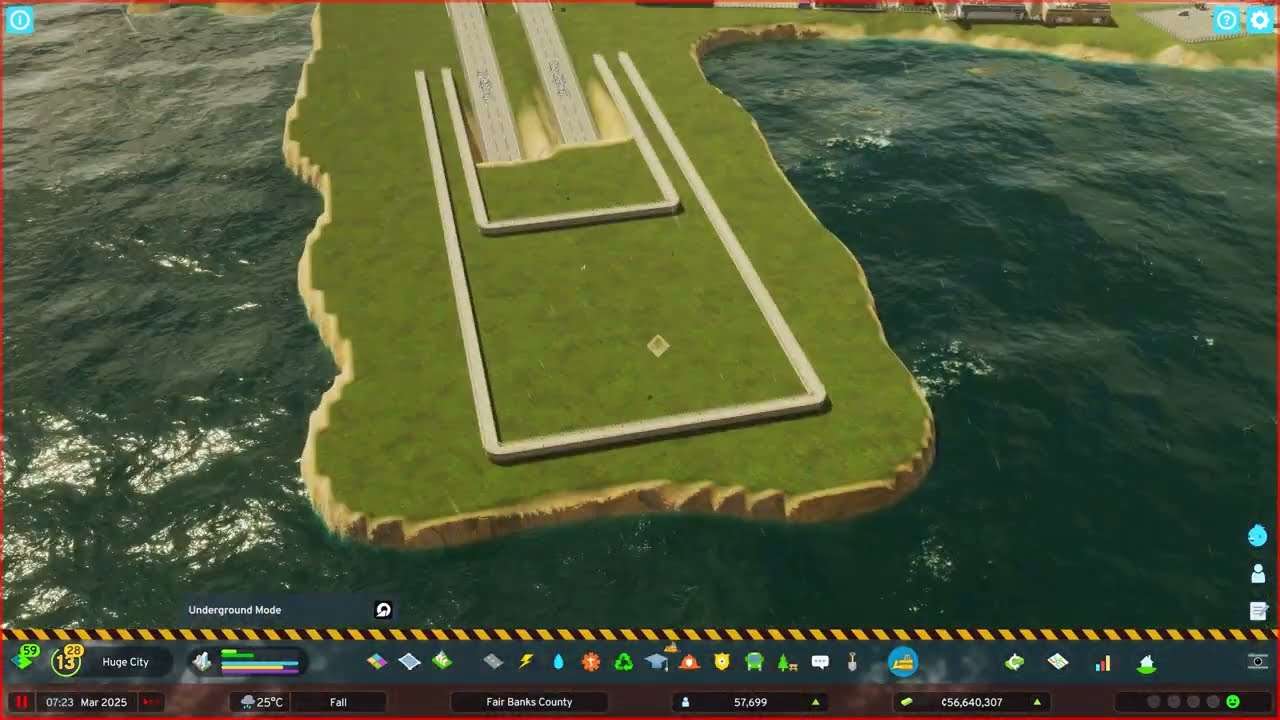
Episode 3 is about making Fair Banks County look less flat: quay walls along the residential waterfront, landscaping around a new industrial area, a cargo train terminal and rail yard tucked into the terrain, a passenger line that winds with the land, development points into highways, trains and parks, a university between Daffodil and Green Street — and Busy Town.
What happens in this episode
Fair Banks County is growing, with the first taller buildings appearing, but the island is very flat. This episode focuses on beautifying the city instead of growing it, with landscaping I was still learning in Cities: Skylines II after watching videos and testing.
How it was built
Quays and landscaping
The industrial area, a small landscaped hill and the quays along the sea took about an hour, which is typical for me at this stage. Quays are always time-consuming.
Development points
The saved points go into highways, parking lots, trains, water, trams, park maintenance, large parks, sports parks, the welfare office and the university.
A cargo terminal and rail yard
Some would say you need a rail yard as soon as you invest in trains. I built both together: a cargo train terminal and a rail yard, sitting on an elevated area with the landfill reshaped around it. A few extra tracks and a stone quarry, an idea I saw on YouTube, are purely decorative and make the industrial area look busier and more realistic. Trees go everywhere to make the island greener, and the industrial district is redrawn to cover the whole rail area.
The beach strip gets its road network for future high-rise residential zones, with a broken-up grid and space for a larger train station and parking.
A rail line that follows the land
A passenger line runs down from about 10 m to ground level along the terrain, winding gently so it looks like it has always been there. A future station on the island is planned. The cargo harbour would have to sit outside the city limits, so it waits. The road tools are the main reason I’d choose Cities: Skylines II over the first game.
Small lots and a university
Lots are kept small, though some can grow, and some low-rent options appear. The university fits between Daffodil Street and Green Street after removing a few roads, with an extra wing and a park. Hickory trees decorate it.
Offices, welfare and Busy Town
An office and commercial centre in the middle of a residential area gives people work nearby, surrounded by medium density and row houses. A welfare office needs a big square, which I don’t love, but sometimes you have to make room. Busy Town unlocks gated communities and ore mining. I’m holding back on Big Town and high density, because the city isn’t ready for much larger buildings. A park barely fits after narrowing Foster Lane. Noise pollution is next on the list.
Video chapters
- 00:00Beautify first, grow later
- 15:21Quays, landscaping and development points
- 23:26Cargo terminal, rail yard and decorative tracks
- 27:33Small lots, low-rent options, a university
- 32:21A rail line that follows the landscape
- 36:53An office centre and the welfare office
- 41:30Busy Town and a park that barely fits
Clicking a chapter starts the video above at that point.
FAQ
How do you make train tracks look like they've always been there?
Let them follow the landscape. Instead of cutting straight lines, I run the track down from about 10 m to ground level along the terrain with gentle curves, so it looks like the route was planned around the land.
Do you need a rail yard for a cargo train station?
For trains to run, yes — I built a cargo train station and a rail yard together. Plan the space for both before the industrial area fills up.
Why not jump to high density early?
Big Town unlocks high-density housing and buildings get much larger. In a small city that can bring problems too early, so I held back.