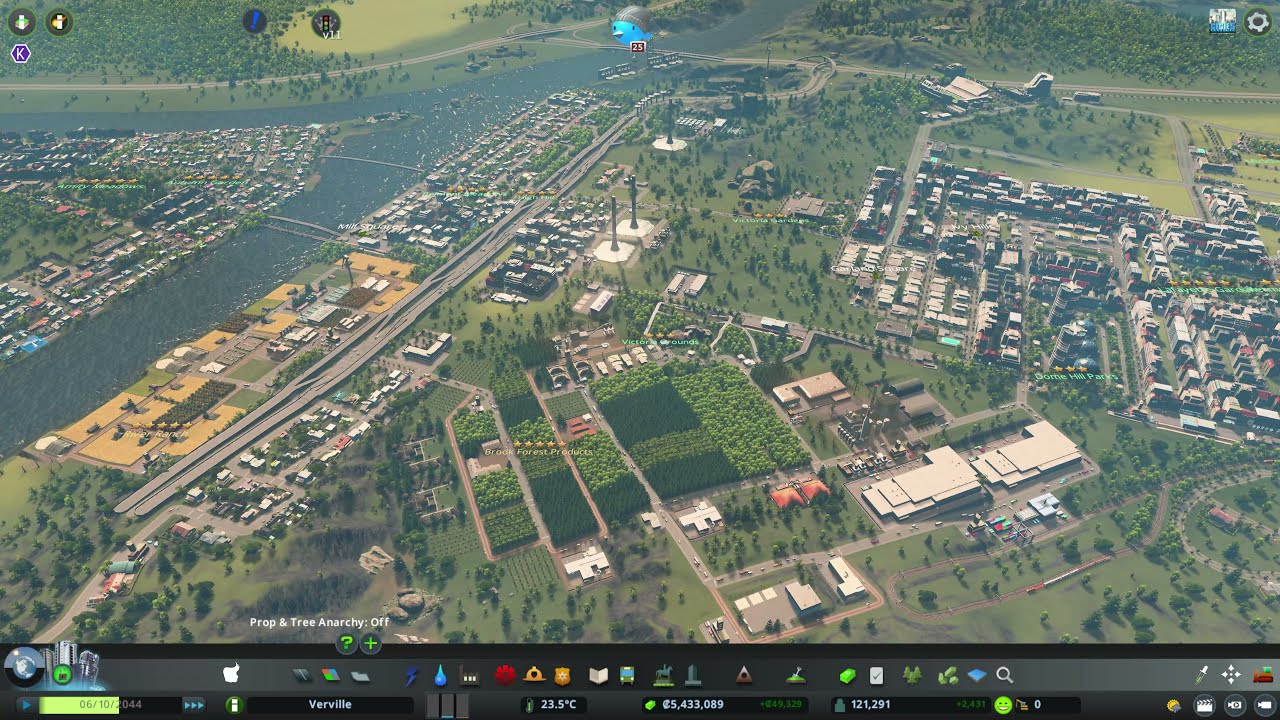
With the rail network finally working, Verville builds a large forestry industry in the mountain forest — tricky on steep slopes — next to an existing freight station, adds a mixed office, residential and commercial area with a small park, finds that a two-lane/one-lane asymmetric road instantly cures a stubborn jam, gets a library for a four-star polytechnic institute, and tries simple industrial zones with farming and wood specialisations plus warehouses. The city passes 300,000.
What happens in this episode
Episode 18 taught me that too many train stations overload freight and passenger trains, so the lines are now separated. This episode focuses on the forestry industry in the big forest up north, served by an existing freight station, plus Adventure World and the downtown blocks.
How it was built
Forestry on steep slopes
A one-way road and water first, then a large industry area, because forestry buildings are bigger than farm buildings. The steep slopes made many placements fail. Sawmills don’t need to sit in the green forest zone, just the right industry area. Smaller buildings sometimes have different slope requirements. Log yards, sawdust storage, several plantations, a two-lane one-way and brushed-in trees complete it. Hopefully the train station can carry everything out.
A new mixed district
A new area along the river gets office, residential and commercial zones. Commercial zoning goes to service buildings, since commercial demand isn’t high. Quay walls prevent floods again. A small park with a centred gate (Move It), cafés, restrooms, gazebos and a playground. Parks help businesses and shops too, not only homes. It reached three stars.
The asymmetric-road fix
Traffic jumped up and down at one junction. Lane rules helped a bit, but the real fix was a road type I’d been searching for: a two-lane plus one-lane asymmetric road. Once it was swapped in with lane arrows, the traffic behaviour changed completely. What an interesting approach. Elsewhere, I found boulevards with a median still allowed parking, so I banned it. A two-lane sound-barrier highway got clearer lane assignments and priority rules.
A four-star institute
The polytechnic institute needed more attractiveness, and a library pushed it toward four stars. Fire, health and police cover the forestry area, and a residential block was rezoned as offices.
Simple industrial zones
I tried simple industrial zones with farming and wood specialisations in Thornton district and Hemlock Hills. They filled faster than expected, even with planted forests and a small animal farm. The bakery already exists in town. Balanced warehouses for forestry and farming products went in. Verville is past 300,000, the trains run without backups, and a much bigger part of the city may follow on the new tiles.
Video chapters
- 00:00Fewer stations, less trouble
- 05:24Forestry on steep slopes
- 10:41Plantations, water and tree brushes
- 16:33A new mixed district
- 22:15A small park for offices and homes
- 27:30Lane rules and an asymmetric road
- 38:16No parking on boulevards, highway merges
- 43:36The road type that fixed everything
- 48:40A four-star polytechnic institute
- 55:04Simple industrial zones with specialisations
- 1:00:23Warehouses and plans for a bigger city
Clicking a chapter starts the video above at that point.
FAQ
Why can't I place forestry buildings in Cities: Skylines?
Usually the slope is too steep, or the building sits in the wrong industry area type. Smaller buildings sometimes have easier slope requirements.
Can an asymmetric road fix a traffic jam?
In Verville, swapping a road for an asymmetric two-lane/one-lane road and setting lane arrows changed the traffic behaviour instantly and cleared a long-standing jam.
Do parks help offices and shops?
Yes. Not only residential zones benefit from parks — business and commercial zones like them too.