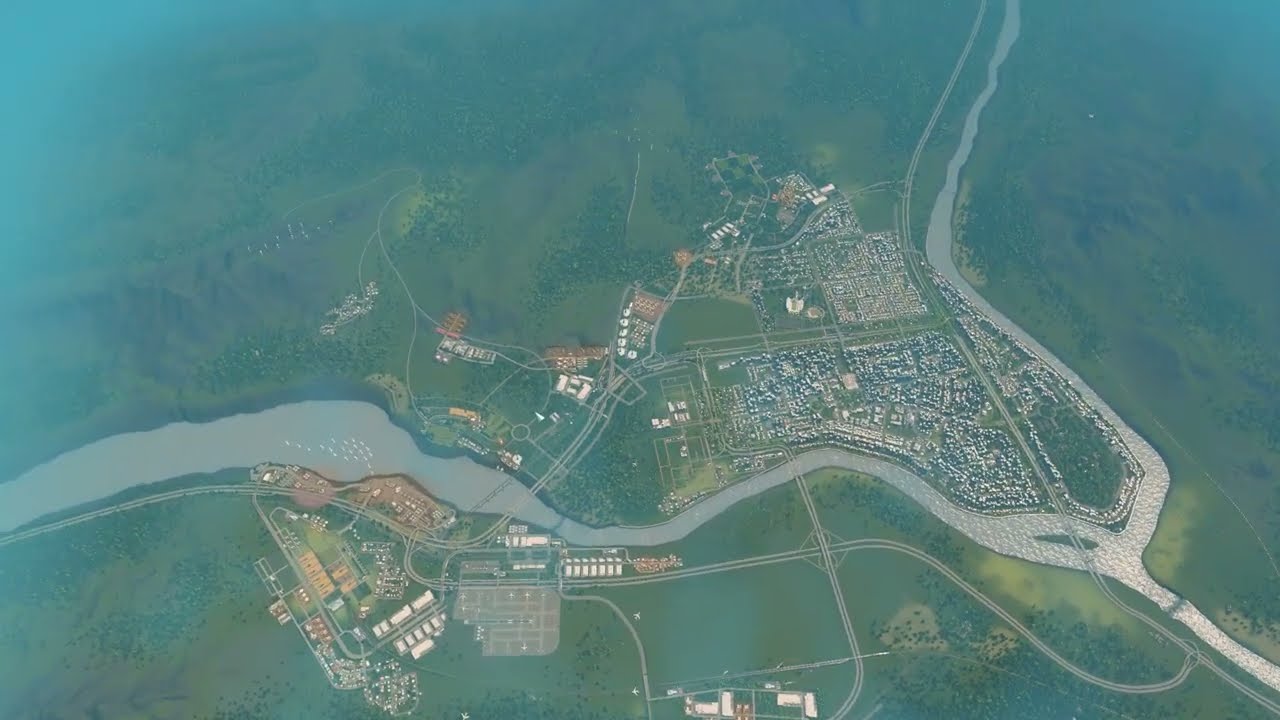
The new station area reminds me of Japanese cities, with a station at the centre and high-rises around it. But the tracks are spaghetti. I untangle them so freight trains can pass straight through instead of turning into the main station, and lower the line into a landscaped trench with tree barriers. A city train loop links three stations, and every arterial becomes a six-lane avenue with bike lanes. Two old roundabouts go, nearly every park reaches five stars, and the college gets room to grow. Traffic holds at 85%.
What happens in this episode
The station district from the last episodes reminds me of Japanese cities: a station at the centre, high-rises around it, then lower density. I started a new format with my previous Episode 41: play first, then record the voice-over in DaVinci Resolve. It’s more work, but more structured. Let me know which you prefer. I’ve already booked days off for the Cities: Skylines II launch.
How it was built
Untangling the tracks
First I level the track heights, then delete the spaghetti mess. A rail overpass lets freight trains go straight through instead of turning into the main station. Main stations don’t handle goods. The pedestrian underpasses have to go to make room, and a two-lane highway link is reconnected.
A landscaped trench
The northern tunnel is replaced by tracks in a shallow trench through the residential area. Its sides are planted rather than left as bare rock walls, so it looks planned instead of just lowered. A line of medium trees adds another sound barrier. Bigger trees would look unnatural next to low-rise homes. A cargo train ran east to west right away.
A parking lot mistake
Every big station needs parking, I thought. The small lot I added with the parking lot mod caused a traffic mess next to the station, so I deleted it.
A city train loop
A city train line links the main station, the stadium station and the rural northern station, and closes the circle. It started with 229 passengers. New pedestrian paths sneak across Pearl Bridge and Taylor Bridge between the ramps.
Avenues with bike lanes
A viewer suggested roads with bike lanes. I upgraded every arterial to a six-lane road with bike lanes, and people use them massively. Traffic is steady at 85%. Two old roundabouts from the early days go, and a bike avenue now runs from downtown to the rural west. A new on and off ramp prepares the next downtown district.
Five-star parks
Nearly every park gets gazebos, playgrounds and climbing frames to reach five stars. It’s more recreation for residents and a draw for newcomers on the way to 100,000.
Room for the college
The college is at three stars. Low-rise homes, some roads and the public library make way, so it can grow towards four stars. Industry is fine: the cargo airport, farming and forestry have no complaints. Oil or ore comes next. The budget swings around zero with five million in the bank. The mix of downtown high-rises with Madison Park, Moorpark and Barlow is one of my favourite builds so far.
Video chapters
- 00:00Spaghetti tracks and a new format
- 04:06A freight bypass past the main station
- 09:32A landscaped trench and tree barriers
- 13:34A parking lot mistake and a city train loop
- 20:32Six-lane avenues with bike lanes
- 24:54Two old roundabouts removed
- 29:19Five-star parks and college expansion
- 33:34Recap and industry check
- 37:54Room for the college
Clicking a chapter starts the video above at that point.
FAQ
Should freight trains pass through the main station?
No. Passenger stations don't handle goods, so give cargo trains a bypass that lets them go straight through instead of turning into the main station.
Do bike lanes reduce car traffic in Cities Skylines?
They help. Six-lane roads with bike lanes on the arterials gave citizens a real alternative, and many switched to bikes.
How do you get a park to five stars?
Add amenities until its entertainment value reaches the next level: gazebos, playgrounds, climbing frames and the like in each park area.