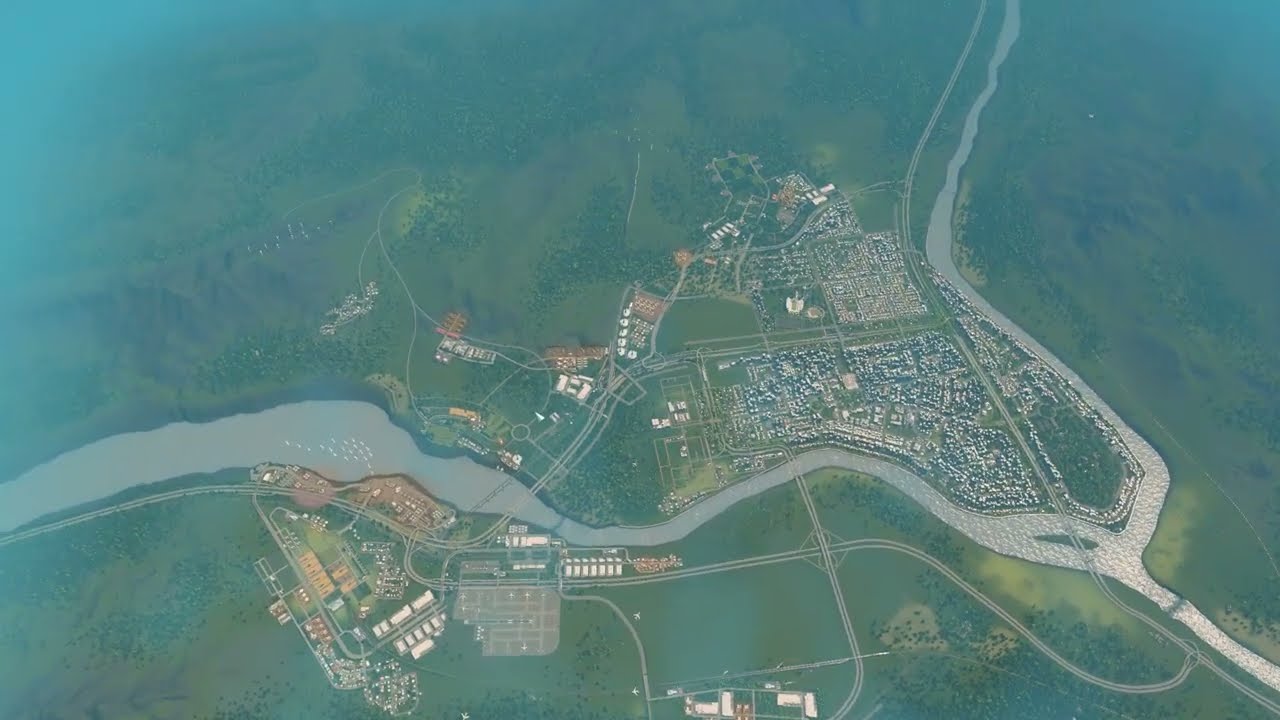
Springvalley gets its first unique factory: a furniture factory in a small specialised industry district, supplied with locally stored paper and planted timber so nothing is shipped out first. Next to it, Barlow district grows as a low-density village with basic services, a high-rise ban and corner shops. Two bus lines connect the rural areas and parks, the education budget is trimmed, and trucks dropping goods at the farm stations lead to a new cargo station for the forestry district.
What happens in this episode
The forestry district from Episode 24 works well. It just needs a few more log yards, so resources stay in the city instead of being exported. The old industry area was cleared, and its road network stays, because it could become a rural old-town district later. An airport is still on the to-do list.
How it was built
Which unique factories fit?
I go through the unique factories. The steel plant, toy factory, printing press, glass, clothing and car factories all need resources I don’t have yet (oil, plastics, glass), and some are massive. The furniture factory needs paper and planted timber, and forestry makes both. So it goes into a small specialised industry district with medium warehouses storing paper, so no paper leaves the city before it reaches the factory. Springvalley will have locally produced furniture.
Barlow district
Next to it, a small grid of simple residential blocks, typical of North America and elsewhere. It gets basic services: a school, a police station, a fire station and a local doctor. These are workers with lower education, and every city has neighbourhoods like this. Wind turbines supply power without touching the main grid. District policies are kept minimal, and Barlow is set as low-density residential, with a high-rise ban so the shops stay small. A few corner stores are added.
Bus lines
A forestry line runs counter-clockwise through the rural area to the farm district, and the long Butler’s Line links Spruce Meadows, Butler Park and the other big parks. Lines get distinct colours (forestry is green) so they’re easy to recognise. A bus stop that blocked traffic and the jammed farm roundabout get lane fixes and no pedestrian crossings.
Budget and services
Income is about 222,000 a week, but education is surprisingly expensive, so its budget drops. Policies cost 30,000. All services check out well, and traffic flow is at 82 percent. Cities: Skylines II will apparently make you think about wind direction, which will matter a lot for big industrial areas.
A cargo station for forestry
Forestry trucks were driving to the farm district’s train stations to drop off goods. A one-way loop helps a little, but the real fix is a cargo train station for the forestry district, on an above-ground line through the countryside. The first trains loaded and left within minutes.
Both industry districts are now five stars. What should come next: an airstrip, moving the service area out of town, or more residential land? Tell me in the comments.
Video chapters
- 00:00More log yards and future plans
- 04:20Which unique factories are possible?
- 08:50A simple residential village
- 13:06Wind turbines and district policies
- 17:10High-rise ban and bus lines
- 21:10Coloured lines and lane fixes
- 25:25Budget check: education costs
- 29:39City services check
- 34:14A cargo station for forestry
- 43:19Two five-star industries
Clicking a chapter starts the video above at that point.
FAQ
What does the furniture factory need in Cities Skylines?
Paper and planted timber. Both come from the forestry industry, so storing paper in nearby warehouses keeps it in the city for the factory.
How do you keep a district low-density?
Paint it as a district, zone low-density residential, and set the high-rise ban policy so commercial buildings stay small too.
Why do trucks drive across town to drop off goods?
They head for the nearest cargo station that accepts their goods. If an industry has none of its own, its trucks use another district's station. Give each industry its own cargo station.