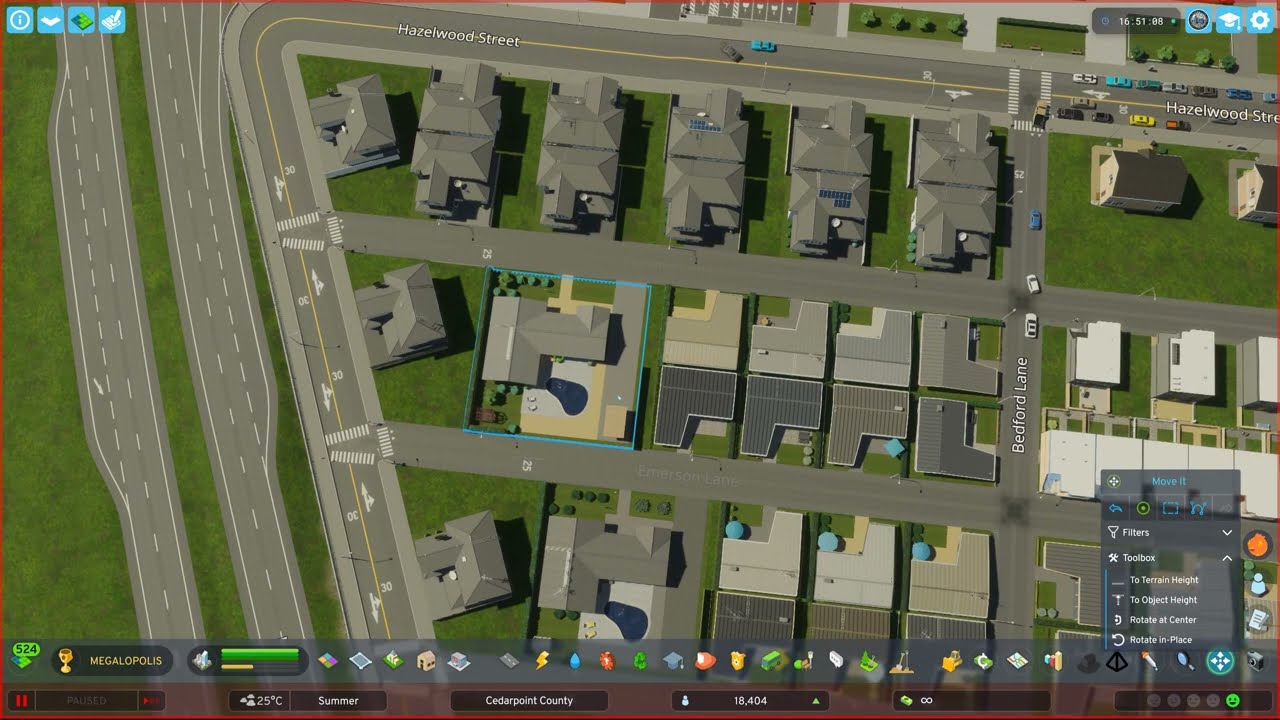
Tile 2 builds a central train station the Japanese way — with the offices, shops, hotels and high-rises clustered around it — plus a six-lane city entrance, a tunnel and new bridge for the third rail line, high-rise homes on a plateau, a deliberately shabby commercial block and gravel textures along the tracks.
What happens in this episode
Tile 2 of Cedarpoint County took about six and a half hours to build and became the transport heart of the county: a central train station with a district inspired by Japanese cities around it. In hindsight, an industrial tile might have been the better second step. Right now there’s no rail yard, so only two of the map’s incoming rail lines can be connected.
How it was built
A new city entrance
I didn’t like the original highway connection, so it went and a six-lane road became the new entry point. The roads of tile 2 tie directly into the downtown from episode 1.
Everything around the station
Anyone who has been to Japan knows the pattern: in Tokyo, Osaka or Kyoto the important companies, shops and hotels sit right around the central station. That’s what this district recreates — high-rise offices, medium-sized businesses, homes, and some streets with parking so people can drive to the station. North Gate Street gets a second connection across the tracks to the main arterial, so it isn’t the only way into this part of the island.
Hotels, a bus terminal and taxis
Every big station needs hotels. Four smaller, less exclusive ones go up around it, together with a bus terminal and a taxi stand. Next to the natural forest, a park area with an info centre and a large parking lot is prepared. My first ring road through it didn’t work, so it was rebuilt with a different layout.
A high-rise plateau
On a small plateau between the highway connection and the end of the station, a circular road wraps around high-rise homes for wealthier residents, with a few parks. Winter arrived halfway through, which I love in real life but not in Cities: Skylines II: everything turns white and the lighting makes colours impossible to judge.
Moving the station for the third rail line
To reach the third incoming rail line at the far edge of the map, the line has to cross the sea to the islands. That meant shifting the whole station and its tracks a few notches, a tunnel running under the plateau, and one of the new bridges from Bridges & Ports across the channel between the first island and the mainland.
A deliberately run-down commercial block
Next to the station, a low-rise commercial block is meant to look less polished. The gas station lot gets bigger, dead ends are blocked with trash cans and clutter, and the middle of the block becomes a yard for the business owners with bins and tyre marks.
Detailing in spring
Spring was the perfect time to detail, because textures were visible again. Nothing makes rail tracks look more realistic than gravel, so riverbed and gravel textures from Sully’s packs go along the tracks in varying densities, with bushes and rocks. Between the office towers, a small business park with paving and benches gives office workers a place to eat lunch, and a pergola I hadn’t used before becomes a rain shelter for trash bins. Concrete slabs cover the tunnel entrance to hide graphical glitches, the plateau’s quay walls get greenery, and traffic cones go along Cedar Lane. Tiny details like these often separate a good decoration job from a bad one.
Next: tile 3, the port and industry hub.
Video chapters
- 00:00Replacing the highway with a six-lane entrance
- 05:08Two rail lines in, no rail yard yet
- 07:40Everything around the station, like in Japan
- 10:24A second link across the tracks
- 14:15Mid-rise blocks and a high-rise plateau
- 21:36Moving the station for a tunnel and bridge
- 24:20Park, hotels, bus terminal and taxis
- 30:32Detailing the run-down commercial block
- 34:37Gravel along the tracks, a business park
- 40:04Covering the tunnel, last details
Clicking a chapter starts the video above at that point.
FAQ
How do you build a Japanese-style station district in Cities: Skylines 2?
Cluster everything around the central station: high-rise offices, medium-sized businesses, homes, hotels and a bus terminal and taxi stand. In Tokyo, Osaka and Kyoto the most important companies and shops sit right around the main station.
How do you make train tracks look realistic?
Gravel. I paint riverbed and gravel textures from Sully's packs along the tracks in different densities, then add bushes and a few rocks.
Why does winter make building harder in Cities: Skylines 2?
Snow turns everything white and the lighting changes, so it's hard to see colours and textures while detailing. I waited for spring before doing the detail work.