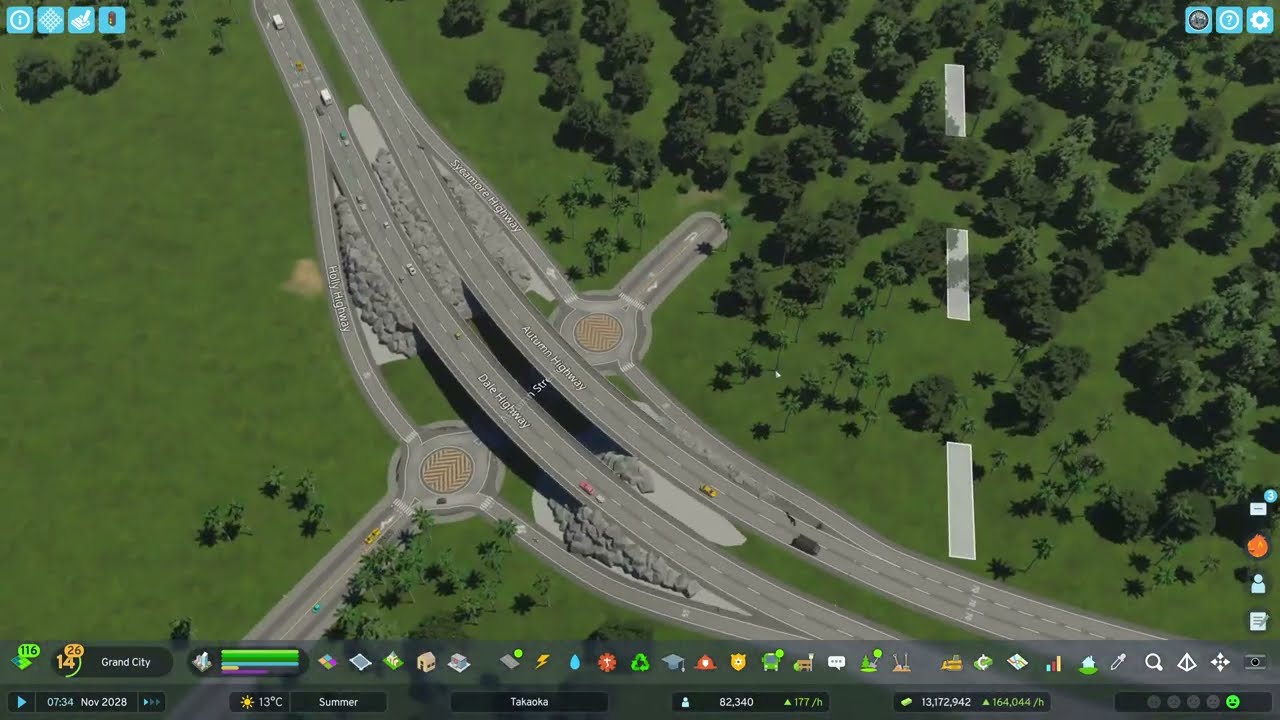
A second coal mine on a 39-tonne deposit, rocks to stabilise the slope behind nearby houses, roadside greenery against street parking, a new cargo train link over the highway (first accidentally connected to the passenger line), medium-density Japanese buildings to soften the downtown edge and a European-style truck rest stop — at almost 80,000 residents.
What happens in this episode
Episode 15 of Takaoka picks up at the coal mine and stone quarry from part 1. The parking lots under the train line close off the area realistically. Grass between them wouldn’t fit.
How it was built
A second coal mine
The ore view shows another deposit of about 39 tonnes, enough to use. The first one only has 15 tonnes left. The new mining area is pulled away from the houses and given a rough edge, and rocks along the slope make it look like the ground behind the homes has been stabilised. Placing the rocks without creating a wall of floating stones took care. Oil is still in deficit.
Greenery against parking, bridges over the highway
Roadside greenery keeps people from parking on a busy road, so traffic flows better. With Anarchy the road layout is reorganised, the fire station’s helicopter base moves, and two quick bridges cross the highway.
The cargo rail link
A new cargo train hub needs a freight line, and I first connected it to the passenger line by mistake. Freight doesn’t belong on the commuter tracks. The fixed version crosses the highway section at about 3% slope and 180°, followed by a cargo route between the terminals. It’s not the prettiest transition, but it works. After a few minutes the first freight train rolled in.
Small fixes and a commercial strip
Alleys and a footpath let residents walk between the two areas, a bridge that shouldn’t have been one is replaced, textures fill the gaps, and a small commercial district grows near the mall. One connection was 20 m too high instead of 10, which explained why it wouldn’t link up. Smoothed out, it’s a much better transition.
Softening the downtown edge
The edge between high-rise downtown and the low-rise area was too harsh. Medium-density Japanese buildings (2×2) go in as an intermediate band, and some high-density lots follow where demand is strong. Small parks fill leftover gaps. A big junction may need a larger roundabout; for now, the pedestrian crossings go.
A truck rest stop
To finish the area: a rest stop, as they’re called in Europe, where truck drivers can get fuel, food and a break, with parking lots that are actually in use. The storage warehouses are filling up too. I’d love an industry expansion for Cities: Skylines II; industry is what excites me most in these builds. Takaoka is now almost at 80,000 residents, and a luxury living area is next on my list.
Video chapters
- 00:00A second coal mine on a 39-tonne deposit
- 04:20Greenery against street parking
- 10:07Cargo rail — on the wrong line at first
- 14:27The first coal train arrives
- 20:06Smoothing a 20 m height mistake
- 24:35Softening the downtown edge
- 28:58High density and small parks
- 55:21A truck rest stop and 80,000 residents
Clicking a chapter starts the video above at that point.
FAQ
How do you connect a mine to the cargo rail network?
Build a cargo train hub next to the industry and run a separate freight track to it — and make sure you connect it to the freight network, not a passenger line. Then set up a cargo route between the terminals.
How steep can a railway be in Cities: Skylines 2?
Keep it gentle. I aimed for around 3% when crossing the highway section; earlier in the series an 11% gradient was clearly too steep.
How do you make high-rises blend into low-rise areas?
Add an intermediate band of medium-density buildings — here Japanese 2×2 mid-rises — between the towers and the houses, so the height steps down gradually.