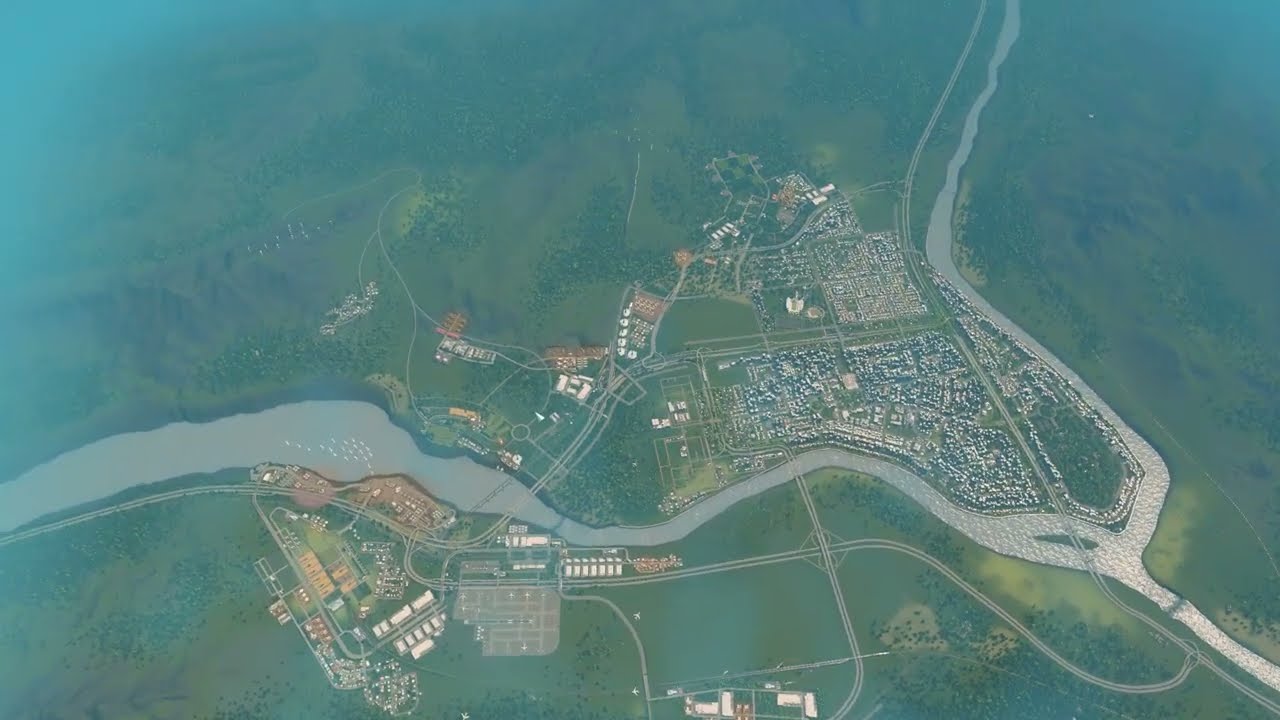
Amity Estate, the second farming district, gets more fields and fertile land. Then Springvalley finally gets ore: Sunset Ore Products starts with a main building, workers' barracks, large and underground mines and warehouses. A new train junction lets trains reach the district's rail warehouse from any direction, a new highway connection and a rebuilt interchange get careful lane math, and a flour mill that was making people sick moves away. Grinding mills and glass plants follow, and the international airport has to wait.
What happens in this episode
Amity Estate, the newest farming district across from the Florence oil field and the cargo airport, is still smaller than the Sycamore area and isn’t very profitable yet. It gets the last available fields, a wider fertile land area and some decoration, so it can grow towards five stars.
How it was built
Ore at last
The one industry Springvalley still lacks is ore. Alongside Terry Morgan Drive I paint a new ore area, Sunset Ore Products for now. I pause the game and place the main building and workers’ barracks right away, so I don’t forget them. Then come large ore mines and underground mines placed away from the main building, with rough landscape left as it is. Warehouses follow, plus a new industrial road crossing the highway at 9 m.
A rail junction
A big construction: a new train junction, with retaining walls along the tracks so it looks reasonable in tight space. The unreasonable train underpasses are gone. Trains can reach the district’s rail-connected warehouse from any direction, because rail is its main export route. A new highway connection gives trucks access too.
Node spacing, again
If there’s one lesson I’ve learned, it’s enough nodes between crossings. That goes for roads, trucks and trains. The old intersection was too close from the start, so I rebuild it. Brook Heights, the small slope town, has developed nicely.
Lane math
On the new ramps, lanes split from three to two and merge in the right places, and I ban lane changes where vehicles should decide early. Checking each ramp immediately shows when nodes sit too close. I considered another ramp, but there are already plenty. The rural roads become industrial roads.
A sick neighbourhood
Citizens were getting sick. A flour mill next to homes caused ground pollution. I moved it, sorry, my mistake, and things recovered quickly. An extra doctor, fire and police cover the industry. A bridge slope is adjusted for a nicer transition onto the highway.
Processing
Grinding mills and a glass manufacturing plant go in. Post-processing takes a lot of space. Not all factories have enough ore yet, and more mines may be needed. I promised the international airport for this episode, but the industry, interchange and rail took over. Next time, for sure.
Video chapters
- 00:00Amity Estate gets more fields
- 04:18Starting Sunset Ore Products
- 08:58Mines, warehouses and a new link
- 17:51A train junction and node spacing
- 21:52Brook Heights and the interchange
- 27:53Lane math on the new ramps
- 31:54One more ramp? Not yet
- 36:08A mill making people sick
- 40:16Grinding mills and glass
- 44:45The airport has to wait
Clicking a chapter starts the video above at that point.
FAQ
How do you start an ore industry in Cities Skylines?
Paint an ore industry area over an ore deposit, place the main building and workers' barracks first, then mines, warehouses and processing like grinding mills and glass plants, with good road and rail access.
Why are citizens getting sick near industry?
Ground pollution from a nearby processing building. Here a flour mill next to homes caused it; moving it away fixed the problem quickly.
Why does node spacing matter for rail too?
Trains, like cars, need distance between junctions. Keeping enough nodes between crossings is relevant for roads, trucks and trains alike.