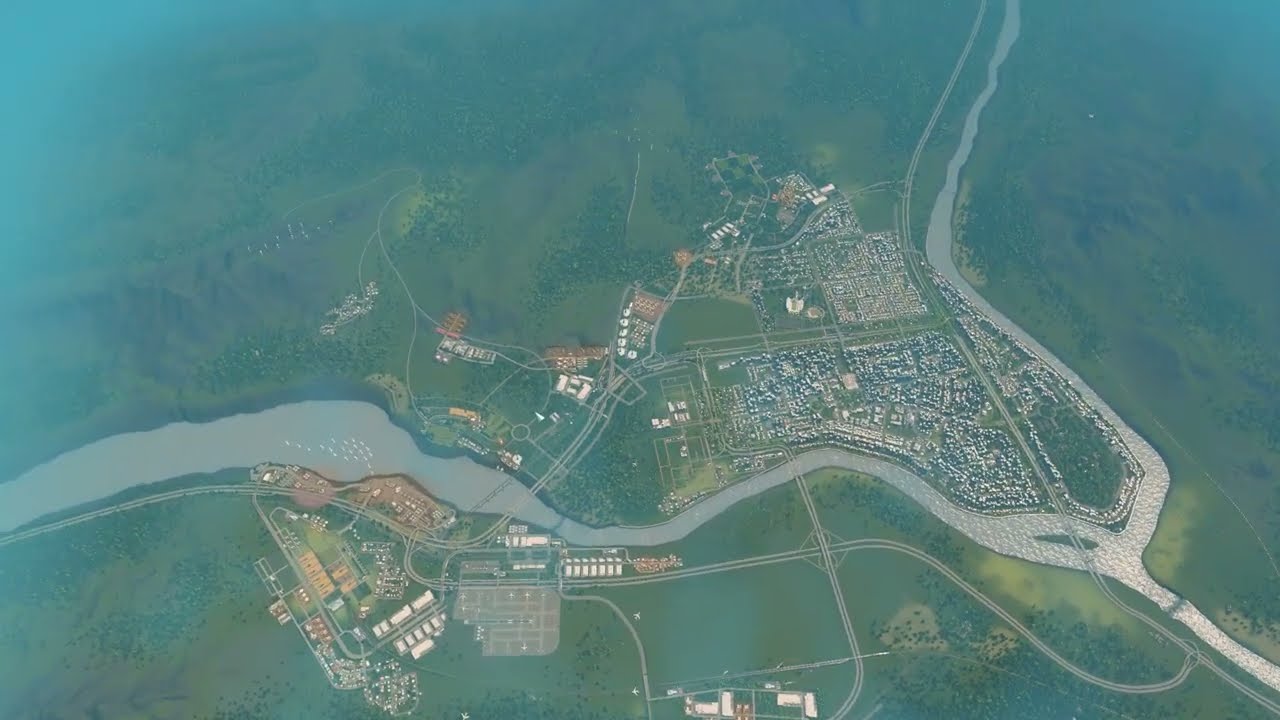
Planes are still queueing at the cargo airport, so on a viewer's hint I delete most of the stands and rearrange the taxiways for nearly twice as many. A three-lane road fixes warehouse U-turns, and a reduced layout works better. Neighbouring cities buy our raw materials. The steep bridge everyone disliked becomes a smoother slope with an underpass, and a water pollution source is spread out. Then I test whether bus lines to industrial districts help with workforce. Traffic improves 2 to 3%, and lines with zero passengers are deleted.
What happens in this episode
Episode 45 fixed the trains. Nodes were too close, and I keep forgetting how long trains are. Lots of trains run now with no jams. The new farm’s milk parlours and slaughterhouses still lack raw materials and may need more pastures. Today’s focus is the cargo airport again, thanks to a hint from a viewer.
How it was built
Stands and taxiways
I delete most of the airplane stands and rearrange the taxiways to fit nearly twice as many. Then I let it run before decorating. The first planes left. Many trucks were making U-turns between the warehouses, so a three-lane road without parking fixes the lane math there. A reduced layout worked even better than a dense one. Neighbouring cities are buying lots of raw materials from us. I hadn’t expected that.
Crossings
I upgrade a road at the exit and enforce left-or-right only at the junction: no lane changes in the crossing and no pedestrians.
The steep bridge
The viewer also didn’t like a very steep bridge, and I never really liked it either. It’s rebuilt as a gentler slope with an underpass. The central hospital moves, and a few roads become unnecessary.
Water pollution
The water downstream of the oil industry is polluted. I spread the outlets out and use the pollution-reducing option. Measured pollution is minimal and mostly ground-related.
Planes find their stands
Planes are now spreading across the empty stands, sometimes two to one, and it’s much better than before. A quick fix at a small crossing sorts the traffic. A tunnel handles the few cars that need it, and the airport gets fences.
Buses to industry
Does public transport to industrial districts help them find workers? I add bus lines to each one, except Ramasaki Industry for now. Traffic flow rose 2 to 3%. The city simply has too few bus lines, and I’m slowly grasping how crucial they are.
Housing near industry
Industry still lacks workforce, so I add a few residential streets right next to it. The air pollution from chimneys there will be completely new in Cities: Skylines II. A tree sound barrier with 30 m spacing separates homes from the cleaner industry. Bus lines with zero passengers are deleted. Following your suggestions keeps making Springvalley better.
Video chapters
- 00:00Trains fixed, planes still stuck
- 04:05Rearranging the stands
- 08:28First planes leave, trucks U-turn
- 12:42A three-lane industrial road
- 16:51A reduced layout and exports
- 21:36Rebuilding the steep bridge
- 26:46Water pollution and an underpass
- 30:46Planes spread across the stands
- 37:13Buses to the industrial districts
- 41:45Housing next to industry
- 46:19Air pollution and a tree barrier
- 50:31Deleting empty bus lines
Clicking a chapter starts the video above at that point.
FAQ
How should cargo airport stands be laid out?
Give every stand a clear taxiway access and enough taxiway length before the runway. A simpler, reduced layout worked better here than a dense one.
Do industrial districts need bus lines?
It can help workers reach jobs there. In Springvalley it raised traffic flow 2 to 3%, but some industrial lines carried zero passengers and were deleted.
How do you reduce water pollution downstream of industry?
Spread out the polluting outlets, use the water pollution-reducing options, and keep water intakes upstream.