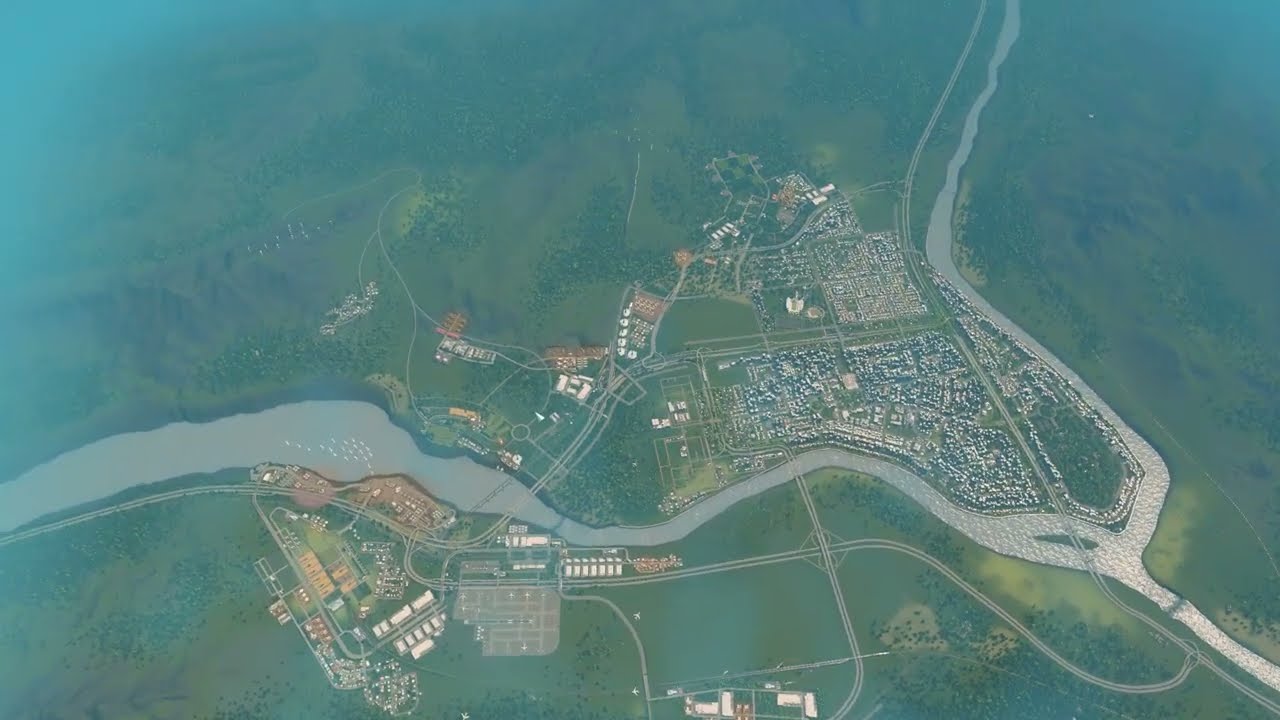
With the Florence oil field at five stars, I start a fresh area around a closed lake. It gets a road layout that follows the shoreline, a fixed diamond interchange with sound barriers, a solar plant instead of turbines on the shore, low-density homes, hotels and a commercial core with tourism policies. A second passenger train line and a small farm in Birch Sector follow. The cargo airport is enlarged with more stands and a second runway attempt, but planes still won't use the stands, and outgoing trains still pile up at the border.
What happens in this episode
The Florence oil field from Episode 43 has already reached five stars. It has rigs, warehouses, barracks, services and its own cargo station. A cargo station to bring raw materials back to manufacturing could follow. Today, though, I start something completely new: an untouched area I want to be low-density and recreational.
How it was built
A shoreline layout
A train station comes first, so I don’t forget it. Then a basic road network that respects the landscape and shoreline, before any arterials. The plan: a few offices, mainly hotels and small holiday homes, and some commercial space where visitors can spend money. Roads stay a set distance from the highway and cross the tracks on elevated roads.
Power
Turbines would only make about seven megawatts and spoil the shore, and a closed lake rules out hydropower. So the area gets a solar power plant.
The diamond interchange
The vanilla diamond interchange isn’t too bad, as I’ve seen worse. I fix its lanes with TM:PE and upgrade the connecting highways to versions with sound barriers. I hope the vanilla interchanges in Cities: Skylines II get the lane math right. A water tower and pumps go in, with pipes along the roads, plus two recycling centres and a fire helicopter depot.
Zoning and policies
Low-density homes go right by the lake, where limited land should drive up land value, with some commercial near the station and a few offices. District policies cover small business enthusiast, high-tech housing, high-rise ban and heavy traffic ban. Willow Hills gets a tourism specialisation.
Trains and hotels
A second passenger train line connects to the main station, and the first hotels and inns appeared quickly. I accidentally created local produce shops (an eco supermarket) instead of tourist commerce. An intercity bus station, a park, tree sound barriers, a library and some high-density homes follow.
A small farm
Birch Sector gets a small farm with fields and potatoes, its main building, water and power.
A bigger cargo airport
Two big warehouses, track slope fixes and lights help the oil traffic. The cargo airport is far too small. I extend the airport area, flatten the ground, pave it and add more stands. Planes queue but won’t use the new stands, and even a second runway attempt didn’t fix it.
Still stuck
Outgoing trains still pile up at the border, blocking passenger and cargo trains alike. Fixing that comes first next time, maybe with a second rail exit. For now, Applegate Hills, Underhill Heights and Willow Hills have changed this area a lot, and I like it.
Video chapters
- 00:03A five-star oil field and a fresh area
- 04:20A shoreline road layout
- 09:09Hotels, shops and crossing the rails
- 13:20Power without spoiling the shore
- 17:54Fixing the vanilla interchange
- 22:15Lakeside zoning and policies
- 26:49Willow Hills and tourism
- 31:25A second train line, the first hotels
- 35:56Wrong shops and an intercity bus station
- 40:54A small farm in Birch Sector
- 51:10Warehouses and train traffic
- 56:05Expanding the cargo airport
- 1:05:57A second runway
- 1:11:11Trains still stuck
- 1:20:58To-do list
Clicking a chapter starts the video above at that point.
FAQ
How do you power a district without ruining its landscape?
Check the options: turbines would spoil the shoreline and a closed lake can't take hydropower, so a solar plant tucked away from the homes was the cleanest choice here.
Are vanilla diamond interchanges good enough?
They work, but their lane assignments are rarely right. Fix lane arrows with TM:PE and upgrade to highways with sound barriers if the city will grow around them.
Why won't planes use my cargo airport stands?
In this episode I couldn't solve it: more stands and a second runway didn't help. Check that every stand is connected to the taxiways and runway.