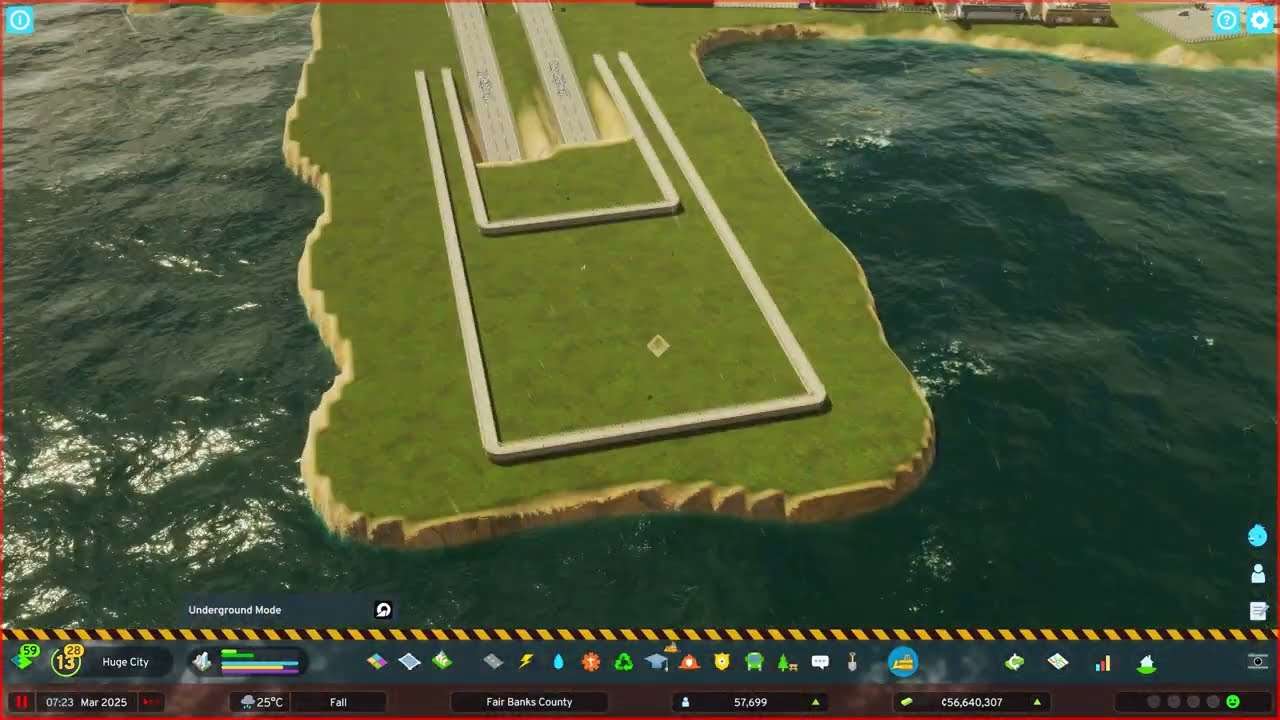
After an honest look at what Cities: Skylines II does well (roads, highways, custom roundabouts) and what disappointed me (water bugs, no Asian theme, oversized buildings), Fair Banks County overhauls its industry: the cargo train terminal is rebuilt on a plateau with a road tunnel, a chemical plant and new industrial zones go in, the rail yard gets connected, and the automotive factory signature building takes a slice of coastline.
What happens in this episode
The new interchange from episode 23 may look confusing, but it lets everyone get where they need to go, especially down to the industry. Before playing, I shared some honest thoughts.
My take on Cities: Skylines II at the time
Many of my expectations were met. The roads and highways are far better than anything we had before. The preset roundabouts are too small, but you can build custom roundabouts in a few simple steps (I made a tutorial for that), just like in the first game. I could never have built an interchange like this one in Cities: Skylines 1. I missed custom LUTs, autumn looked dull, and the map has no real winter, which I prefer.
Two things really disappointed me: the water mechanics, which ended my first CS2 series when water flooded land I couldn’t fix, and the missing Asian theme. Early on there were three building styles (European, North American and Asian), and as a big fan of Japan’s architecture and road layouts I’d hoped for it. A content creator pack with a few assets isn’t the same. Oversized buildings like the high school and hospital were the third. Still, I love this genre and I’m sticking with it. A lot of the hate was aimed at developers who don’t set studio policy.
The city had about 67,600 residents, probably half what the same area would hold in the first game, and earned more than 600k per hour. With no way to run out of money, there’s no micromanagement. It can be relaxing, but it’s unusual.
How it was built
A bigger cargo station
Oil fields and ore deposits further down mean trucks would drive a long way, so the farming and oil area needs a bigger cargo train station with warehouses. The existing terminal’s layout was poor (my advice: plan a cargo terminal before placing it), so it was bulldozed.
A plateau and a tunnel
The new station sits on a plateau. I lowered the ground about ten steps, then tried several approaches. The road became a tunnel by itself with odd portals, so the terrain was carved again with rough edges. A slope of −5% from a straight road gave exactly the hill I wanted, with the tracks curving back up. A three-lane one-way road and a roundabout (to handle future traffic) connect it, and pedestrian crossings come out of the industrial roads.
A chemical plant and new zones
Industrial demand was still high, so new zones fill quickly. A chemical plant signature building goes in on a new side road. It can’t be upgraded. There’s little difference between the industrial zone types in this game. A road maintenance depot, a fire helicopter depot and a fully upgraded healthcare facility serve the industrial area. The game’s lighting changed three times during the session without me touching any settings, sometimes bright, sometimes dark and dull, which makes this episode look uneven.
The rail yard turned out not to be connected at all, which is why there were no vehicles. Fixed, with more capacity. Another rail yard may follow.
The automotive factory
The special industry list shows what’s still needed: two more oil, six more forestry, four more mining. One building would have taken half the island, so no. With more oil industry placed, the automotive factory signature building unlocked. It needed a large plot, so a slice of shoreline was terraformed away. The pollution isn’t great, but now the city produces cars locally.
Where are the trucks?
The strange end: a huge industrial district, and almost no trucks moving oil or goods to the cargo stations. Maybe it’s the road layout or too few nearby workers. I didn’t know at the time. I was even tempted to go back to Cities: Skylines 1.
Video chapters
- 00:00What CS2 gets right
- 04:00Population, money and no micromanagement
- 08:29Why a bigger cargo station is needed
- 12:52Disappointments: water and no Asian theme
- 20:47Rebuilding the cargo terminal on a plateau
- 30:18Chemical plant and new industrial zones
- 34:51Services, lighting changes, the rail yard
- 45:40Special industry and the automotive factory
- 56:14Where are the trucks?
Clicking a chapter starts the video above at that point.
FAQ
How do you build a custom roundabout in Cities: Skylines 2?
Use a one-way road and the continuous road tool, and place each segment at exactly 90 degrees until the circle closes. It works at any size, so there is no need to rely on the small preset roundabouts.
Should a cargo train station sit on a plateau?
It can. I raised the station onto a plateau and ran the road underneath it in a short tunnel, which saved space and looked better than a flat layout. Plan the layout before placing — I had to demolish my first attempt.
What were the biggest disappointments of Cities: Skylines 2 at launch for you?
The water mechanics, which flooded and ended my first CS2 series, and the missing Asian building theme that was shown before launch. Oversized service buildings came a close third.