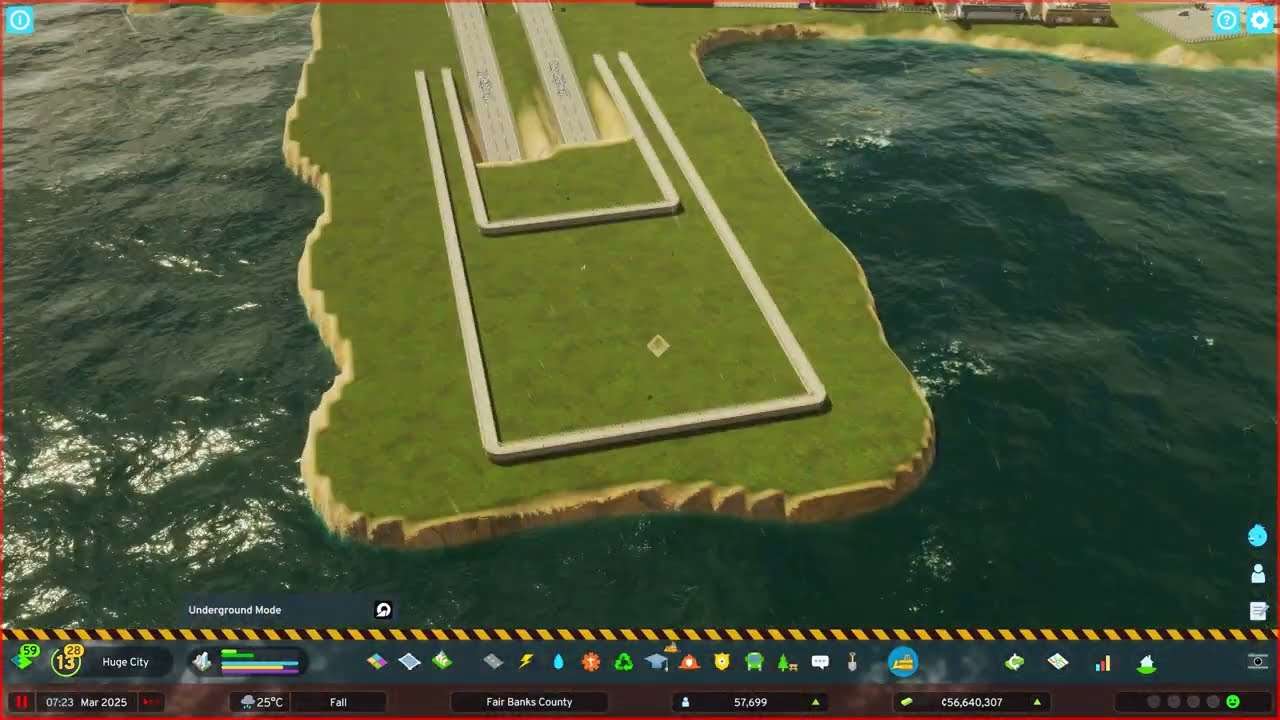
Fair Banks builds a typical North American commercial strip off the new highway ramp: a bigger road in, high-density shops replaced with low density because they looked overwhelming, a road maintenance depot, the food station and Gatehouse Residence signature buildings, a second crematorium for the hearse backlog, lane and crosswalk fixes — and the first grain, chicken and vegetable farms.
What happens in this episode
The suburbs are fading out, the nature reserve is in and the new highway ramp leads towards the coming industrial district. Episode 16 of Fair Banks County builds something I’d planned for a while: a commercial district with a mall-like structure, plus the first farms. But first, the city didn’t have enough hearses to collect the dead, so a second crematorium goes in, expanded straight away with a refrigeration wing and three hearse garages.
How it was built
Too much high density
A bigger road leads into the new area. The first version used high-density commercial zones, and it looked overwhelming, far too different from the other side of the highway. Big businesses like that belong downtown, so they were deleted and rebuilt as low-density commercial. The path trick fixes buildings facing the wrong way. A police station goes nearby, because businesses appreciate it.
Services and signature buildings
A road maintenance depot (the first in a while) is upgraded straight away. The food station signature building, “room for all the hungry customers under one roof”, fits in nicely. The district gets recycling, roadside parking fees and speed bumps. One piece of land stays green on purpose, and more oaks are planted. Trees take more than a gameplay year to grow through their four stages. The high-rise idea came from the Toronto area, where I’d seen residential towers rise out of suburban surroundings.
The evening rush
At 6:45 p.m. traffic backed up: an off-ramp was blocked by the next junction. Crosswalks go (people still crossed anyway, and a garbage truck had to wait for them), and a road becomes two lanes with dedicated left and right turns. Parking is disallowed, a parking lot goes nearby, and the Gatehouse Residence signature building gives the area a central feel.
The first farms
Finally the farms: mostly grain because the demand is huge, another chicken farm and a carrot and vegetable farm. Production ramps up slowly while the farms level up. Many were at level 2 of 5, some at 4. Imports of oil, grain, chicken and vegetables should fall over time. A fire helicopter depot covers the farming and industrial area. It had to move because it was spoiling the landscape. The episode ends with more lane maths, traffic lights removed and four-lane nodes fixed. I really wanted a traffic manager mod by then.
Video chapters
- 00:00A second crematorium for the hearse backlog
- 04:04Too much high density — back to low
- 13:53Road maintenance and the food station
- 17:53Toronto memories and growing trees
- 22:17Fixing the evening rush
- 26:17Gatehouse Residence and parking
- 30:53The first farms
- 39:41Lane maths and a helicopter depot
Clicking a chapter starts the video above at that point.
FAQ
How long do trees take to grow in Cities: Skylines 2?
From what I've heard, more than a gameplay year — trees go through about four growth stages before reaching full size, so plant early.
Why replace high-density commercial with low density?
Next to the low-rise areas across the highway, big commercial blocks looked overwhelming. A North American suburban commercial strip reads better with low-density stores, parking and a few signature buildings.
Why are new farms slow to produce?
Farms grow through levels (I saw 1–4 of 5) and production ramps up with them. Imports of grain, chicken and vegetables fall gradually rather than instantly.