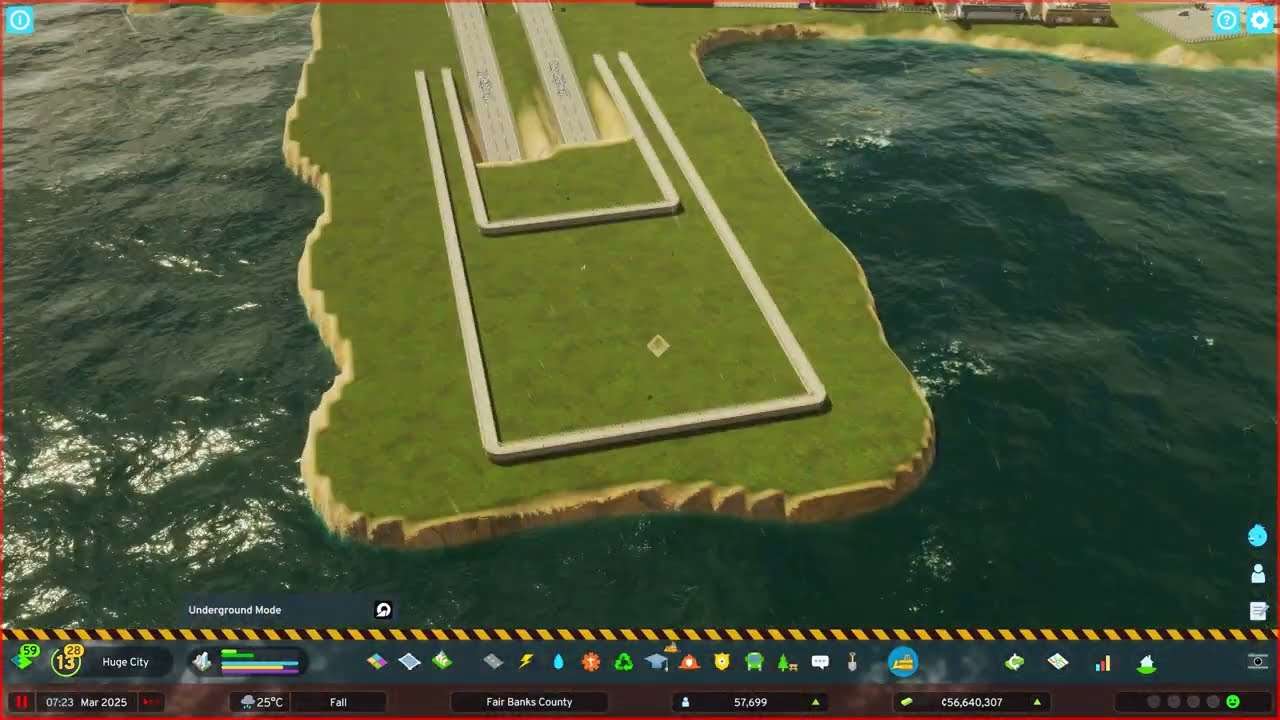
Huge City (milestone 13) arrives, a fuel plant signature building unlocks (−5% industrial air and ground pollution citywide, +2% efficiency) and goes in by the harbour, an outskirt district is densified with plenty of alleys and paths, Bedford Field gets its policies — and a check reveals the whole area has no bus stops at all, while the city earns 240,000 a week.
What happens in this episode
Last time, the highway connection reached the new district, the fertile land was marked and the dense city started fading out. Episode 14 of Fair Banks County builds the outskirts. I’d planted trees first so I wouldn’t have to do it after zoning. I had hoped for a lake in the park, but getting the water there would have needed planning from the start, so that idea was dropped.
How it was built
Huge City and the fuel plant
Huge City, milestone 13, brings 3.6 million (not needed), 13 development points and 24 more tiles. After Small City, the milestones aren’t that exciting anymore. A signature building appeared unexpectedly: the fuel plant. It causes medium air, ground and noise pollution locally, but gives −5% industrial air and ground pollution citywide and +2% industrial efficiency. It goes next to the cargo harbour on ground levelled out of the water, with a one-way road. The film academy mansion finally finds a spot too, for now.
Densifying the outskirts
More homes, shops and offices make the outskirts denser, and with decoration it finally looks like a proper neighbourhood. Some areas are deliberately emptier because they’re the edge of town.
The path trick
The episode shows one of my key techniques in vanilla Cities: Skylines II: using paths to control building orientation. The game often lines up buildable areas oddly, and there’s no tool to change a building’s orientation, so placing or removing a path changes how the zoning cells line up. The district ends up small and cozy, with many alleys and paths for walking and maybe cycling later.
Bedford Field
The new district Bedford Field gets energy consumption awareness, recycling, roadside parking fees and speed bumps. When the population started dropping, possibly because of the parking fee, I lowered it back to 10. Beachwood Dale next door is wealthy, almost a gated community.
No buses at all
A check revealed something embarrassing: this whole part of town has no bus stops. I want people on public transport as long as it’s affordable. It’s not about making money: the city earns about 240,000 a week, far more than it needs, even for expensive landmarks and maybe an amusement area later. The train connection already runs down here and will come in handy.
Video chapters
- 00:00Recap and a lake that won't happen
- 06:53Huge City and the fuel plant
- 11:02Densifying the outskirts
- 23:49Bedford Field and parking fees
- 27:51No bus stops, too much money
Clicking a chapter starts the video above at that point.
FAQ
What does the fuel plant signature building do?
It causes medium air, ground and noise pollution locally, but gives −5% industrial air pollution and −5% industrial ground pollution citywide, plus +2% industrial efficiency.
How do you change which way buildings face in Cities: Skylines 2?
There's no tool for it in vanilla. I use paths: placing or removing a path changes how zoning cells line up, so buildings spawn facing the street I want.
Do roadside parking fees affect pets or residents?
Not pets — but higher fees can push residents to leave or park elsewhere. When the population started dropping in Bedford Field, I lowered the fee back to 10.