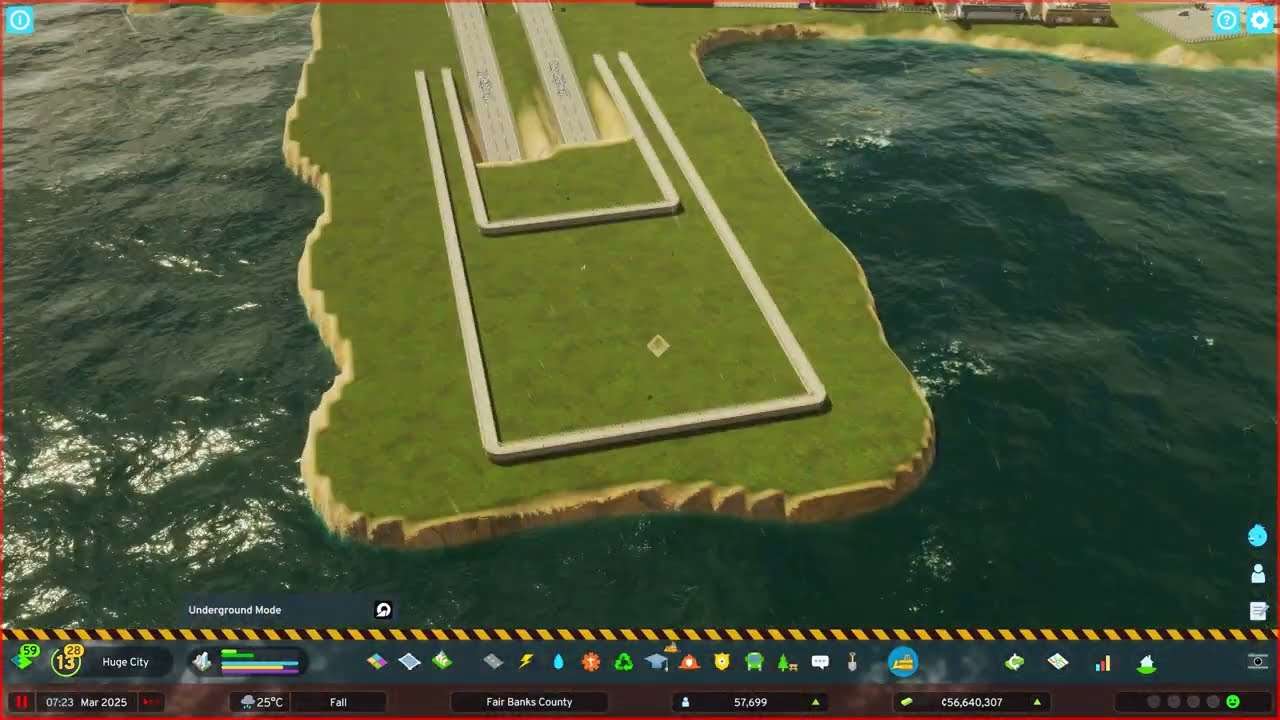
Fair Banks County decides where downtown ends: suburbs, farmland and small towns will follow instead of one huge city. Power and water are fixed, one rail line now links every station, a hilly area becomes industry with forestry and a single-road cargo station, Large City unlocks, taxis arrive with a minimum fare — and 25 million in the bank shows the city is underspending.
What happens in this episode
After more than 90 hours in Cities: Skylines II I was still learning. In episode 10 of Fair Banks County, the question is where downtown should end. I could keep building the beach strip all the way along, but I don’t want one huge city. The plan: finish the dense core, then suburbs, then farmland with one or two small towns. One overpass still doesn’t match the smooth curves around it.
How it was built
Fixes first
Electricity and water were becoming issues, so those come first. A train line gets a new waypoint and now connects all the stations. New parks increase happiness, and medium-density housing fills in.
Pillars in the way
Some parking spaces were blocked by a handful of bridge pillars. Without Move It or a way to delete individual pillars, that space just couldn’t be used. Frustrating, and one of several reasons I was waiting for mods.
A new industrial area
A relatively flat area with road and rail access turned out suitable for industry. After landscaping the hills, it gets general industry and forestry, and the hills keep the noise away from the homes. A cargo train station with only one road in and out worked fine, something that would have been risky in the first game. The production panel still shows shortages of grain, cotton and stone, which further industrial and farming areas will need to cover.
Large City and taxis
Large City brings 12 development points, 21 expansion permits and 3.2 million. I didn’t spend much on intersections or automated parking, but a tourist attraction near the station and taxis, which I’d completely forgotten, go in. One quarter of the fleet is electric, and a minimum fare of 15 is set. Annoyingly, special buildings can’t be moved once placed.
What was missing
My honest view at the time: I loved the game and its potential, but I missed things from the first game, above all custom parks instead of pre-made ones, mods and the map editor. Those limits kept me from playing more. I had to manage traffic actively only in a few spots, usually where pedestrians crossed a busy road without lights.
Policies and too much money
New districts get policies: the combustion engine ban, energy consumption awareness, recycling and speed bumps. Service buildings get upgrades, because with 25 million in the bank and +80k income, the city was earning too much. That means citizens aren’t getting the services they could. Low-density homes along the shoreline will soften the edge of downtown next.
Video chapters
- 00:00Where should downtown end?
- 09:45Power, water and one line for all stations
- 14:18Pillars blocking parking space
- 27:38A new industrial area with forestry
- 33:32Single-access cargo station, Large City
- 41:07Development points and taxis
- 57:10What I miss: parks, mods, the map editor
- 62:18District policies and 25 million unspent
Clicking a chapter starts the video above at that point.
FAQ
How do you stop a city from becoming one giant downtown?
Decide where the dense core ends. In Fair Banks I capped downtown, planned suburbs beyond it, then farmland and one or two small towns — and kept the beach strip from being built all the way along.
Can a cargo station work with only one access road?
In Cities: Skylines II it worked fine for me — something that would have been risky in the first game.
Is having lots of money in the bank good?
Not necessarily. With 25 million saved and +80k income, the city wasn't spending enough on services for its residents. I'd rather invest it.